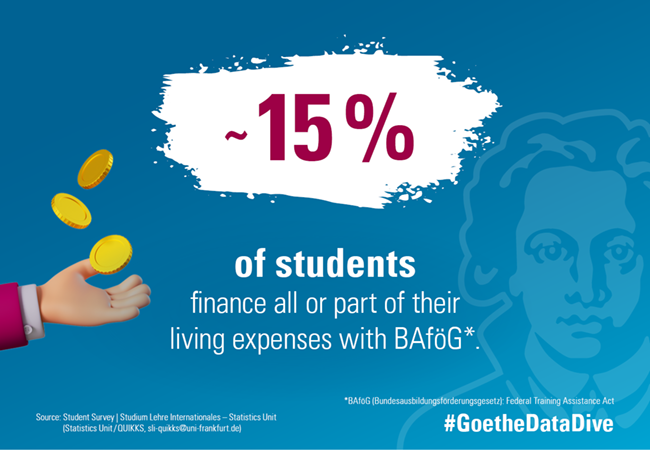
How do students at Goethe University Frankfurt finance their studies? A look at the 2022/23 university-wide student survey reveals: Nearly 15% of respondents stated that they finance their living expenses wholly or partially through BAföG – the abbreviation for Bundesausbildungsföderungsgesetz, i.e. the Federal Training Assistance Act. But how significant is their financial dependence on it – and who benefits the most?
BAföG as a Supplement or Main Source of Support
The survey differentiates the extent to which BAföG contributes to student finances:
- 6% of students use BAföG in a supplementary manner – meaning it covers up to 50% of their average income.
- 8.9% report that BAföG covers more than half their living costs.
The figures show: BAföG is a key financial pillar for many students.
Background Matters: Marked Differences in BAföG Usage
The survey results show one striking structural difference in BAföG use: Students who are the first in their family to attend university (“first-generation students”) use BAföG almost twice as often (20.5%) as students from academic family backgrounds (10.2%).
This underscores BAföG’s role as an important tool for promoting educational equity – though only if students actually make use of it.
Why Many Don’t Apply – Despite Being Eligible
Many students don’t apply for BAföG even though they qualify – mostly due to lack of knowledge: According to a joint study by the Max Planck Institute for Research on Collective Goods and the Fraunhofer Institute FIT, 82% of surveyed students wrongly believe they are not eligible – often due to misconceptions about parental income. Other reasons include unfounded fears about repayment and the perceived complexity of the application process. To reduce these barriers, an AI-powered chatbot was developed, capable of providing personalized eligibility information and calculating potential BAföG amounts. Initial tests show that transparent information can significantly increase students’ willingness to apply – especially among those from low-income households. (Source: Der Spiegel, July 8, 2025)
It’s not just individual students raising concerns – student associations and trade unions also criticize deep flaws in the current BAföG system. The education union GEW and the national student association fzs have filed a complaint against Germany at the United Nations. They argue that the current BAföG structure violates the UN International Covenant on Economic, Social and Cultural Rights, which guarantees fair access to higher education. According to GEW, BAföG only reaches around 12% of students, and the calculated need-based funding amounts sometimes fall below the minimum subsistence level. The main criticism of fzs concerns the housing allowance, which does not reflect actual rent costs. Both organizations are calling for a review under international law by the UN Committee in Geneva. (Source: Der Spiegel, July 7, 2025)
Background and Further Information
→ Full results of the 2022/23 student survey (in German) as a PDF file.
→ Detailed information about BAföG applications and advising services is available on the website of the Frankfurt Student Services (Studierendenwerk Frankfurt).