In the training pharmacy and with the online tool “MyDispense,” pharmacy students can test and expand their counseling and professional skills.

In a side hallway of Building N260 on Riedberg Campus, inside the Institute for Pharmacology and Clinical Pharmacy, a wooden door leads to a place no patient has ever entered: a training pharmacy. The room may be small, but it is equipped with everything – pill boxes, brown bottles, a compounding scale, a red German pharmacy sign, oversized cardboard boxes advertising medical shampoos, a sales counter with a pharmacy register, a prescription scanner, and a coin tray. And, of course, behind the counter stands a friendly person in a white coat asking, “How can I help you?” That no real patients with prescriptions ever show up here has nothing to do with the room’s hidden location: the space is designed exclusively for training purposes, allowing pharmacy students to practice consultations – just like those that happen hundreds of times a day in every pharmacy.
Today, Jonah Tutsch, an eighth-semester pharmacy student preparing for his second state examination, plays the role of pharmacist. The “patient” is portrayed by licensed pharmacist Catarina Santos Carvalho. “Hello. I have a prescription. Also, my mouth hurts. Can you give me something for it?” she says, placing a prescription for asthma inhalation powder on the counter. Jonah Tutsch begins asking questions: when did the pain first occur, how does it feel, has she used the medication before? Santos Carvalho replies that she hasn’t seen the doctor – just picked up the prescription – and isn’t quite sure how to use the inhaler. Jonah Tutsch suspects oral thrush, a possible side effect of the medication, and gives her an over-the-counter gel (“Please apply it four times a day in the mouth”). He also recommends she visit the doctor again and demonstrates the correct use of the inhaler: “Exhale fully, seal your lips around the mouthpiece, inhale deeply, hold your breath briefly, exhale slowly.”
Roleplay With Debrief
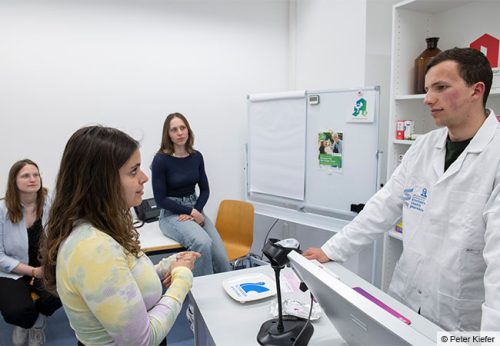
The consultation is observed by Johanna Saumer and Rekia Sinderwald, both doctoral candidates in Dr. Sina Oppermann’s research group. The two licensed pharmacists are currently doing their doctorates in clinical pharmacy and also work in community pharmacies. Both know the challenges of consulting patients. Saumer helped set up the training pharmacy and installed the cash register system. “That was very good,” Sinderwald tells Tutsch. “You correctly suspected the thrush, gave dosage instructions, and your inhaler demonstration was great. But you could’ve asked if the patient is taking other meds, like beta blockers, which can reduce the effect of the inhaled drug.” Saumer adds, “Catarina, you should have mentioned that you’re lactose intolerant.” That detail was part of the role brief Saumer had prepared. These role briefs include instructions to the pharmacist (“Find out the following during the consultation…”) and patient characteristics (“shy and embarrassed; only gives information when asked”).
Next up is Xenia Reznitski, also in her eighth semester, playing the pharmacist. Paul Herkert, a graduate now completing his practical year in Oppermann’s group, plays a very challenging patient. “You asked great questions,” Saumer says afterward. “Your reference to the Lung Health Alliance’s website was excellent.” Herkert adds: “I felt well advised.”
The students all agree that this type of training is invaluable. “You don’t get to do this as part of the regular program,” says Tutsch. Even during the eight-week internship required during the basic studies (often completed at a community pharmacy), students usually only get to work behind the scenes – handling inventory management or compounding. Consultations are only permitted during the practical year, after the second state exam, and only under supervision – even for those working part-time in a pharmacy.
Complex knowledge in realistic situations
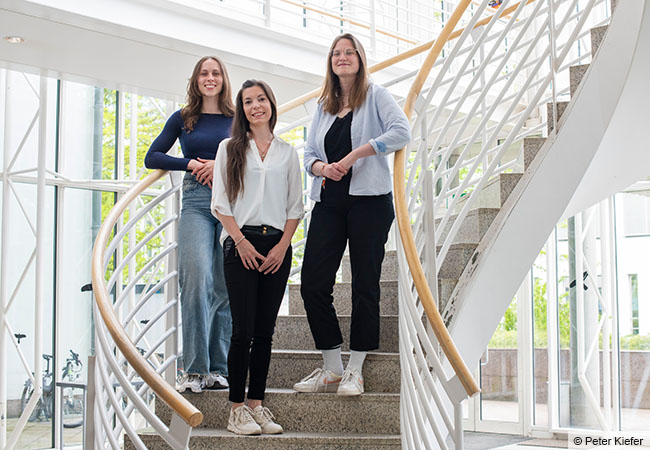
Johanna Saumer says: “Rekia and I both studied pharmacy at Goethe University, and we both wished we had had more practice-oriented teaching, especially before entering the practical year. Suddenly facing real patients can be overwhelming.” Rekia Sinderwald adds: “This type of training gives students experience and confidence in handling consultations.” Prof. Sina Oppermann explains: “In our training pharmacy, students learn how to apply complex knowledge in realistic scenarios. They often struggle to link concepts across different disease areas. For example, they might study diabetes medications in one course and heart meds in another – fields on which they are also examined – but in real life, a patient may take five different medications for high blood pressure, asthma, diabetes, etc., prescribed by several specialists. That quickly creates a complex treatment plan, and it’s hard for some patients to keep track of the medicines they are supposed to take. More importantly, dangerous drug interactions can go unnoticed.”
That’s why consultation skills must be trained, says Oppermann. Pharmacists need to review all potential interactions – prescription, OTC, supplements, and even food. Sometimes, they may need to call the doctor, and that, too, is practiced in the training pharmacy. In the future, actors may be brought in to play patients or doctors to increase realism. This kind of preparation is vital, says Oppermann, especially since up to 25,000 people die annually in Germany due to adverse drug reactions, including interactions and side effects.
Virtual Pharmacy
To prepare students for the more logistically complex sessions in the training pharmacy, Oppermann and Sinderwald are also working to integrate the online tool “MyDispense” into the pharmacy curriculum. In MyDispense, a virtual patient avatar enters a virtual pharmacy, the consultation plays out via dialogue bubbles, and the program gives feedback on student decisions and competencies. MyDispense works with various databases and can simulate avatars from children to elderly, multimorbid patients. Sinderwald explains: “With MyDispense, students can work through complex cases, like counseling a pregnant woman. Unlike in-person training, they can pause, repeat cases, and think things through calmly. It’s less stressful: they don’t have to recall knowledge and interact at the same time but can structure their thoughts and then enter their replies to the virtual patient.”
Originally developed by Monash University in Australia, MyDispense was translated and adapted to German law by the University of Greifswald. Thanks to cooperation with Greifswald, Goethe University secured a German version, which now needs to be tailored to the Frankfurt curriculum. That is because, although Germany has a licensing framework for pharmacy education, it lacks a unified national curriculum, Oppermann explains. “Setting up the training pharmacy was both costly and labor-intensive, and we are very pleased to have been able to realize this project thanks to funding secured through teaching innovation grants from Goethe University’s quality assurance program. We will begin integrating the training pharmacy into the program in the 2025/26 winter semester.”
But with MyDispense still to come, more work lies ahead. Writing scenarios and entering cases is time-intensive. “We need additional staff to support the work already done by our doctoral students,” says Oppermann, adding that it would be illusory to think such a project can be realized “on the side”, in addition to regular research work. Student assistants and pharmacy interns will help long-term. The goal is maximum benefit through collaboration with other universities already using training pharmacies or MyDispense, including Greifswald, Bonn, Düsseldorf, Halle, Heidelberg, Mainz, and Munich. The broader goal is to harmonize clinical pharmacy teaching across Germany.
“In our training pharmacy – and later, with MyDispense – students are exposed to everything that can go wrong when dispensing medication,” says Oppermann. “Sure, these exercises are a bit stressful. But we all agree: This hands-on training greatly improves the quality of pharmacy education, and it makes Frankfurt more attractive for future pharmacy students.”
Further Information:
Portrait of Sina Oppermann
Literature: Frank Dörje et al:
Patient-oriented teaching formats in clinical pharmacy – status quo in German university pharmacist education.