A Review of the “Sinn und Bedeutung” Conference

The 30th “Sinn und Bedeutung” (Sense and Meaning) conference, held at Goethe University Frankfurt at the end of September 2025, drew a sizeable audience with a large share of international participants. Organized by Gesellschaft für Semantik (GfS, Society for Semantics), the annual conference was co-founded by semantics professor Thomas Ede Zimmermann, who taught at Goethe University until 2020.
GfS was established in Blaubeuren in 1994 and held its first conference on the topic of “Sinn und Bedeutung” in 1996. In 2000, the conference was hosted in Amsterdam, marking the first time it was held outside Germany. In recent years, conference locations have alternated between German and international venues. “One of my first ‘Sinn und Bedeutung’ conferences was in Frankfurt in 2003. Back then, I participated as a doctoral student, but it wasn’t nearly as large as it is now,” recalls Cornelia Ebert, successor to Thomas Ede Zimmermann in the professorship for semantics at Goethe University and spokesperson for the German Research Foundation’s (DFG) Priority Program “Visual Communication” (ViCom).
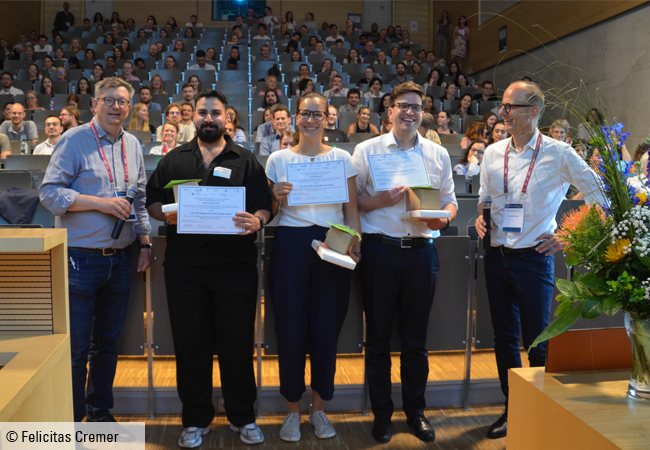
For its 30th edition, the conference returned to the Main metropolis. Ebert says that “Sinn und Bedeutung” has meanwhile become the most important European conference on the semantics, pragmatics, and philosophy of language – if not the most important worldwide. Participation in the conference is apparently quite appealing – so much so that not everyone who submitted a presentation topic was able to participate: there were a total of 260 submissions, but “only” about 50 talks and 40 posters were included in the conference program. In total, 160 experts from Europe, the US, Canada, Japan, Singapore, and India at various career stages took part. “About half of them were early career researchers,” says Lennart Fritzsche, who co-organized the conference – a very encouraging number.
The topics of the presentations revolved around formal semantics, pragmatics, and philosophy of language. This time, two major linguistic research projects based at Goethe University played a key role: one focus was on the topic of negation, while another centered on visual communication. The context for this includes the DFG Collaborative Research Center “Linguistic and Extra-Linguistic Negation,” led by Romance Studies Professor Cecilia Poletto. This project explores, from various disciplinary perspectives, how negation is realized in different languages, how it is acquired by young children, and what insights it offers into language processing in the brain. Meanwhile, the DFG Priority Program ViCom focuses on communication that does not occur through written or spoken language but instead through facial expressions, gestures, signs, or images. This cross-institutional program is headed by Cornelia Ebert (Goethe University) in collaboration with Professor Markus Steinbach (University of Göttingen). In cooperation with ViCom, one panel addressed the semantics and pragmatics of demonstration, i.e. the pointing elements of communication.
Following the conference, the contributions will be published in the “Proceedings of Sinn und Bedeutung,” which holds the status of an academic journal. “The conference has boosted Goethe University’s international recognition as a hub for visual linguistic research,” Ebert is convinced, adding that the Institutes for Linguistics, English and American Studies, and Philosophy “worked together wonderfully.” Particularly noteworthy: With the support of Goethe University’s leadership, the contributions were interpreted into sign language for the first time.