The goal of the European research project A4CLIMATE, which is now starting under the leadership of the German Aerospace Center (DLR) with 17 partners from nine countries – including researchers from the Institute for Atmospheric and Environmental Sciences at Goethe University – is to significantly reduce the climate impact of air traffic. The project focuses on reducing contrails, which contribute far more to atmospheric warming than the CO₂ emitted by aircraft.
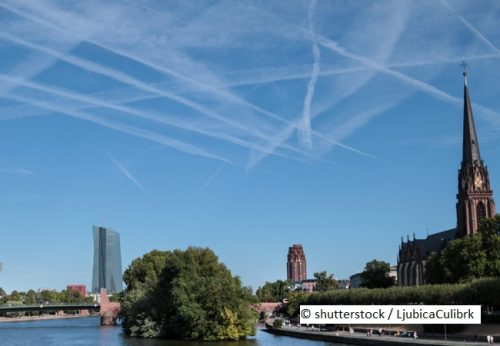
Aviation contributes to global warming through both CO₂ emissions and non-CO2 effects such as contrails. These line-shaped ice clouds form at altitudes of 8 to 14 kilometres under very cold and humid atmospheric conditions. Although contrails persist for only a few hours, their annual warming effect is comparable to that of all aviation-related CO₂ accumulated in the atmosphere since the beginning of aviation. Therefore, the EU has mandated the monitoring of these non-CO₂ effects by 2028.
The European research project A4CLIMATE aims to help significantly reduce aviation’s climate impact by minimizing contrail formation through smarter flight routing, advanced engine technologies and sustainable alternative fuels. Led by the German Aerospace Center (DLR), the project brings together 17 partners from nine countries, including experts from universities, industry leaders and stake holders. A4CLIMATE strengthens the scientific understanding of engine emissions, contrails and their climate effects, and translates this knowledge into practical solutions for more climate-compatible flight operations.
The first series of demonstration flights operated by TUIfly has now begun. The aim of these trials is to steer aircraft around air layers in which climate-warming contrails could develop.
Innovative engines and alternative fuels
In parallel, A4CLIMATE investigates how modern, low-sooting lean-burn engines and alternative fuels influence contrail formation. This is because soot particles serve as nuclei for ice crystal formation in contrails. Laboratory tests on the ground and at airports are complemented by dedicated flight campaigns. So far, the impact of reduced soot on contrail formation and ultimately on climate warming remains unknown. Over the coming years, A4CLIMATE will address this knowledge gap and compare the climate benefits of various mitigation strategies, including modern engines, alternative fuels and operational measures.
Researchers led by Prof. Alexander Vogel from the Institute for Atmospheric and Environmental Sciences at Goethe University will carry out these ground measurements in collaboration with teams from the Max Planck Institute for Chemistry in Mainz and the University of Leeds. Their aim is to investigate the chemical composition of the particles in aircraft exhaust plumes and the ability of the particles to form ice crystals in the laboratory. In another subproject of A4CLIMATE, measurements are also planned in a research aircraft over the North Atlantic in 2027. There, the Frankfurt researchers will examine whether sulfur compounds and lubricating oil particles, which are also released by low-soot engines, take over the role of soot particles as condensation nuclei.
Source and more information:
DLR Press Release
A4CLIMATE website