When ultrathin crystal layers are stacked on top of each other with a slight twist, so-called moiré materials with entirely new quantum properties emerge. An international research team involving Goethe University has now observed in detail for the first time how a special form of superconductivity arises in such materials.
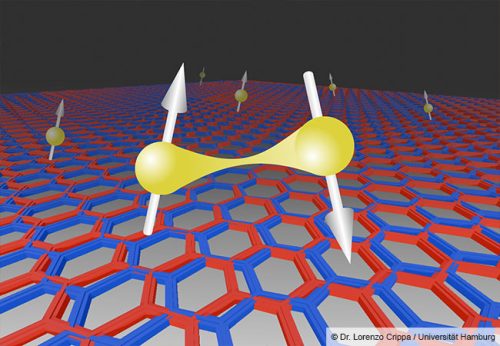
In these structures, the behavior of electrons is fundamentally altered: their mobility is strongly restricted, while their mutual interactions become dominant. As a result, novel quantum states emerge, including correlated insulators, magnetism, and so-called unconventional superconductivity. Until now, however, it has remained unclear how exactly superconductivity develops from such strongly correlated starting states.
A new study in Nature now reports, for the first time, a direct microscopic connection between a correlated normal state and the emerging superconductivity in moiré materials. The theoretical work was supervised in part by Prof. Dr. Roser Valentí at the Institute for Theoretical Physics, Goethe University Frankfurt, carried out in close collaboration with international partners from Princeton, San Sebastián, Hamburg, and Würzburg, and embedded within the DFG Research Unit QUAST, for which Valentí serves as spokesperson.
For the study, the researchers combined high-resolution scanning tunneling microscopy with detailed theoretical models to investigate twisted graphene systems. These materials offer exceptional control over electronic interactions and symmetries.
The key finding: superconductivity does not emerge from an ordinary metal, but from an already strongly correlated state with broken symmetry. Particularly surprising was the discovery of a spiral ordering of an electronic degree of freedom known as the „valley.“ In addition, multiple energy gaps and their dependence on temperature and magnetic field could be observed—clear evidence of the close connection between the normal state and superconductivity.
This work thus provides new understanding of how unconventional—and potentially high-temperature—superconductivity arises. Its concepts are transferable to other material systems and could, in the long term, help to deliberately develop new quantum materials and superconductors for future quantum technologies.
Publication: Hyunjin Kim, Gautam Rai, Lorenzo Crippa, Dumitru Călugăru, Haoyu Hu, Youngjoon Choi, Lingyuan Kong, Eli Baum, Yiran Zhang, Ludwig Holleis, Kenji Watanabe, Takashi Taniguchi, Andrea F. Young, B. Andrei Bernevig, Roser Valentí, Giorgio Sangiovanni, Tim Wehling, Stevan Nadj-Perge. Resolving Intervalley Gaps and Many-Body Resonances in a Moiré Superconductor. Nature (2026) https://doi.org/10.1038/s41586-025-10067-1