The topic of science for policy is highly complex. Many factors come into play, from formulating messages to identifying target groups. An institution’s self-conception and remit are just as significant as budgets and (wo)manpower. At the behest of Goethe University Frankfurt, transfer experts from various research and higher education institutions in the Frankfurt/Rhine-Main region met for the fourth time since 2022 to present their latest projects in small groups to develop solutions to shared challenges and engage in their very own kind of knowledge transfer.
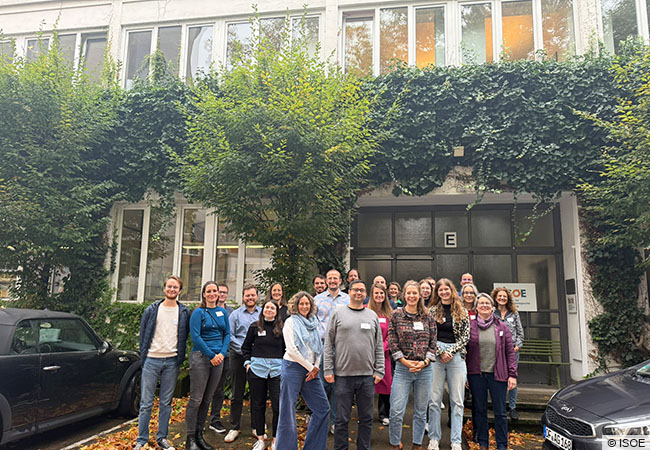
It’s late September, and a few yellow leaves are already scattered in the courtyard leading to the entrance of ISOE. This morning, the Institute for Social-Ecological Research is hosting a meeting of around 20 experts from various research and higher education institutions from the Frankfurt/Rhine-Main region. The event was organized by Goethe University’s Research Support (RS) division as part of the EU project ENGAGEgreen, specifically by Tome Sandevski, who heads the team for policy engagement within Research Support.
Since the first meeting in 2022, the venue has changed each time. This, too, is part of knowledge transfer: getting acquainted with the work environments of colleagues engaged in similar projects and who often face similar challenges – including establishing a network to make it easier to pick up the phone and seek advice.
There are several new faces this time – another indication of how dynamically the field of knowledge transfer is evolving and how many different levels it encompasses. Alongside Goethe University, today’s participants include representatives from the Leibniz Institute for Peace and Conflict Research (PRIF), the Research Institute for Social Cohesion (FGZ), the Senckenberg Society for Nature Research, the Leibniz Institute for Financial Market Research (SAFE), ISOE, the Federal Institute for Population Research, Geisenheim University, and representatives from RMU partner universities JGU Mainz and TU Darmstadt; some of the participating institutions have sent several representatives in different capacities.
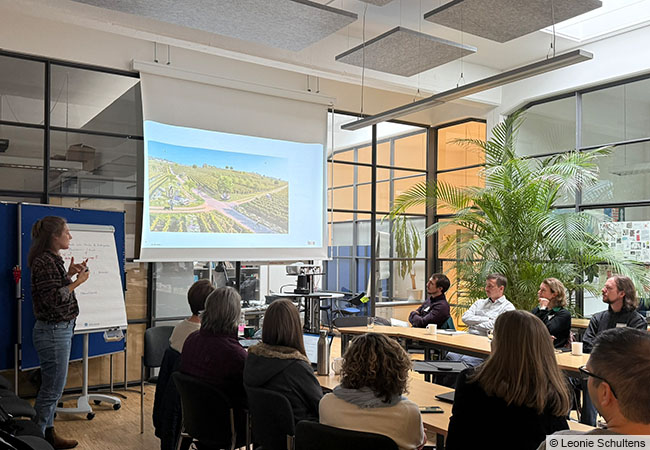
As usual, the meeting begins with a round of introductions, followed by a presentation from the host institute. This time, Dr. Verena Rossow (ISOE) presented a joint transfer project with Geisenheim University (HGU): “GeisTreich” focuses on the diverse, multifunctional aspects of viticulture and the distinctive cultural landscape of the Rheingau in the face of advancing climate change. The project’s target groups, Rossow explained, are as varied as the grape varieties cultivated at Geisenheim – a university specializing in viticulture. Its various innovative formats address all stakeholders in the Rhinegau region. “As part of the project, we are developing a research path through the university’s experimental vineyards. On a hike, you can experience research with all your senses.”,” Rossow noted, using an impressive presentation to illustrate how features like a water trench, plant diversity in so-called “maxi lanes”, deadwood corners, and seating areas can provide added value – for both people and nature. The cooperation between ISOE and Geisenheim University has been very successful, even if the format development is taking longer than expected – “partly because the project has demonstrated the substantial need for coordination and communication within the university,” explains Katja Röser, project coordinator for GeisTreich at Geisenheim University.
Following the presentation, organizer Sandevski shared updates on the latest transfer developments within RS. By the end of the year, he will have held a total of 12 workshops on the topic of academic policy engagement, bringing researchers from Goethe University and its RMU partners together with policymakers. The latter, like their counterparts in academia, come from a wide range of areas of responsibility and typically work either in Hesse’s state capital Wiesbaden or Germany’s capital Berlin. Sandevski also mentioned Brussels, where Goethe University maintains an office that is used, among others, for meetings focused on planning and implementing EU projects. One program particularly important to Sandevski is the Mercator Science-Policy Fellowship Program. Organized by the Mercator Foundation and RMU in cooperation with numerous academic institutions, it facilitates personal exchange between executive staff from politics, the public sector, media, civil society, and academics in the Rhine-Main region. As a program unique in Germany, it directly addresses the needs of executive staff, offering them independent academic expertise and supporting them in finding new perspectives on their respective areas of focus.
More information here →
Workshops
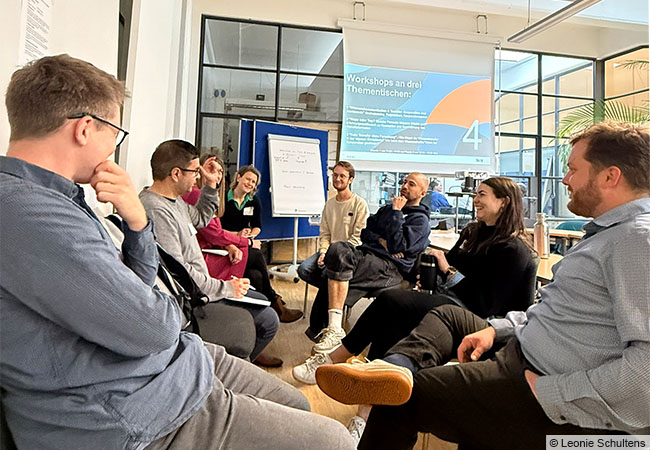

In the subsequent three workshops, interdisciplinary small groups discussed three specific questions. To ensure all participants could engage with all topics, groups rotated after a set amount of time.
- Hit or Miss? Which formats work (or don’t)?
The “panel format” is a classic in many academic events, but as the participants in the discussion were all too aware, it comes with a wide range of expectations. A challenge familiar to many attendees is the tendency among researchers to prefer exchanging ideas with peers rather than engaging with the broader public. Additionally, many past experiences show that small-scale events are more effective than broader communication efforts. “A limited number of multipliers decreases the likelihood of the message being diluted,” was a widely shared conclusion. There was also consensus on the value of established recurring formats, such as the World Café in Brussels, which both serve their purpose and require minimal personnel and time investment. Another benefit is that they are often already familiar to the desired target audiences. When some participants shared difficulties in placing research-related topics in Berlin, the best practice approach paid off immediately: as the discussion revealed, others already have significant experience with lobbying. A quick decision was made to connect bilaterally. Meanwhile, workshop members also learned about the opportunity to rent a space in the capital for knowledge transfer purposes through the Hessian State Chancellery. - Science Communication / Transfer Cooperation and Exchange
In addition to calls for proposals and application submissions, “policy briefs” – i.e. short publications issued by scientists or policymakers –, took centerstage at the discussion. There is widespread consensus that an inter-institutional database containing various policy brief formats would be helpful, especially for tapping into specific knowledge directly and fostering connections with other institutions. Such a repository of information would not only simplify joint consultations – after all, the communication goals of research institutes differ from those of consulting agencies, banks, and associations that also prepare policy briefs for policymakers. A shared approach would also make it possible to divide tasks, coordinate efforts, and implement desired measures both more effectively and more quickly – not to mention the synergies that arise from overlaps and critical cross-cutting topics like sustainability, housing, or funding. As part of the discussion, the question was raised: “If we manage to establish interfaces and/or coordination units within our organizations in the future that enable a concerted approach, how do we then measure our projects’ impact on our target groups? For instance, is science adequately heard when it comes to financial issues?”
However, as the discussion progressed, it became clear that the challenge of effectively communicating with external target groups is only one side of the coin. Even within individual research institutes, different languages, cultures, traditions, and approaches exist. For those in charge of knowledge transfer, creating a unified document from all these diverse pieces of information often proves to be highly challenging. - How does internal knowledge transfer between the transfer unit and researchers work?
The discussion quickly showed that the workflows vary depending on the institution and research alliance. Nevertheless, commonalities exist here, too, most notably in the form of personal networks. “Trust in the intermediary role of the transfer unit is essential,” was one widely agreed upon conclusion. Ideally, there are central transfer contacts who support researchers and ensure a shared level of communication. All participants are aware that the level of support required by scholars can vary greatly. Whereas some operate largely independently, others require specific assistance.
At the meta level, the workshop highlighted the key conditions needed for smooth internal knowledge transfer: in addition to proactive researchers, it also takes sufficient time and resources within the transfer unit, as well as accessible formats.
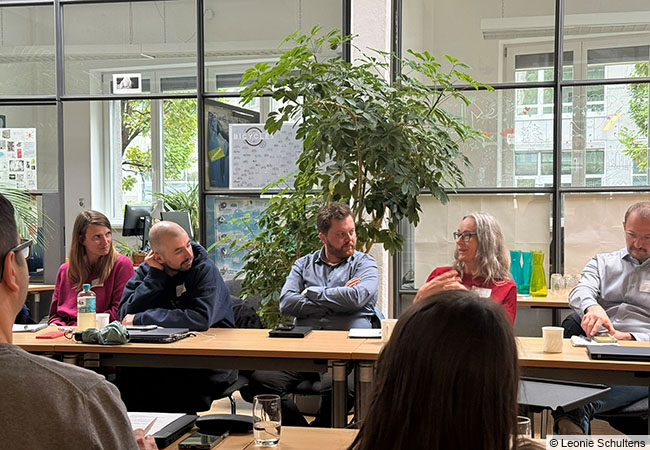
Once everyone had had the chance to participate in the three workshops, Sandevski asked the group about their main takeaways. Here, too, there was widespread agreement among participants: the exchange in small group formats between universities, non-university research institutions, and other stakeholders is seen as both productive and encouraging. Despite the wealth of topics and the different approaches, many shared goals also exist, including the desire to continue working in small groups, to build a shared platform, and to consider colleagues when establishing connections in the political sphere. Participants also expressed excitement about the upcoming ENGAGEgreen Policy Engagement Toolkit, which will offer researchers and staff active in knowledge transfer numerous resources and practical examples.
With such feedback, it’s only fitting that Sandevski has already started planning the next meeting, where the group intends to delve deeper into the topic of policy briefs – fully in line with the spirit of transfer.