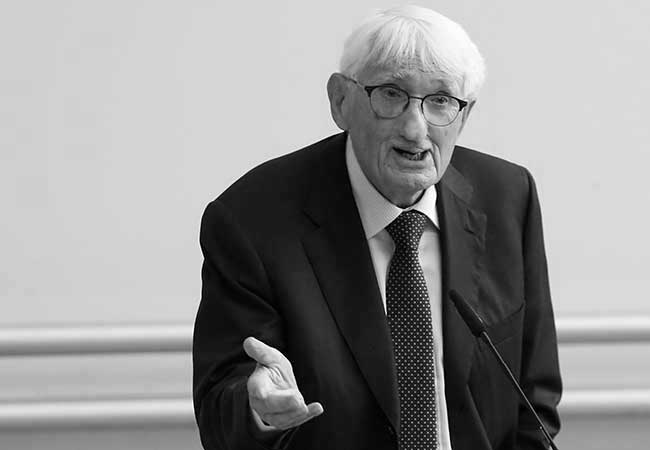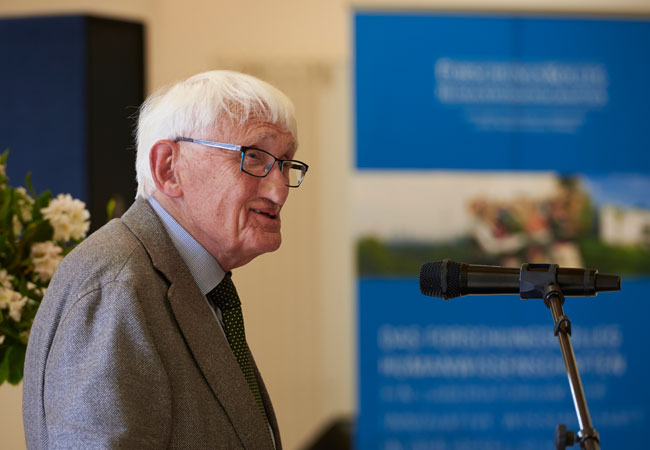
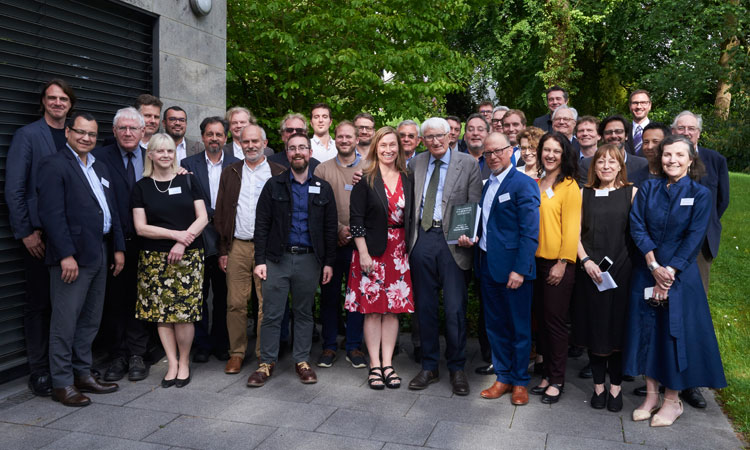
A great honour for Jürgen Habermas: in the year of his 90th birthday, Cambridge University Press has published an extensive lexicon about the philosopher and sociologist who was a professor at the Institute for Philosophy at Goethe University until 1994. The international team of authors includes academics from Goethe University. The two editors Amy Allen and Eduardo Mendieta personally presented the compendium to Jürgen Habermas on Monday May 27 at the Forschungskolleg Humanwissenschaften in Bad Homburg.
In more than 200 entries, Habermas’ basic concepts, categories and topics are explained and their intellectual and academic context detailed. The palette of more than 120 concepts extends from “aesthetics” to “world disclosure”; the list of important Habermas-related thinkers begins with Theodor W. Adorno and ends with Iris Marion Young. The Frankfurt philosophers Axel Honneth and Reiner Forst are discussed in the chapter “Names Associated”. The work is characterised by a system of references between individual entries and literature for further reading on each topic. In addition, it contains an overview of Jürgen Habermas’ academic career, a list of his works, and an extensive bibliography. The publishers hope that the lexicon will serve as a source of reference for academics, students and other readers interested in Habermas’ work and its reception in the 20th and 21st century.
Matthias Lutz-Bachmann, professor for philosophy at Goethe University, and director of the Forschungskolleg Humanwissenschaften emphasized that the “Cambridge Habermas Lexicon” demonstrates Habermas’ towering importance. “Yes, I would even go so far as to state that Jürgen Habermas is the worldwide most important philosopher of all philosophers living today. And we can be proud and grateful that he is a member of the Institute for Philosophy at Goethe University and a frequent guest at the Forschungskolleg Humanwissenschaften, as well as at the Frankfurt Excellence Cluster ‘The Formation of Normative Orders’. We have all learned immensely from him to this day.”
Lutz-Bachmann also announced that a new book by Habermas is expected to be published this year: “In the fall of this year, at the age of almost 90, this great philosopher and important intellectual stimulator will be submitting his 1,700-page late work in two volumes, “Diskurs über Glauben und Wissen” (Discourse on Faith and Knowledge) to Suhrkamp. We had the privilege of discussing preliminary passages from this work in a small work group two years ago during a workshop over several days at the Forschungskolleg Humanwissenschaften. This work lets us see his intellectual brilliance once more from a totally new perspective.”
Amy Allen, Eduardo Mendieta (eds.): The Cambridge Habermas Lexicon. Cambridge University Press 2019