Several Tiny Forests will soon be planted at Goethe University, which is inviting interested individuals to help bring these fascinating ecosystems to life and care for them. Landscape architect Robert Anton is excited about the project and explains the reasons why.
An Idea Gains Momentum
It was his charming idea that led Japanese vegetation scientist Akira Miyawaki to worldwide renown: Using the Miyawaki Method, it is possible to plant a miniature forest on a small area. Robert Anton, technical director of Goethe University’s Science Garden and responsible for its outdoor spaces, is an expert in the care of plants and animals. What does he think of the idea, which at first glance might be mistaken for mere political symbolism? “I’m truly impressed by Miyawaki’s method. Of course, one could argue that a large forest would be even better. But that’s not the focus of this approach, designed primarily for densely populated cities, which are increasingly suffering from climate-related warming but still offer small spaces for greenery. Miyawaki’s ecological approach shows that even the smallest areas – he himself considered the lower limit to be roughly the size of a tennis court – can be utilized. These areas are left largely untended, allowing them to develop into a small wilderness, a natural refuge for insects and birds. Considering the dramatic declines in biodiversity and species variety, this approach could spark a movement.”
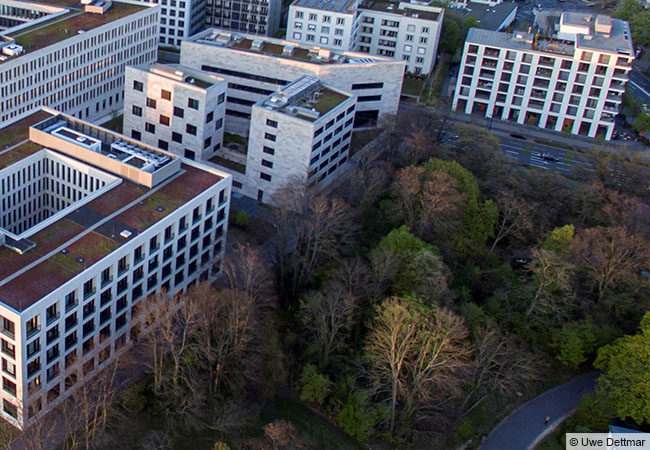
In Frankfurt, the “MainWäldchen” initiative has already established several Tiny Forests, including in Eckenheim. Anton also points to a small, forested area in the southeastern part of Westend Campus, located between the PA Building and Gisèle-Freund-Platz. Many trees, mostly sycamore maples, that originally stood here succumbed as a result of the extremely dry summers since 2018. However, the gaps created were naturally reforested by the miniature woodland itself, with some existing trees growing into the newly opened spaces. “Although this isn’t a Tiny Forest in the traditional sense – it wasn’t artificially planted – it demonstrates how a miniature forest can function. When nature is given some leeway, it can handle succession – as we biologists call it – on its own.”
Necessary Preparations
It takes a certain amount of preparation before a miniature forest can be left to thrive on its own, the landscape architect explains. It’s not enough to simply leave a forested area to itself. First, the soil must be loosened to a depth of 70 centimeters and enriched with nutrients. The plants will initially require watering, and the area also should be protected with fencing. Anton emphasizes the importance of planting correctly – perennials, shrubs, and trees must be properly placed. “Many amateur gardeners make the mistake of planting too deeply, which can cause the plant to rot and die. That’s one aspect we will address during our planting event, where we will contribute our expertise to make sure everything is done correctly.”
Before the end of this year, Tiny Forests will be set up on both Riedberg and Ginnheim Campuses, with the Westend following next year. The initiative is made possible by a donor. “While the minimum size of a Tiny Forest is considered to be a tennis court, there is no need to implement a rectangular area. Inspired by the shapes of English landscape gardens, the forest can take on an organic form. We do, after all, have to keep the space limitations in mind, especially since we want to plant in small, previously unused areas that may be located between buildings or along the campus perimeter.”
Miniature Forests in a Changing Climate
Another aspect of the Tiny Forests project Anton points out is scientific monitoring: Each Tiny Forest will be compared to a similar area. Discussions are currently underway to determine the exact parameters of these comparisons, which could include different soil preparation methods or planting densities. “We already have an area in the Science Garden on Riedberg Campus that has been left untended; it was set up by Professor Meike Piepenbring. Incidentally, our approach aligns with a legal requirement according to which a certain percentage of all areas in Germany must be designated as wilderness. We haven’t met that target yet.”
The plan is to plant natural vegetation, although climate change raises some important questions: What characteristics must the plants have to withstand the likely rise in temperatures? “If, in 20 to 30 years, the climate in Central Europe resembles that of central Italy, we’ll need a different, more resilient vegetation than we have today. These are questions that ecological research at Goethe University is already exploring intensively and Professor Wolfgang Brüggemann has already achieved positive results with heat-resistant oaks on Riedberg Campus.”
Environmental Education
The tree sponsorships on Goethe University’s campuses have already proven very popular. The Tiny Forests project seeks to further encourage participation from interested citizens and bring environmental education into the community. Among the ideas being considered are future use of the Tiny Forests by school classes as well as guided tours. “It would be amazing to see as many people as possible get actively involved. We’re starting with the work in November.”
Planting Date for the Tiny Forests on Riedberg Campus: November 22, 2025.
If you’re interested in actively contributing to the planting of the miniature forests, please contact Susanne Honnef, Office for Private University Funding, at Honnef@pvw.uni-frankfurt.de.
Updates on the progress of the project will be prominently featured on Goethe University’s Instagram channel.
More information about the Tiny Forests and Goethe University’s sustainability strategy →