Just days after Goethe University Frankfurt’s large summer celebration, a smaller, more personal gathering takes place each year: the summer festival for international researchers and doctoral candidates. This year, participants from 23 different nationalities came together.
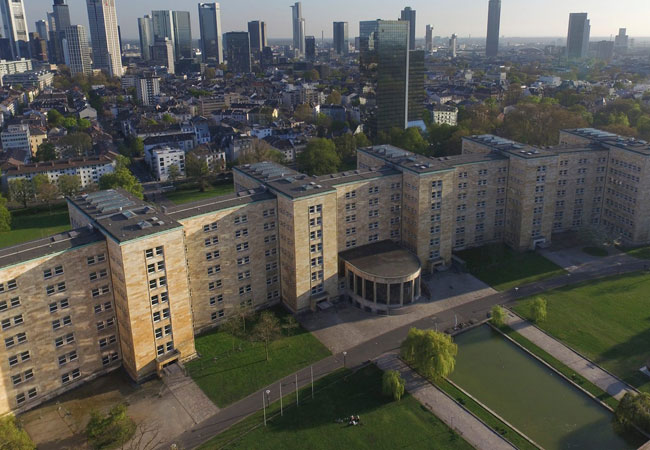
The annual summer festival for international researchers and doctoral students at Goethe University has become a tradition. Now in its eleventh year, it always follows shortly after the university’s main summer event and takes place at its nearby guesthouse on Ditmarstraße, just a short walk from Westend Campus. In the summer months especially, it’s an ideal setting for celebrations, featuring lush, tree-lined lawns, spacious terraces, and fountains that offer inspiration through nature and the arts, as well as a space for encounter.
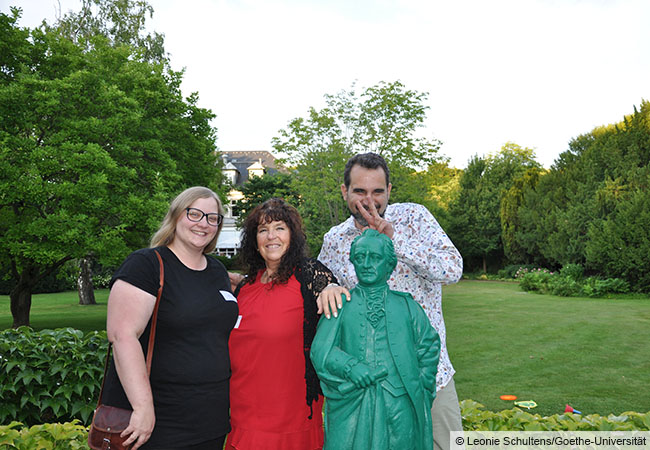
It’s a Friday evening in mid-July, and the recent heat has finally abated. The grand gate of the Ditmarstraße guesthouse stands open. The scent of food fills the air – this time, there’s a Nepali buffet. Follow your nose and the sounds, and you will soon find yourself in the foyer of the elegant building. Both there and in the expansive garden, the evening unfolds with a scene of people from different countries and all ages. Children dart across the lawn, the band Mediterraneo led by guitarist Walter Bareither plays jazz, and the music blends with the soft hum of conversation in many languages drifting through the warm evening air – framed by laughter, short welcoming speeches, and plenty of selfies with the small Goethe statue.

Exploring the Reception of 1960s and 1970s Turkish Cinema in Germany
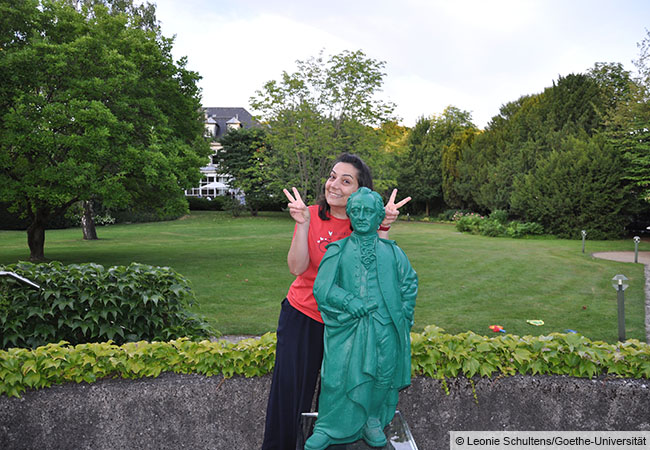
Zeynep Gültekin Akçay, a film and communications scholar from Sivas Cumhuriyet University, arrives before the official start. The buffet is still being arranged, the band is setting up, and even the Goethe statue is still searching for a proper place to spend the evening. The visiting researcher from Turkey uses the spare time for a stroll. Her husband and 12-year-old daughter landed in Frankfurt just a few hours earlier, and the family is happy to spend their first evening together in such a beautiful setting.
During her one-year research stay, Zeynep Gültekin Akçay is working within the Frankfurt Memory Studies Platform at the Faculty of Modern Languages under the supervision of Prof. Astrid Erll, focusing on an oral history project about the reception of Turkish cinema from the 1960s and 1970s. “I’m especially interested in how these films were perceived by first- and second-generation Turkish Germans,” she explains. “What emotions do these films and actors evoke in them?” Her goal during her stay, funded by a scholarship from her home university, is to document these voices.
Since her arrival in early May she has already achieved a lot, making contacts with Turkish communities in Frankfurt, Offenbach, and the surrounding areas. Heidelberg and Mannheim are next on the agenda.
Over the next two months, her family will partly accompany her and use the time to explore Germany. For daughter Ekin, this includes German lessons and swimming – she has already won several gold medals – while her father will continue working remotely. The exciting opportunity to explore a new country together during the summer holidays is one the entire family is looking forward to.
In early December, the family plans to embark on another cultural adventure – this time to experience Germany’s – and prime among them – Frankfurt’s Christmas markets. Until then, Zeynep Gültekin Akçay will continue her research – building a foundation that will allow future generations to hear the voices and understand the emotions of the past.
Although her stay is dedicated entirely to research, her example shows how profoundly academic exchanges abroad can influence family life – and how they contribute to international dialogue, not just in the present, but for generations to come.
Frankfurt’s Appeal as a Hub for Finance, Research, and Communication
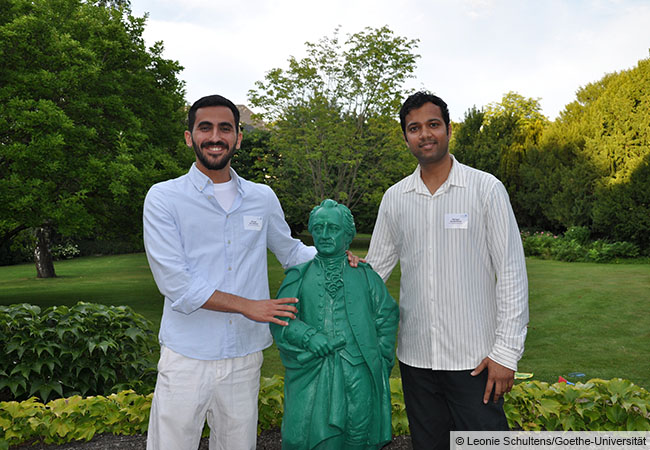
The impact of an international stay is also evident in a conversation with Saurabh Sharma and Zafar Abdullayev. Both were looking for study opportunities in Frankfurt, Germany’s financial center, and are now PhD students at the Graduate School of Economics, Finance, and Management (GSEFM), located at the House of Finance on Westend Campus. “As home to the Bundesbank as well as the European Central Bank, the city is ideal for studying economics,” says Saurabh Sharma. The PhD student from Jaipur, India, and his fellow from Baku, Azerbaijan, have been living in Frankfurt for two years.
Both are especially interested in monetary policy transmission and can often be seen together or with other members of their cohort. “I love Frankfurt – the different nationalities, the city’s many impressions, its opportunities – and the local and German traditions that people practice here,” says Zafar Abdullayev. This unique atmosphere is also reflected in the program, he adds. “Our cohort is very diverse – about half the students come from outside Germany, mainly from Asia, Africa, and European countries. The mix of nationalities is just as remarkable as the wide range of experiences and perspectives we bring into our research, discussions, and studies.”
In addition to his academic work, Saurabh Sharma particularly appreciates Westend Campus. “It’s beautifully green, especially compared to other urban universities I’ve visited. Everything is walkable and easy to reach yet surrounded by nature. Sometimes I see people just lying in the shade under the trees, with the skyline or the Taunus mountains as a backdrop.” Zafar Abdullayev nods and adds that he especially values the exchange with professors. “Even during my planning phase, before arriving, I was focused on learning from these faculty members. To find all of this in one place – that’s truly unique!”
GSEFM is an alliance between Goethe University Frankfurt, Johannes Gutenberg University Mainz, TU Darmstadt, and the Leibniz Institute for Financial Research SAFE. This allows participants to also attend courses at partner institutions. Saurabh Sharma, for example, is taking a course on artificial intelligence at TU Darmstadt. “Now consider that it’s just a 30-minute train ride from the Westend to the airport and you’ll truly come to realize how well-suited Frankfurt is as a hub for finance, research, and communication,” he says.
Zafar Abdullayev has received a scholarship from his university and will return here after completing the program. “I want to support my country’s education sector, but if opportunities arise elsewhere, of course I’d be open as well.” Saurabh Sharma also plans to first return to India, where he previously worked in the banking sector. He definitely wants to continue his research and – depending on where his interests lead him and which opportunities arise – he would not be opposed to going abroad again.
Italian expertise, Jewish philosophy, summer school, and being a Mensch
Italian researcher Dr. Francesco Pio Leonardi’s focus is Jewish philosophy, with a main emphasis on the works of Franz Rosenzweig and Hermann Cohen, as well as mathematics. He is particularly interested in the concept of revolution in Jewish philosophy and how it impacted Western thought. “To conduct research on these topics under the guidance of Professor Christian Wiese – holder of the Martin Buber Professorship for Jewish Philosophy of Religion and Director of the Buber-Rosenzweig Institute, opened in 2021 – is a great honor for me,” he says. “Not only because he is a leading authority in the field, but also because he is a true Mensch – someone who meets others with the same openness with which he approaches his scholarly endeavors.”
Francesco Pio Leonardi is convinced that Judeo-German philosophy provides valuable impulses, and not just for other European cultures. For him, Goethe University – with its strong research focus in Jewish religious history – was a logical place to conduct his research. In September, he will participate in the Summer School taking place in Frankfurt, organized by the Frankfurt–Tel Aviv Center for the Study of Religious and Interreligious Dynamics – a joint research institution of Goethe University Frankfurt and its long-standing partner, Tel Aviv University. “Especially in view of the current situation in the Middle East, it is particularly important to foster mutual understanding,” he says.
Before that, however, he will return to his home in Sicily for a month. He commutes frequently throughout his research stay. “My son is just over a year old, and I always try to be away only a few weeks at a time so that I can then spend a few weeks at home with him and my wife.” The direct connection from Frankfurt Airport makes it that much easier.
From Malaysia, Ireland, and Germany to leukemia research at University Hospital Frankfurt
Hui Ming Tew from Malaysia is also among the attendees. The young woman is researching childhood leukemia at the Faculty of Medicine. After completing her schooling in Malaysia, she first pursued a Bachelor’s degree in Ireland. She became well acquainted with Germany during her Master’s in biochemistry at the University of Bonn. “Doing research in different countries was definitely an enriching experience,” she says. Her decision for Frankfurt was linked to her research area of stem cells. “In the course of my research, I came across Professor Michael Rieger. His studies on leukemia fascinated me. On the spur of the moment, I contacted him and asked if he would be interested in supervising me as a PhD candidate. The decisive moment for me was the second on-site interview, where I got to know the working atmosphere and the friendly colleagues. It just clicked.” In addition, she had heard many positive things from friends who are also pursuing their doctorates in Frankfurt – about the city, the university, and especially its international networks.
There was, however, one small obstacle: “I was actually supposed to begin my PhD in September, but due to complications with my visa, I got off to a later start.” The unexpected problems with her residence permit were quickly resolved with the help of University Hospital Frankfurt. “That once again confirmed the impression I had from the second on-site interview. I’m really looking forward to the coming years.” Hui Ming Tew wants to devote these entirely to her research, which she intends to continue even after completing her doctorate. Whether in industry or academia, time will tell.
Brought to you by Goethe’s one and only international Welcome Center
The 2025 Summer Festival for International Researchers at Goethe University Frankfurt once again ended up being a thoroughly successful evening and the little green Goethe statue that made it to this year’s event couldn’t agree more. He was much admired, posed for countless selfies, and enjoyed the convivial atmosphere. Many guests waved goodbye when Florian von Bothmer carried the statue from its seat to its ride, where the poet and thinker was carefully strapped into the passenger seat. The Goethe Welcome Center director and his team – Isabelle de Porras, John Khairi-Taraki, Friederike Schäfer, and Alejandro Rios Aparicio – also took positive stock at the end of the evening. “The goal of our Summer Festival is to bring people together, to get to know each other, to talk about interests, and – who knows? – perhaps also to form lifelong friendships.”
The 2025 Summer Festival for International Researchers: Facts & Figures
68 participants, including 12 family members
36 women, 32 men
23 nationalities
16 faculties
4 organizing team members
∞ impulses for free knowledge exchange and encounters that shape a lifetime
Science Diplomacy Award and Art Donation for the International House on Riedberg Campus
The festival for international researchers and doctoral candidates is traditionally organized by the Foundation for the Promotion of International Scientific Relations at Goethe University. Its chair, Professor Jürgen Bereiter-Hahn, used the occasion to highlight two additional causes close to his heart.
The foundation recently set up the new Goethe International Science Diplomacy Award. Starting in 2026, this €2,000 prize will be awarded annually to a Goethe University researcher to honor outstanding initiatives that strengthen the university’s global scientific networks. Eligible activities include collaborations with international research institutions in crisis regions, innovative approaches to integrating international scholars into research and teaching projects, special exchange activities or guest residencies, as well as exceptional international conferences or workshops held at Goethe University Frankfurt. Also recognized are initiatives that promote dialogue and intercultural exchange with international guests during their stay in Frankfurt.
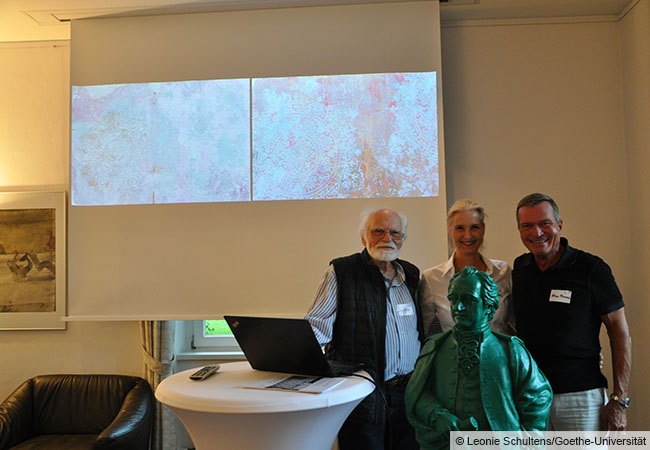
In addition to announcing the award, Bereiter-Hahn also presented the new artworks for the guest house on Riedberg Campus and thanked the donors present, Petra and Oliver Munzel. Thanks to their support, the foundation was able to acquire a work by artist Thomas Pildner as well as nine paintings by painter Sascha Hartwich for the corridors and stairways leading to the roof terrace of the International House at Riedberg Campus. Both artists are distinguished by their sustainable working methods: sculptor and woodturner Pildner uses only dead or already felled trees for his objects, while Hartwich works on hand-crafted cotton paper of various thicknesses, produced from cotton remnants sourced from India, Pakistan, and Nepal.
Guest Houses Under New Management: Kerstin Adamle Succeeds Maria Reinhardt
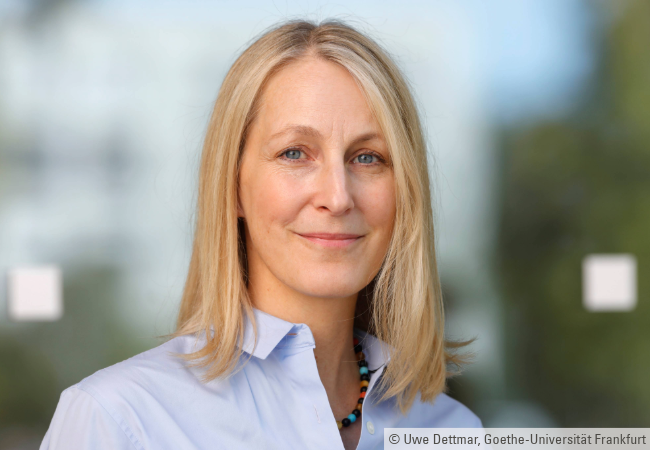
This year’s Summer Festival marks the last for long-serving house manager Maria Reinhardt, who will retire in August 2025. “With Maria Reinhardt, more than just a person is retiring – an institution, the good soul of our guest houses, is taking her leave,” said Professor Bereiter-Hahn, Chair of the Foundation for the Promotion of International Scientific Relations at Goethe University Frankfurt. At the same time, he and the rest of the team are looking forward to working with Kerstin Adamle. “With Kerstin Adamle, we have gained a personality for our guest houses who is just as warm-hearted and competent as Maria Reinhardt,” Bereiter-Hahn added. “We wish her every success and look forward to working together.”