Conference brings together 300 participants from different federal states to forge new paths into the digital future.
On November 26, some 300 participants from Hesse and other German federal states gathered at the #EduNext25 conference, held for the first time at Goethe University’s Westend Campus. The event showcased that universities consider digitalization and artificial intelligence to be central drivers of a comprehensive transformation in teaching and learning. Organized by studiumdigitale, Goethe University’s central innovation unit for technology-supported teaching and learning, in cooperation with the HessenHub network project and the QuiS program, the day was all about exchange, networking, and forward-looking ideas.
Science Minister Gremmels highlights importance of common strategic developments
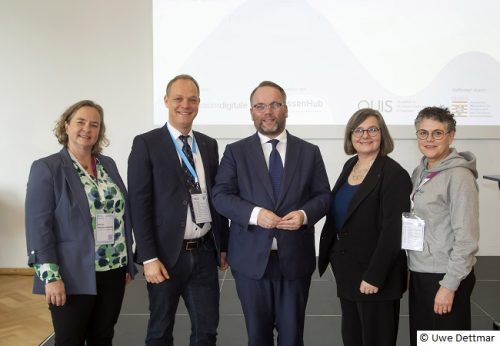
In her welcoming remarks, Goethe University Vice President Teaching and Studies Prof. Dr. Viera Pirker emphasized the ongoing transformation in higher education: “Digitalization and AI fundamentally shape contemporary teaching and studying. It is our responsibility to prepare students for the future by equipping them with knowledge, critical thinking, and a responsible approach to AI.” Pirker highlighted how Goethe University is structurally supporting these developments – through initiatives like the cross-status working group on generative AI, the AI ToolLab, and extensive training opportunities for instructors and students. She also noted the key role played by studiumdigitale as a bridge between technology and pedagogy.
Hessian Science Minister Timon Gremmels built on these perspectives, underscoring the importance of common strategic developments: “Digitalization and AI offer tremendous potential for innovation and learning quality. Their long-term impact depends on stable frameworks, future-oriented investments, and close collaboration among all stakeholders. That is why we support students in understanding, critically evaluating, and competently using AI systems through our ‘Quality in Teaching and Learning in Hesse’ funding program.” Following the welcoming remarks, Prof. Dr. Hendrik Drachsler, Director of studiumdigitale, introduced the first program segment, EduConnect.
Concrete future scenarios: AI agents, immersive learning environments, and gamification
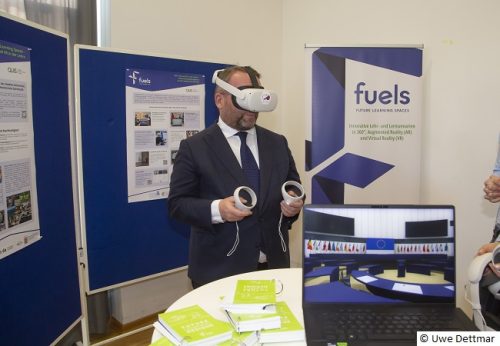
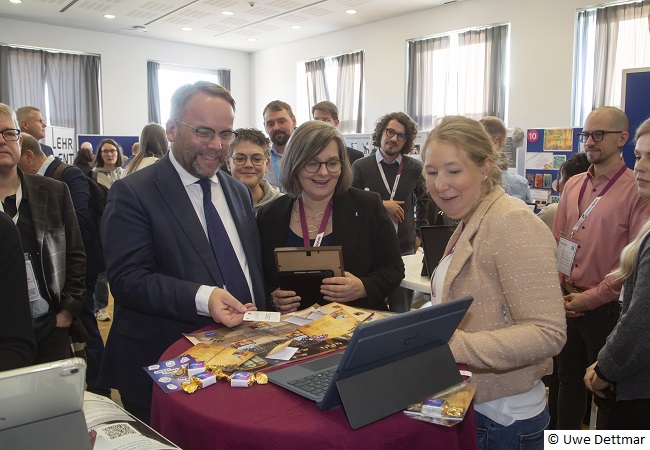
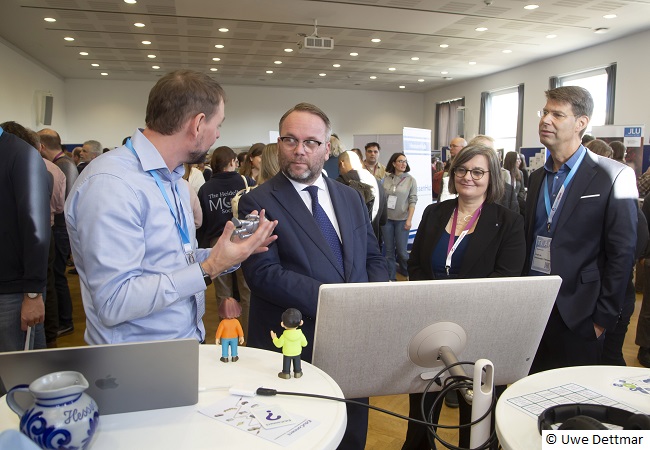
During a tour of the EduConnect exhibition, Minister Gremmels gained insights into innovative projects from the HessenHub and QuiS funding programs. At Goethe University’s booth, Dr. David Weiß, who heads the university-wide working group on generative AI at studiumdigitale, presented specialized AI agents designed to support students in their learning processes or enhance accessibility. This was followed by a demonstration of the “fuels” network project, as part of which project coordinator Dr. Ulrike Mascher (studiumdigitale) showcased immersive scenarios focused on democracy education and political participation. With the help of virtual reality (VR), the minister was able to visit the plenary chamber of the EU Parliament. As part of VR-supported role-playing games, students can take on the roles of EU parliamentarians, honing their argumentation and debate skills. Concluding the tour, Julia Geißler (RheinMain University of Applied Sciences) demonstrated gamification approaches developed within the HessenHub network that foster learning motivation through playful methods.
Controversial theses and cross-state perspectives
In the panel discussion “Strategic Alliances for the Future of Teaching: How Are Germany’s Federal States Addressing AI?”, Paulina Rinne (HessenHub, Philipps University Marburg), Prof. Dr. Konrad Faber (Virtual Campus Rhineland-Palatinate), and Dr. Peter Salden (Center for Academic Didactics, Ruhr University Bochum) debated key theses from university and state perspectives. In the style of an Oxford debate, differing positions emerged – such as the extent to which AI systems should be regulated and the role strategic alliances play in successful AI integration. Interactive audience polls highlighted the multifaceted, dynamic, and highly relevant nature of the discussion surrounding AI in higher education.
A didactic compass for AI decision-making
In her keynote, Prof. Dr. Gabi Reinmann (University of Hamburg) provided participants with a didactic framework for orientation. She explored how the relationship between AI and pedagogy can be defined, which applications are pedagogically meaningful, and how the overwhelming number of AI tools can be systematized and better understood using a few standardized usage models. Her message was clear: AI should be integrated into teaching not through a technology-driven approach, but through thoughtful pedagogical reflection.
Best practices from across Germany
The conference program also featured numerous workshops, presentations, and booths as part of Explore the Future sessions. Topics ranged from AI competency models and maturity assessment tools to 3D scanning, VR/AR applications, accessibility, and digital exams. The practical contributions underscored the creativity and diversity with which universities across Germany are developing innovative teaching and learning offerings.
Exchange, conclusion, and outlook
As #EduNext25 drew to a close, the leadership team of studiumdigitale – Prof. Dr. Alexander Tillmann, Dr. Sarah Voß-Nakkour, and Dr. David Weiß – thanked all participants for their dedication. During the closing get-together, the day’s open exchange continued, accompanied by an informal toast to 20 years of studiumdigitale, which has been a central driver of digital university development at Goethe University since 2005.