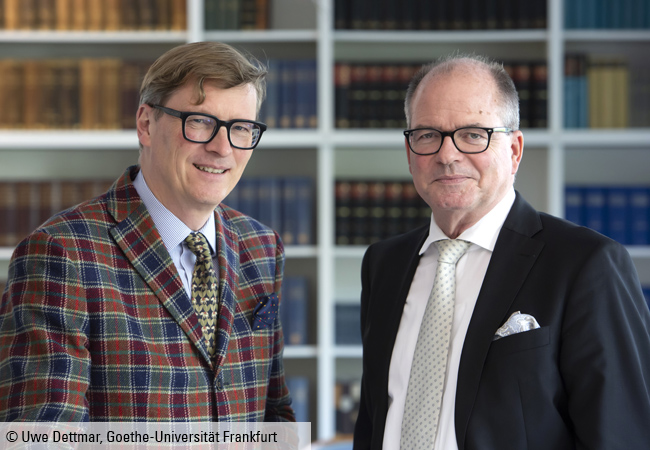
Michael Maaser and Wolfgang Schopf reflect on a multifaceted opening.
On August 28, 2025, starting “at the stroke of noon,” guests gathered at Dantestraße 9, the address across from the Juridicum, the Senckenberg Society, and the Institute for Social Research, which will now serve as the official location of the University Archives Frankfurt (UAF). Visitors were invited to celebrate the opening of a building that, over the past two years, has been adapted to meet the growing demands placed on the archives by Goethe University’s Executive Board, administration, faculties, and students, as well as the scientific and journalistic communities. The archives showcased these demands through a visual and performative program that extended into the evening of the opening day.
Exhibits in Dialogue
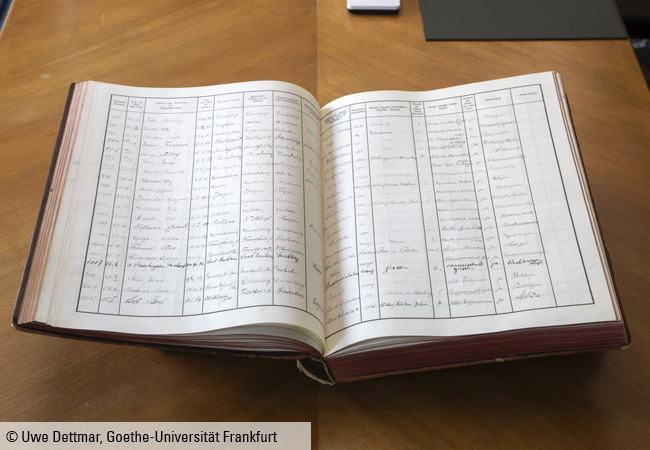
The starting point for exploration was the exhibition space on the ground floor, where twenty perspectives offered “a glimpse into the archives’ holdings, editions, and exhibitions.” The first series of exhibits already represents the three areas in which UAF operates: the university’s history, the history of science, and cultural history. The contract for the foundation of a university in Frankfurt in 1914 served as the basis for everything that followed, always centering on the students, as suggested by Gisèle Freund’s University of Frankfurt ID card from 1929–1931. Science as a whole and its intertwining with contemporary history are reflected in a letter from Albert Einstein to Max von Laue from Oxford, dated May 16, 1933. A letter from the book illustrator to Eva Demski from the exhibition marking 100 years of Goethe University and notes by Wim Wenders on Paris, Texas from FUNDUS. The book published by Verlag der Autoren from 1969–2019 underscores the role of the archives in the interplay of cultural institutions.
In the second series, a montage celebrating 60 years of Frankfurt Poetics Lectures is framed by a facsimile from Franz Kafka’s quarto notebook (from 20 years of the Institut für Textkritik) and a review of title pages from the Streit-Zeit-Schrift by the Eremiten-Presse of V. O. Stomps. In the third series, a portrait of Theodor W. Adorno from the desk of literary scholar Silvia Bovenschen is complemented by a collage by Ror Wolf and an illustrated manuscript by alumna Silke Scheuermann. In the fourth series, the statutes for the University of Frankfurt a. M. issued by “Wilhelm, King of Prussia” in 1914 meet the “Red Star” of Stroemfeld Verlag and a love letter from Herbert Achternbusch to Burgel Zeeh, the eternal executive assistant to Siegfried Unseld. This is followed by an image of the attempted renaming of “Johann Wolfgang Goethe University” to “Karl Marx University” at the main portal in 1968 using brushes and paint, alongside items from the estates of Walter Boehlich and Horst Bingel. Finally, the series includes a sheet by F.K. Waechter, The Red Wolf (Exhibition 2017), a world map whose landmass is formed from book covers of translations of Daniel Kehlmann’s Measuring the World (100 years of Goethe University), and a letter from publisher Peter Suhrkamp to his wife Annemarie Seidel from the Gestapo prison in Berlin, Lehrter Straße, November 1944, taken from one of our major editions.
10,000 Meters of Records
The nostalgic charm was a didactic tool used to create pathways to the archive’s current daily operations, which were introduced by its staff and cooperation partners during workshop visits. With “stacks of records … lying like the Tower of Babel,” the immense requirements necessary to make a collection of 10,000 linear meters of records from an academic institution “workable” and transition it into the age of digitalization were vividly illustrated. The function of a scientific small reference library was explained, alongside introductions to the Photographic Collection and the Art Collection.
Current projects served as practical examples of our financial resources and methods: for instance, the first-ever documentation of all Jewish students at the University of Frankfurt. This effort makes it possible to comprehend the extent of the university’s self-destruction beginning in 1933, previously documented primarily through the expulsion of Jewish scholars. Another example is the investigation of the literal “skeletons in the closet” of the Edinger Institute for brain research and its institutional history during National Socialism. The depth of space in the legacy of astronomer Ernst Zinner was explored, as was a historical study alongside Friedrich Schlegel. “Goethe and the Beagle Boys” represented “Joyful Science,” while the trials and triumphs of editing major letters were brought to life through examples such as those from Siegfried Kracauer to Theodor W. Adorno, Wolfgang Koeppen to Siegfried Unseld, and Rainer Werner Fassbinder to Karlheinz Braun. Rudi Deuble presented the publication of writings from the legacy of Peter Kurzek, and Eva Demski shared her poetics of small things.
Operating across such expansive fields was not anticipated at the time the archive was founded. This began informally in 1914 with the founding of the university, serving as its neglected “repository.” Its modernization was ushered in by Notker Hammerstein through preparatory work for his three-volume university history, published in 1989, 2012, and 2013, and totaling 2,164 pages. For this project, every file and document had to be made readable and evaluated; every piece of “scrap paper” was transformed into a “source.” This could not be achieved with conventional tools, which is why, in 2002, the collection in the basement of the Juridicum was elevated to an institution by the Executive Board under then-president Rudolf Steinberg. The development of its facilities progressed slowly but steadily. Academically, the archives were affiliated with the Institute of History, while administratively, they were integrated into the university’s operations, as evidenced by its first three locations within the Juridicum.
Archive Merger
Also in 2002, the university entered into a cooperation with the Peter Suhrkamp Foundation to house, catalog, and academically analyze the archives of the Suhrkamp and Insel publishing houses at Goethe University. The Uwe Johnson Archives served as a model, having been developed into an internationally renowned research center under the direction of Eberhard Fahlke, managing director of Faculty of Modern Languages Dean’s Office, starting in 1985. This success story continued with the archives of the Peter Suhrkamp Foundation at Goethe University but came to an end in 2010 with the sale of the publishing archives to the German Literature Archives in Marbach, coinciding with Suhrkamp’s move to Berlin. However, the twenty-five years of expertise were not abandoned; instead, they were further developed by Goethe University’s Literature Archives, building on the archives of the Frankfurt Poetics Lectures. This was achieved through cooperation between the Faculty of Modern Languages and University Archives Frankfurt, alongside numerous new partners, most notably Eva Demski and the Verlag der Autoren publishing house and its authors’ foundation. In 2011, the Literature Archives merged spatially with the University Archives and relocated to its facilities in the Juridicum.
The following years were shaped by three key factors: With the major anniversary in 2014, celebrating 100 years of Goethe University, the university’s own historical awareness sharpened, and its history was publicly perceived with a new level of quality. Its presence in the city was strengthened through new initiatives, including 35 exhibitions in the format “Windows to the City,” developed by the UAF and hosted at the Margarete restaurant on Braubachstraße, as well as invitations from the archive to the city’s community to visit the university campus. Lastly, an increasingly critical perspective on history demanded quick and precise responses to questions regarding provenance, the role of donors during and after National Socialism, current issues such as plagiarism cases, and more.
From Temporary Quarters to Bahlsen House – and Now to Dantestraße
In the provisional space allocated to the UAF in the Juridicum, professional work became increasingly challenging, leading to the move in 2017 to Bahlsen House at Zeppelinallee 13. However, the possibility of the site being used by the Max Planck Society was already looming on the horizon, which meant accepting certain shortcomings in the layout of the building. With the current move to Dantestraße 9, the UAF has reached its final destination. Since 2014, the large ground-floor room has been used for exhibitions, events, and seminars, introducing new formats for science communication. Now, the entire building, including public spaces such as the reading room and library, is interconnected with working archives, allowing for the first time the processing of collections in reasonable units. Once prepared for the future, these collections will return to the central archive. This remains a prerequisite for the UAF’s central mission, alongside providing guidance to users: fulfilling the role of the University Archives as the state archive, ensuring document-based legal certainty in administrative actions, personnel matters, and ownership issues, as well as supporting the academic achievements of students, which are reflected in their records. A distinctive feature of the UAF is that these tasks are carried out by staff who are themselves in the academic qualification phase but take on a high degree of personal responsibility at the UAF, where in addition to specialized academic studies, they also gain methodological and practical skills.
As a research archive, the UAF actively contributes to academic production, as evidenced by its publication series with Wallstein Verlag, as well as major editions published by Schöffling & Co., Suhrkamp Verlag, and Verlag der Autoren.
And so, the University Archives Frankfurt at Dantestraße 9 now stands as the physical embodiment of its academic, archival, and didactic practices, representing the identity of Goethe University in its 111th year. We warmly welcome you to visit us in our new home.
PD Dr. Michael Maaser is the Director of the University Archives of Goethe University, and Wolfgang Schopf heads the Literature Archive.