

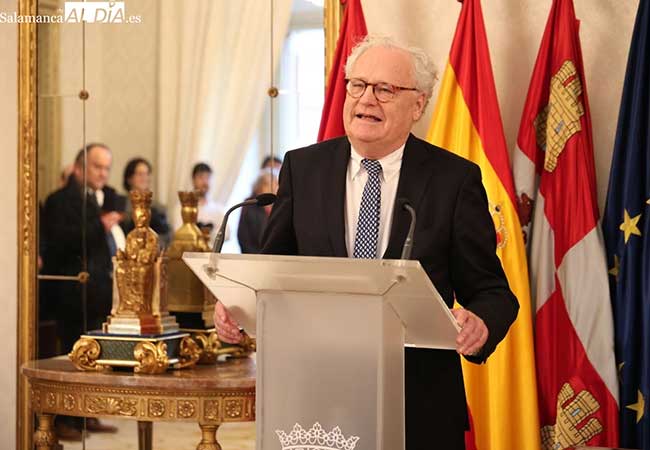
Professor Matthias Lutz-Bachmann, Chair of Philosophy at Goethe University Frankfurt, has been named a Huésped Distinguido (Distinguished Guest) by the City of Salamanca. The honor was conferred on February 11, 2026, during a formal reception at the Salamanca City Hall as part of the international congress “The School of Salamanca: Past, Present, Future (1526–2026)” – an academic event marking the 500th anniversary of the historic intellectual movement known as the School of Salamanca. The program included presentations and debates involving over 150 speakers from more than 20 countries, highlighting the relevance of the School – which refers to a network of 16th- and 17th-century thinkers whose work laid foundational concepts in legal and political philosophy and early international law – for contemporary global challenges.
The title of Huésped Distinguido recognizes Lutz-Bachmann’s “decisive work in repositioning Salamanca at the center of European and global academic debate,” particularly through his leadership of the digital School of Salamanca research project. This initiative, developed with the Academy of Sciences and Literature in Mainz, creates a digital infrastructure that makes the texts and ideas of the School accessible worldwide, bridging humanist tradition and advanced technology.
“The ‘School of Salamanca’ remains significant to this day, as its representatives made decisive contributions to the development of modern law, the formulation of human rights, the recognition of cultural diversity, and the obligation of states to uphold a global order of peace,” Lutz-Bachmann said during the reception hosted by the City of Salamanca. “This achievement was just as groundbreaking as the contributions developed in Salamanca toward integrating philosophy and theology, as well as jurisprudence and economics.”

The mayor of Salamanca, Carlos García Carbayo, presented the distinctions to Lutz-Bachmann alongside Juan Belda Plans and Virginia Aspe Armella – both internationally recognized scholars in early modern thought and the broader influence of the School of Salamanca. García Carbayo emphasized that the anniversary celebrations and related honors help to repay a “historical debt” to what he described as “one of the most influential schools of thought in history,” citing its enduring contributions to law, economics, politics, ethics, and human dignity.
Matthias Lutz-Bachmann’s own scholarly work spans several core areas of the humanities, reflecting both historical depth and philosophical breadth. Since 1994 he has served as Professor of Philosophy at Goethe University Frankfurt, where his research focuses on medieval philosophy, practical and political philosophy, religious philosophy, and critical theory – fields that underpin much of his engagement with historical and contemporary issues in law, ethics, and human rights. His leadership roles include directing the Forschungskolleg Humanwissenschaften Institute of Advanced Studies in Bad Homburg and co-founding the Johanna Quandt Academy to support promising early-career researchers. During his tenure as Vice President of Goethe University (2009–2015), he helped establish key interdisciplinary institutes, including the Center for Islamic Studies and the Research Center for Historical Humanities, and expanded international academic partnerships. Lutz-Bachmann has also initiated and edited several influential academic series in medieval and early modern philosophy and law, and he plays a central role in The School of Salamanca digital humanities project – an international effort to create a digital source edition and dictionary of the juridical-political language of Salamanca’s early modern thinkers, bridging philosophy, legal history, and digital scholarship.


