Are we allowed to break the law for higher purposes? A debate on civil disobedience as a form of protest
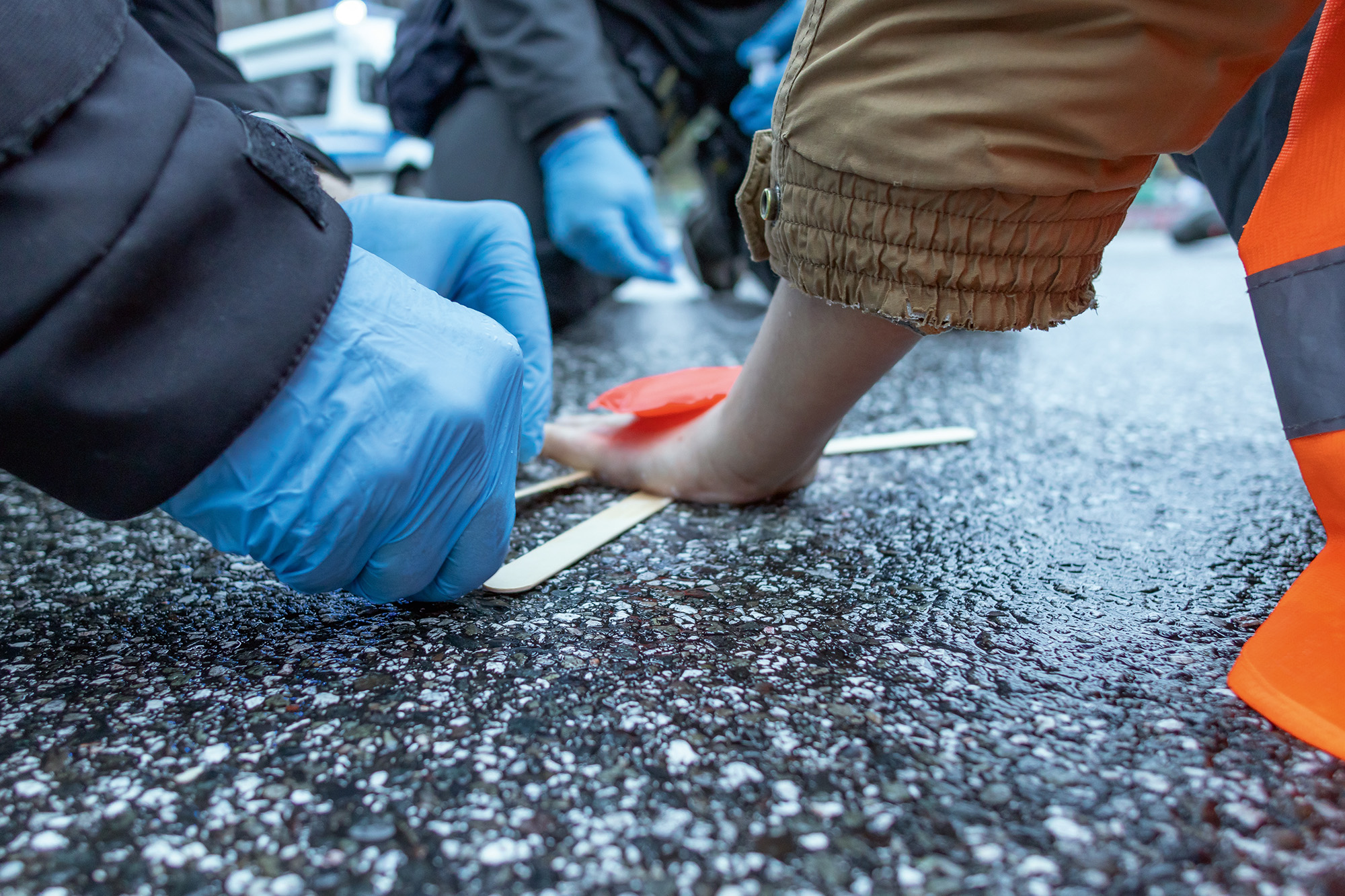
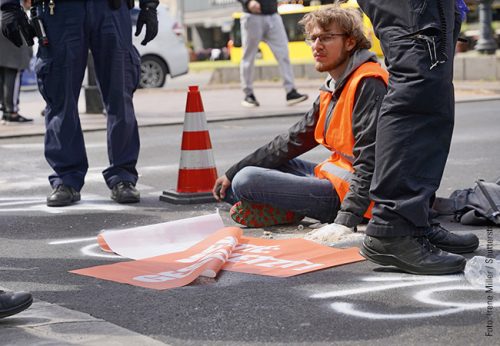
A police officer uses solvent in an attempt to free the hand of a climate activist stuck to the road. Society is divided on the point to which civil disobedience is legitimate.
Photo: Canetti/Shutterstock
To expedite action on climate protection, members of the activist group known as the “Last Generation” are resorting to unconventional methods such as affixing themselves to the streets, vandalizing works of art by throwing soup, and initiating hunger strikes to press for the realization of their objectives. But how far can civil disobedience go without jeopardizing law and order? Dirk Frank discusses this with public law scholars Samira Akbarian and Uwe Volkmann.
Dirk Frank: Ms. Akbarian, you criticize that jurisprudence has so far dealt too little with the legitimacy of civil disobedience as a form of protest.
Samira Akbarian: Until a few years ago, there were only a few legal contributions on the subject. In my dissertation, I endeavored to explore the constitutional and democratic implications of civil disobedience, examining it through the lenses of both law and justice. While political science has already delved into this topic, jurisprudence has not yet fully addressed its significance.
Uwe Volkmann: I should mention my predecessor, Günter Frankenberg, at this point, who dealt with the phenomenon of civil disobedience early on. However, systematic treatment of the subject as a whole, also in connection with political theory, remains rare, apart from a handful of isolated and sporadic studies.
»Public opinion misjudges the democratic significance of protests«
Frank: If we were to talk about the current relevance of the topic, we can also observe a certain degree of polarization. Some see climate activists gluing themselves to roads as a necessary protest to raise awareness of increasingly dramatic climate change. Others think the protests, although the activists’ concerns may be justified, go too far.
Akbarian: We assume that democracy, especially representative and majoritarian democracy, is fair. However, this is a misconception, as not everyone can equally participate in the procedures of a majoritarian democracy. In this respect, representative and majoritarian democracy depend significantly on rallies and protests, which may and should, at times, „disrupt“ public order. It is crucial to differentiate between this aspect and the question of the extent to which disturbances to public space are still protected by the freedom of assembly. In my view, both public opinion and the legal system often misconstrue the democratic significance of protests, defining the scope of protection for the freedom of assembly too narrowly.
Volkmann: I would agree insofar as I would say that the current debate about the criminal prosecution of climate activists is somewhat overheated. On the other hand, I disagree with Ms. Akbarian on one point: that civil disobedience is a response to a lack of representation. Political science research has found that the views of certain groups are indeed not adequately represented in the political arena. This is also considered as one of the causes for the emergence of populist or authoritarian movements. However, these are typically the socially disadvantaged classes, who then do not vote because they do not expect to gain anything from it anyway. But it is hard to imagine an issue other than climate protection that is more strongly represented in the political system.
Frank: A common criticism of civil disobedience is that it is the work of an intellectual elite who claim to have the solution. In contrast, the majority of the population is seen as ignorant.
Volkmann: This is indeed problematic in two respects: Firstly, insofar that we, as members of a political community, are obliged to adhere to its laws. Secondly, in the sense of democratic equality, we attribute to everyone the same ability to decide on political questions that we attribute to ourselves. On the other hand, however, this is also seen as a tremendous affront: Why should my opinion count as much or as little as that of someone who understands much less about the matter than I do? Through civil disobedience, people step out of democratic equality by deciding themselves that their solution to a problem is the one and only, and non-negotiable.
Akbarian: I agree with your assertion that the accusation of know-it-all behavior cannot be entirely dismissed when it comes to civil disobedience. Furthermore, in the context of climate protection, civil disobedience is not limited to those who are most adequately represented. It began with schoolchildren who lacked the right to vote, representing not only their interests but also those of individuals unable to advocate for themselves, such as people from the Global South or future generations yet unborn. Engaging in civil disobedience demands considerable courage; activists are frequently subjected to physical violence or intentional collisions with vehicles during protests. Risks are usually only taken by those who can afford to do so. It is therefore no coincidence that individuals with social privileges often exhibit this courage.
Frank: Are there also limits to civil disobedience? Are such boundaries discussed?
Volkmann: If you look at the positions of John Rawls or Jürgen Habermas, civil disobedience is justified on the one hand, but they also set relatively clear limits as to how to go about it. In their view, acts of civil disobedience should be announced in advance and be only symbolic. Climate activists, however, say they will only stop when their demands are actually met. Rawls says that civil disobedience must also take the effectiveness of the protest in the political system into account. The fact that everyone actually endorses the climate protection goals but unanimously rejects the actions of activists should also then be discussed within the groups.
Akbarian: Climate activists usually announce their protests in advance. They give press conferences and communicate with the public.
Volkmann: But not when they are blockading airports.
Akbarian: True. Interestingly, Habermas and Rawls demand that protests should only be symbolic; conversely, the courts, which have acknowledged acts of civil disobedience as justified, have emphasized that a prerequisite of civil disobedience is that it is not only symbolic. This indicates that the criteria put forth by Rawls and Habermas are contentious and, in certain aspects, overly restrictive.
Frank: At present, many citizens are concerned that the rule of law is being challenged. They worry that the debate surrounding increasingly dramatic climate change might make any form of protest acceptable.
Volkmann: It is not a problem in itself when the law is broken, this happens tens of thousands of times every day. But the average lawbreaker does not boast about it, and if they do, then at most in a small circle, not publicly. Climate activists, on the other hand, say they are deliberately defying the law for the higher good. This fundamentally questions the validity of the law.
Akbarian: In doing so, they are also highlighting a core component of the democratic order, namely that the law can also be interpreted differently. Laws are not set in stone. This is also the aim of their protest: It draws attention to the fact that democratic orders can change and that citizens have the power to bring about these changes.
»Laws are not set in stone«
Volkmann: But we must remain within the democratic order, which is distinguished from other orders by the fact that it can change from within.
Akbarian: Only sometimes it isn’t. Democratic inclusion is only ever possible through exclusion; this means that many people are subject to the law and do not have a say at all. What the majority decides, or the person the majority elects as a representative of this majority, applies for the entire population for a period of four years. And it is easier for the social elites to be elected to the Bundestag.
Volkmann: But the principle of majority rule is also such a sore point because it naturally presupposes the willingness to accept the decisions made.
Frank: There is, to a certain extent, left-wing and right-wing civil disobedience. And left-wing groups are often assumed to be more peaceful.
Akbarian: In my opinion, civil disobedience contributes to fostering a democratic society by endorsing freedom and equality for all within the democratic community. This occurs through the form of protest, where genuine acts of civil disobedience adhere strictly to non-violent means.
Volkmann: However, there are now also other groups that are making civil disobedience their own, for example the Identitarians. If a play is performed that they don’t like, they sit down on the stage and try to stop it. In effect, the Identitarians hijack this form of protest. How, then, can we distinguish between good and bad disobedience? This cannot be done via the means used, the breach of the law is the same on both sides. Is it possible to call certain goals correct and others not? If they are clearly against certain constitutional provisions, maybe it is. But there are many goals that are still largely within the bounds of what can be negotiated democratically.
Frank: What would you as jurists wish for? That society might also learn to tolerate such protests and not always cry out for the rule of law?
Akbarian: I think that democratic order also includes disorder, otherwise we would find ourselves in an absolutist state. Democracy is characterized by its inherent capacity for change, and these changes are often initiated by disrupting the existing order. This upheaval, in turn, may give rise to disorder, which eventually transforms into a new democratic order.
Volkmann: The effect of civil disobedience, however, is also that you can attract a lot of attention with relatively few people and resources, precisely because they are breaking the law. The only other comparable option is mass: When 100,000 or 200,000 people demonstrate for or against something, it attracts attention. But if everyone said: Climate activists gluing themselves down is normal, the protest potential would quickly fizzle out.
Akbarian: If such a significant number of people were ready to attach themselves to an object and disrupt public order, we might be approaching a quasi-revolutionary state, posing a considerable threat to democracy indeed. However, until that point, I would contend that these are democratic mechanisms that, depending on the justice or democracy-related issues emerging in society, can occur from time to time and can then also be resolved by democratic society.
The interview was conducted by Dirk Frank, Deputy Press Spokesperson of Goethe University Frankfurt.