

Study commissioned by the Academy for Islam in Research and Society (AIWG) at Goethe University reveals major differences between Germany’s federal states
The Academy for Islam in Research and Society (AIWG) at Goethe University published a new study on Islamic prison chaplaincy in Germany today (March 11, 2026). The author is religious studies scholar Dr. Sarah Jadwiga Jahn. The study traces the developments and debates surrounding the topic, outlines the current state of implementation in the individual federal states, and formulates recommendations for addressing challenges that remain unresolved.
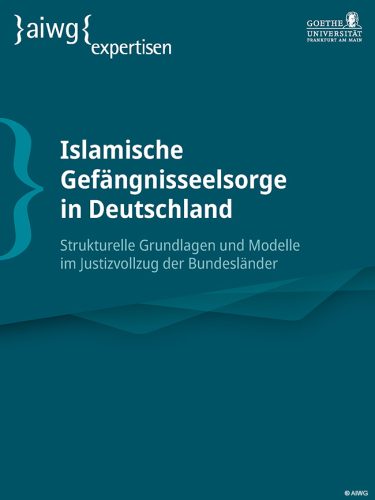
The study on prison chaplaincy commissioned by the AIWG builds on the findings of the German Islam Conference (DIK), which in 2017 formulated key recommendations for chaplaincy services in correctional institutions. One of these recommendations was the establishment of a national working group within the Conference of the Federal Ministers of Justice. Since then, pastoral care for Muslims has been significantly expanded at the state level. However, as the AIWG report entitled “Islamic Prison Chaplaincy in Germany: Structural Foundations and Models within the Federal States’ Correctional Systems” (available in German) shows, that the provision of such services varies considerably. The spectrum ranges from the deployment of volunteers to formal agreements between individual correctional institutions and Islamic communities or associations. While, for example, Brandenburg, Saxony-Anhalt, and Saarland currently do not provide Islamic prison chaplaincy, other federal states have developed transitional models or operate on the basis of pilot projects. Some states offer Islamic chaplaincy as a regular service. The German correctional system explicitly seeks to contribute to the resocialization of inmates. In this context, Islamic chaplaincy can form part of holistic rehabilitation measures for Muslim prisoners who make use of religious services, thereby potentially fostering positive societal effects.
Notwithstanding the positive developments, several unresolved challenges still stand in the way of a nationwide expansion of pastoral care services for Muslim women and men – including a clear distinction between Islamic prison chaplaincy and extremism prevention or deradicalization efforts. In addition, a legally recognized right to refuse testimony would need to be established, putting Islamic chaplains on an equal legal footing with their Christian counterparts and protecting them in the exercise of their duties. The study offers impulses and examples of how minimum standards in education and training could be secured and harmonized nationwide, as well as how the specific responsibilities of chaplaincy within correctional institutions could be more clearly defined. Another open question is how long-term funding through the budgets of the federal states can be ensured.
Prof. Dr. Bekim Agai, AIWG Director, on the study’s results:
“Established training structures for Islamic chaplaincy exist at the Centers for Islamic Theological Studies in Tübingen and Osnabrück. At the same time, there is still a lack of clearly defined professional profile in practice and there are hardly any reliable employment prospects. Such prospects, however, should exist to enable graduates to enter this demanding profession. Their standard-based academic qualifications would ensure a high-quality pastoral care.”
The German original of AIWG’s study on “Islamic Prison Chaplaincy in Germany: Structural Foundations and Models within the Federal States’ Correctional Systems” can be downloaded from AIWG’s homepage: AIWG-Expertisen – AIWG – Akademie für Islam in Wissenschaft und Gesellschaft
About the Author
Dr. Sarah Jadwiga Jahn, a scholar of religious studies and organizational studies, researches the perception and management of religious and cultural diversity in public institutions (police, correctional services, and municipal administration). Since 2018, she has been a full-time lecturer at the University of Applied Sciences for Police and Public Administration North Rhine-Westphalia (HSPV NRW). She earned her doctorate at Leipzig University in religious studies and sociology, with a dissertation on positive religious freedom in correctional settings. Since 2012, she has published on the management of religious diversity in prisons.


