Intercultural insights into a research expedition to Australia by the Frobenius Institute many decades ago
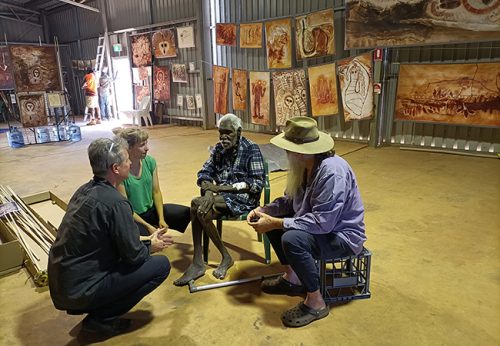
Photo Kim Doohan
Eighty-five years ago, a group of cultural anthropologists from Frankfurt embarked on an expedition to Northwest Australia to study the culture of the Wanjina Wunggurr community. A memorable relationship developed, not without misunderstandings, that is today characterized even more by a desire for mutual understanding.
Maliba was one of the first places to which Lorri, an Indigenous guide, led the German expedition. Protected by a rocky outcrop, the expedition members from Frankfurt’s Städtisches Völkermuseum, today Weltkulturen Museum, and the Research Institute for Cultural Morphology, today the Frobenius Institute for Research in Cultural Anthropology at Goethe University Frankfurt, set up camp from June 15 to 28, 1938, in the midst of rugged, golden-brown sandstone cliffs and vast plains with dry grass and prickly, bright-green bushes. Here, in the sparsely settled Northwest Australia, far away from Nazi Germany, which was busy imposing ever more restrictions on scientific freedom, the German anthropologists planned to study the culture of the Wanjina Wunggurr community, a group of Indigenous Australians, to which Lorri also belonged. The researchers were particularly interested in the rock paintings at Maliba, which recount a story of Larlan, the creation of the sky, the sea, the land and everything in them. And of the spirits they called Wanjina. A culture, thousands of years old, that was deeply threatened even in the remoteness of the Kimberley region at the hands of European settlers as well as imported diseases.
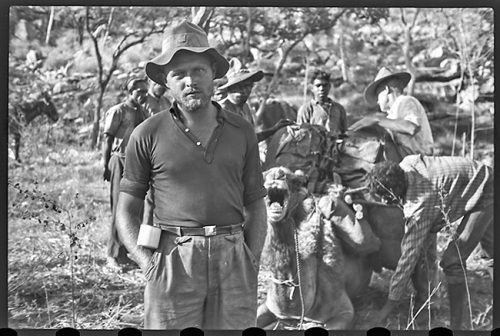
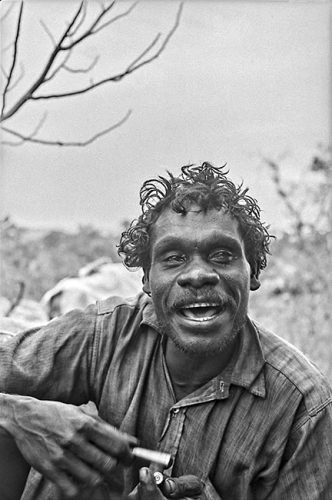
Photos: Fotoarchiv Frobenius-Institut
A relationship that continues today
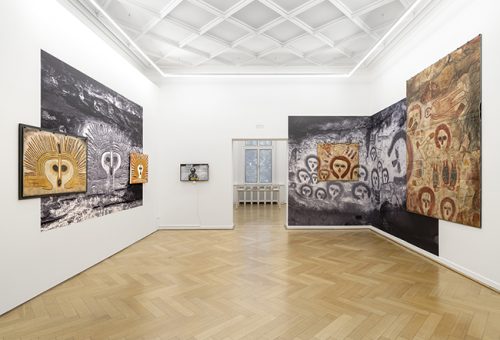
“Over 80 years ago, researchers and artists from the Frobenius Institute traveled to Wanjina Wunggurr Country and met our ancestors. They learned many things, collected material artifacts and took lots of notes, which they took back to Frankfurt. In 2023, four members of the Wanjina Wunggurr community traveled to Frankfurt to inspect these notes and prepare pieces for the exhibition ‘COUNTRY BIN PULL’EM’. The exhibition (…) we co-curated aims to show that we, the Wanjina Wunggurr traditional owners, are still here and that our culture is impressive,” wrote the community’s representatives in a welcome address for the exhibition at the Weltkulturen Museum in Frankfurt, which was curated together with the Frobenius Institute and ran until August 31, 2025. Apart from contemporary works of art by the Indigenous delegation, other objects on display include paintings on pieces of bark or shields the expedition members acquired through barter back in 1938. At that time, however, the researchers sometimes ignored the rules for handling such objects and overlooked the fact that the members of the Wanjina Wunggurr community regarded these transactions less as bartering and more as the foundation for personal spiritual relationships. The context of such acquisitions is an important theme of the exhibition. Also prominently on display are expedition photographs and monumental copies of rock art from the Frobenius Institute’s rock art archive. The institute, which was named after its founder Leo Frobenius, is celebrating its 100th anniversary in Frankfurt this year. It was Frobenius who commissioned artists to make copies of Indigenous rock paintings in Africa and Australia. He was convinced that painted copies could convey the spiritual essence of rock art better than photographs could. The result is the exhibition “COUNTRY BIN PULL’EM – Looking Back Together” organized within the research project “The German Ethnographic Expeditions to the Kimberley, Northwest Australia. A Collaborative Assessment of Research History, the Interpretation of Australian Aboriginal Heritage and Digital Repatriation” at the Frobenius Institute for Research in Cultural Anthropology at Goethe University Frankfurt and the University of Western Australia (UWA) in Perth.
IN A NUTSHELL
- Eighty-five years ago, a German expedition traveled to Northwest Australia to study the culture of the Wanjina Wunggurr community. The expedition was not without misunderstandings and cultural differences, yet it also aspired to faithfully document the knowledge of the Indigenous people.
- In 2023, members of the Wanjina Wunggurr community traveled to Frankfurt to inspect the expedition’s collections. Together with researchers working in Frankfurt today, they curated the exhibition “COUNTRY BIN PULL’EM”, both with contemporary artworks and historical objects.
- The research conducted at the interface of the different knowledge cultures of German researchers and the Indigenous community led to conflicts, for example with regard to the handling of secret and sacred knowledge. The project highlights the need to show cultural sensitivity and handle traditional knowledge with respect.
- The collaboration has produced new insights into the rock art. Anthropological research and the oral traditions of the Wanjina Wunggurr community complement each other and allow for a deeper, holistic interpretation of the rock art sites, which German researchers in 1938 only partially understood.
The soul of the “Country”
The idea for the exhibition came from Associate Professor Martin Porr at the University of Western Australia. Reading an expedition report by a Frobenius researcher had alerted him to the collections in Frankfurt, and he brought them to the attention of the Wanjina Wunggurr community. “Although the Indigenous peoples meanwhile have rights to their land, they live where they were resettled in 1956 – far away from the homeland of their ancestors. This has caused social problems and contributed to the disintegration of traditional society. The members of the Wanjina Wunggurr community were interested in the collections because they want to connect more with their ‘Country’ and their traditional culture,” explains Dr. Richard Kuba, who led the research project together with Associate Prof. Martin Porr. The Wanjina Wunggurr community believes that their land, the Country, is inhabited by forces that are deeply intertwined with human beings. They believe that it was these forces that drew the German researchers to the Kimberley region over 80 years ago: COUNTRY BIN PULL’EM, the land that “pulled” them. And that this encounter laid the foundation for a relationship that continues today. The German-Australian research project was also made possible thanks to funding from the University of Western Australia and the German Research Foundation (DFG). It has enabled the project team to digitize objects from the collections, expedition reports, photographs and copies of rock art and make them available online to the Wanjina Wunggurr community. In July 2023, the researchers participating in the project traveled to some of the rock art sites previously visited by the German researchers together with Traditional Owners from
the Wanjina Wunggurr community, and in November 2023, together with the Weltkulturen Museum, they welcomed a delegation from the Wanjina Wunggurr community to Frankfurt.

Photo: Fotoarchiv Frobenius-Institut, Frankfurt am Main
Contrasting knowledge cultures and surprising solutions
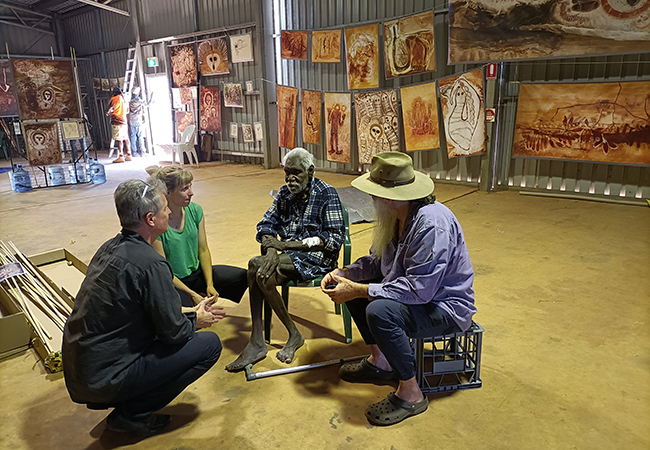
The Traditional Owners, individuals who hold rights to certain places on the basis of their ancestry and life experience, wanted to know how their community and cultural values are presented there in the notebooks and publications of the expedition members of 1938, which are kept in the Frobenius Institute’s archives. In the rock art collection and among the objects in the Weltkulturen Museum, the Traditional Owners tracked down objects and images that, according to tradition, count as sacred or secret and should be hidden from the eyes of uninitiated individuals. Other items can be restricted for women, young people or non-family members. “In Indigenous cultures, successors are introduced to traditions over many years. Initiation rites govern who is allowed to see what,” explains anthropologist Kuba. Men possess knowledge that they keep secret from women, he says, and vice versa, and no one is allowed to know everything. “Researchers, by contrast, press for open access – access to knowledge for everyone. To that extent, there is a culture clash right from the outset,” admits Richard Kuba. “As an anthropologist with an obligation toward culturally sensitive research, I must, however, respect such traditions.” And seek solutions acceptable to everyone involved in the research process. It therefore follows that Traditional Owners are asked to release photographs and copies of rock art for exhibitions and publications. If they refuse, researchers and curators such as Richard Kuba sensitize the public to the reasons why. One example is the publication on the Frobenius expedition of 1938, which until 2011 existed only in German: The book, which revealed secrets of the Indigenous people, was translated into English and distributed by an Australian publisher without knowledge of the Wanjina Wunggurr community. When researchers from the Frobenius Institute sent the book to the Indigenous partners, they simply let it disappear, not knowing that hundreds of copies had been printed. A copy is now on display in the exhibition at the Weltkulturen Museum – with passages blackened and pages torn out, which highlights the need to show consideration toward the cultures of others. Kuba has seen male curators in Australian museums guarding collections that, according to Indigenous beliefs, are to be kept secret from women, and female curators guarding collections that are to be kept hidden from men. Despite being an experienced researcher, Kuba is fascinated by this completely different way of handling knowledge: “In Australia, my colleagues and I went through a steep learning curve.”
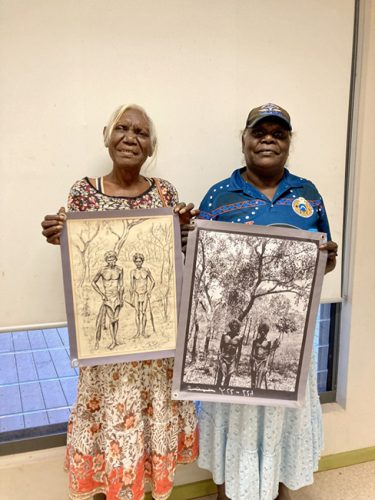
Photo: Christina Henneke
Return to Maliba
For Kuba, Maliba was also fascinating. Eighty-five years after his predecessors from the institute, he visited the Maliba I and II rock art sites together with his colleague Christina Henneke, co-project manager Martin Porr and Traditional Owners John Wunargnu Rastus and Rona Gungnunda Charles. The goal was to compare the oral traditions passed down by the latter with the expedition reports from 1938 and to gain new insights from this into the millennia-old rock paintings.
To signal to the Wanjina that they are approaching and bringing visitors with them, the Traditional Owners call out to them. It is their way of showing respect to the “Country” so that its “spirit” will supply the visitors with what they need. John Wunargnu Rastus hastily tears a branch from a bush, plucks off the leaves and piles them up. He sets them alight. He pours water from a drinking bottle, causes a spicy smell of smoke to rise. The visitors must walk through it. They are then regarded as cleansed and ready to enter the site. “It created a sacred atmosphere, almost like in a church,” recalls Kuba. When comparing expedition reports and rock art sites, the anthropologists and Traditional Owners together found an explanation as to why the Indigenous guide Lorri might have classified one of the artistic paintings as “rubbish” in 1938: Overlooked back then by the researchers from the Frobenius Institute, there is a drawing of a spirit-like being next to the main group of paintings. It is considered inauspicious for the uninitiated observer, and neither Lorri nor the German anthropologists back then should have seen it. However, one of the researchers from the Frobenius Institute had slipped away from Lorri’s watchful eye and discovered the rock art site. When inspecting the paintings more than 80 years later, the Indigenous guides astound Richard Kuba: Rastus and Charles know all the names of the depicted spirits; the traditions they narrate, thousands of years old, seem convincing.
Individual parts form a whole
For the research group in Frankfurt, the reason why certain things stayed hidden from the 1938 expedition is clear: Their predecessors had selected the sites to be studied on the basis of pragmatic considerations such as accessibility. The rock art sites in the Kimberley region, stone circles in the landscape, rocks and rivers, fuse together in the Wanjina Wunggurr culture’s conception of a parcours, a sequence of images that narrate a story. A story of the creation of the sky, the sea, the land and everything in them. And of the spirits that John Wunargnu Rastus calls Wanjina. Just like his grandfather Lorri did.
and Koralyi.
Photo: Wolfgang Günzel
About
Dr. Richard Kuba, born in 1963, studied cultural anthropology and African history in Munich and Paris and earned his doctoral degree in Bayreuth with a dissertation on the precolonial history of West Africa. Since 2005, Kuba has been responsible for the Ethnographic Pictorial Archive, the Rock Art Archive and the Legacies Archive at the Frobenius Institute and has built up the institute’s online pictorial archive. Kuba has curated numerous exhibitions, including ones at Gropius Bau in Berlin (2016) and Museum Rietberg in Zurich (2021).
kuba@em.uni-frankfurt.de

The author
Jonas Krumbein, born in 1985, studied history and political science in Freiburg and Durham (England) and works part-time as a freelance journalist.
j.m.krumbein@icloud.com
To the entire issue of Forschung Frankfurt 1/2025: Language. The key to understanding