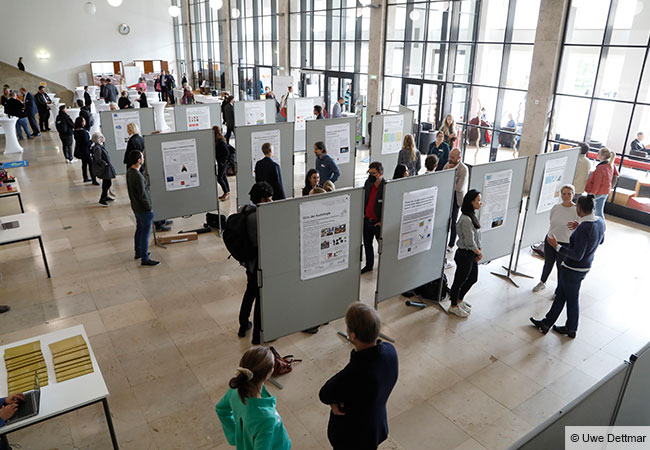
Ten years ago, the Rhine-Main Universities launched the Mercator Science-Policy Fellowship Program. The transfer project fosters dialogue by connecting academics with experts from politics and administration. At the end of January, the fellows had the opportunity to participate in no fewer than five events within a single week (detailed information available in the article “From Academia to Ministries, Agencies, Media or NGOs? A Dialogue With Practitioners on Career Opportunities and Paths”). During the closing event on January 29, it became clear how impactful encounters can be, even when the initial matching between discussion partners might have seemed a bit unconventional.
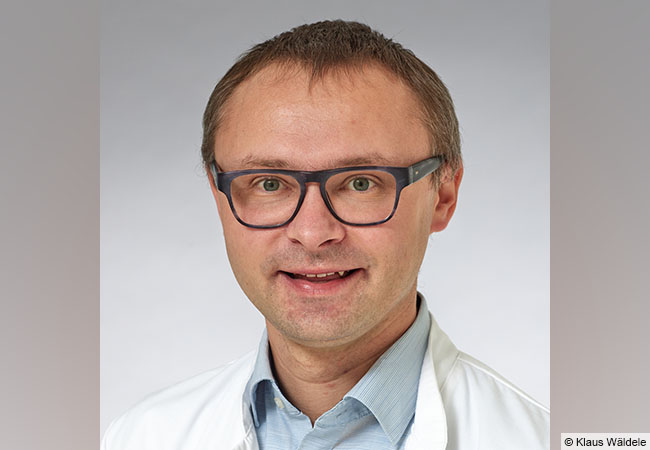
Henner Hollert, Professor of Ecotoxicology, puts it succinctly: Typically, his interactions with the ministry revolve around securing third-party funding for research projects. Through the Mercator Science Policy Fellowship Program at RMU, however, he connected with ministry experts who share his environmental protection goals – partners for substantive discussions who also open new perspectives. “That’s what makes this program so special: we discovered common ground. In this trusted setting, we were able to develop ideas together and carry them forward. By working together, we can achieve far greater impact. Personally, that has been deeply inspiring.”
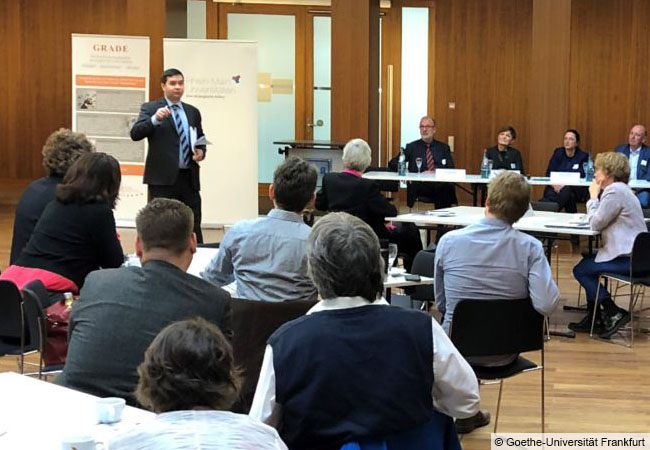
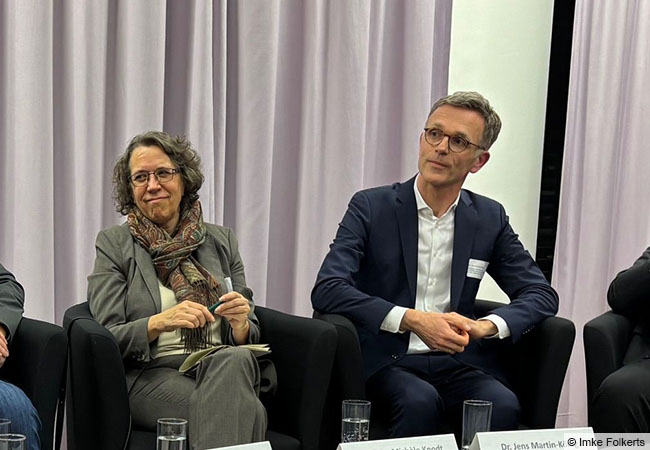
Alongside Prof. Michèle Knodt, political scientist at TU Darmstadt, as well as Dr. Jens Martin-König and Peter Hanisch from the Hessian Ministry of Agriculture, Environment, Viticulture, Forestry, Hunting and Homeland (HMLU), Hollert took part in a panel discussion at the closing ceremony of the Mercator Science Policy Fellowship Program and the ENGAGEgreen project. Moderated by program coordinator Tome Sandevski, the discussion explored the program’s effectiveness: What do fellows gain from engaging with researchers? And how does hands-on collaboration help researchers communicate their findings to a specialized audience?
What’s the topic?
What happens when senior executive staff from politics and administration approach researchers with specific concerns related to their professional practice? And what do researchers gain from such an exchange?
Who might find this interesting?
Anyone curious about how university research connects with and impacts society.
Why does this matter for the Rhine-Main Universities?
Universities carry a societal responsibility. The Rhine-Main Universities understand this as a clear mandate to share their knowledge in the service of development, sustainability, and justice.
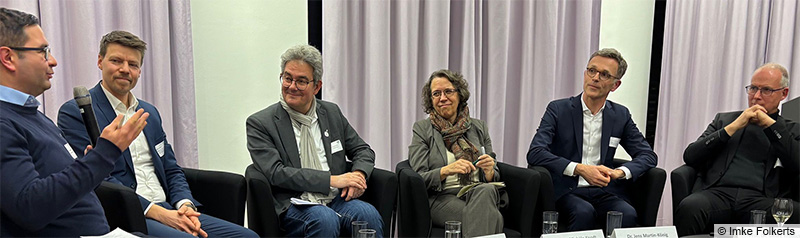
The two representatives from the Ministry of Environment and Agriculture emphasized that their participation proved valuable on multiple levels. One example is PFAS – so-called “forever chemicals.” As an environmental toxicology expert, Prof. Henner Hollert became a key interlocutor. Several follow-up projects emerged from this exchange. Among them, Frankfurt ecotoxicologists continued a state laboratory study on PFAS in coffee-to-go cups; the related publication will be released shortly. A central concern of the ministry’s technical advisors was to raise awareness of the risks associated with fluoropolymers, a PFAS subgroup, and to initiate discussion on their legal regulation. They shared their draft report with researchers in their network for review prior to submission. “That made a real difference and significantly strengthened the document,” Martin-König noted.
The Science-Policy Network also proved instrumental in addressing sulfur hexafluoride (SF₆), a greenhouse gas 24,000 times more potent than carbon dioxide and subject to mandatory reporting to the United Nations. A team led by Prof. Andreas Engel at Goethe University’s Institute for Atmosphere and Environment demonstrated that a leak at an industrial site in the Heilbronn district had released substantially higher volumes of SF₆ than officially reported. On this issue, Martin-König and Hanisch worked closely with colleagues in Baden-Württemberg. The broader challenge: climate protection is still insufficiently regulated under criminal law. “This is a major concern for our F-gases working group, where we see significant legal gaps,” Peter Hanisch explained. The ministry representatives therefore approached Prof. Christoph Burchhardt, a legal scholar at Goethe University Frankfurt, who devoted considerable time to their inquiry. The collaboration resulted in a draft amendment to F-gas criminal law, which has already passed the Federal Council. The work is ongoing: at Burchardt’s initiative, a conference on climate protection and criminal law will be held on April 30 at Westend Campus.
Biologist Henner Hollert underscores how much he has gained from the exchange with the fellows. The protected setting enabled unusually open conversations and offered valuable insights – particularly on how research can generate greater societal impact. One tangible outcome of his discussions with Martin-König and Hanisch was a stakeholder workshop organized by Goethe University’s Sustainability & Biodiversity profile area. As he notes, climate and environmental protection can also strengthen companies’ competitive position – with “better products from Europe” as a mark of quality.
Prof. Michèle Knodt likewise emphasizes the program’s impact on her work. Considering today’s major challenges, she seeks to contribute to solutions through her research as a political scientist. Yet meaningful impact, she argues, depends on knowing the relevant stakeholders, identifying the right entry points, and communicating findings effectively to the public. Unexpected synergies often arise where disciplinary matches initially seem imperfect. “We’re always just slightly off,” she says with a laugh. “But once the conversation begins, connections emerge almost automatically.” Fellows frequently introduce researchers to colleagues within their organizations who are working on related issues. The protected space is crucial, she explains – but so is its breadth. “You engage with people you wouldn’t normally encounter. That’s when new impulses emerge – when you think, ‘Interesting, I hadn’t considered that before, but it could become a research topic.’ Those are the moments that truly move your work forward.”
Good to Know
The Fellows: Discover the members of the current and final cohort of the Mercator Science-Policy Fellowship Program – and explore all participants since 2016 →
You can find detailed information about the Mercator Science-Policy Fellowship Program here →
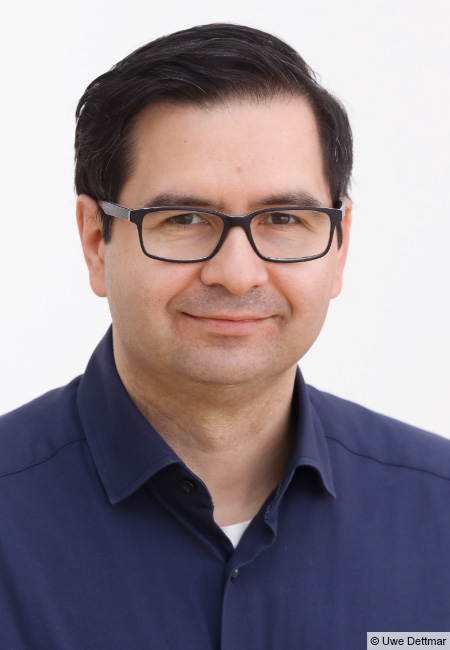
“With this program, we reached a highly diverse group of participants in terms of prior knowledge, thematic interests, and communication cultures – that was fantastic. After organizing several hundred conversations, I realized there is no such thing as ‘science,’ ‘politics,’ or ‘administration’ as singular entities. Understanding the action logics and knowledge needs of the other side takes time – time that is often scarce in the daily routines of both academia and practice. I hope we can approach the exchange between science and practice with a long-term perspective, in order to build trusting relationships between these two worlds.”