Shaping an International Body of Knowledge
Fifteen years ago, Prof. Dr. Jürgen Bereiter-Hahn became chairman of the Foundation for the Promotion of International Scientific Relations at Goethe University – a long name for an institution built on a seemingly simple, logically sound, and for him irrevocable fact: Science is international. “Goethe University acknowledges this at all organizational levels.” In an interview with UniReport, the emeritus professor of cell biology and neuroscience, manager, bridge-builder, and art enthusiast shares insights into the early years of the foundation, its mission and goals, and explains why international relations are always fundamentally about people.
Origins and Early Initiatives
The year is 1983, and Germany is undergoing significant change: Following the March elections, “The Greens” enter the Bundestag for the first time, a growing number of people are joining the peace movement as well as demonstrations against the deployment of NATO intermediate-range missiles on the continent, and public debate about climate change is intensifying due to forest dieback. The fear of nuclear confrontation between the USSR and the West is holding the world hostage. The Cold War’s bloc mentality dominates everything — including international scientific relations.
It is in this politically dynamic year that the Senate of Goethe University, prompted by then-University President Prof. Hartwig Kelm, decides to establish a new foundation aimed at fostering international scientific relations. The date is September 1983.
The resolution outlined that the assets of ten existing foundations would be consolidated into the new foundation. Over time, the capital of these foundations had diminished to the point where their original purpose could no longer be met to the desired extent. This fact alone meant that the new foundation was born amid concerns, and in some cases, outright opposition. However, since it not only pursued its primary goal of promoting the university’s international scientific relations but also allocated part of the combined funds to projects of its constituent foundations, initial resistance gradually subsided. “From the very beginning, the foundation provided tangible benefits for the entire university – across all faculties,” says Bereiter-Hahn.
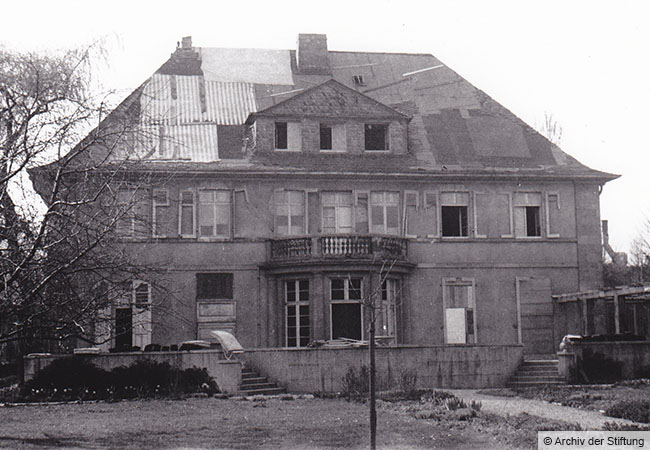
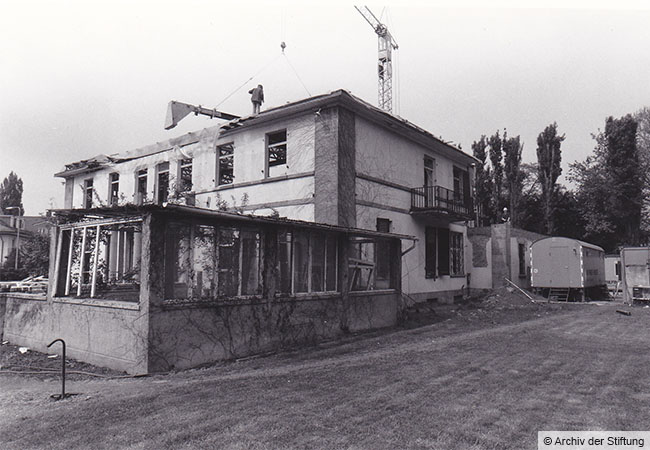
Supported by loans from the City of Frankfurt, the newly established foundation uses its capital to strategically acquire properties that can serve as both guesthouses and meeting spaces. In its founding year, the property at Ditmarstrasse 4 was purchased by the State of Hesse, followed in 1986 by the acquisition of the villa at Frauenlobstrasse 1 from the City of Frankfurt’s holdings. The commitment and collaborative efforts of the Association of Goethe University’s Friends and Supporters and the City of Frankfurt made it possible to carry out the urgently needed core renovations – one of the reasons why both institutions hold permanent seats on the foundation’s council.
The council is composed of at least ten prominent representatives from public life, five of whom serve in a voluntary capacity by virtue of their office. They are Goethe University’s president and another member of its executive board, the mayor of the City of Frankfurt, a representative of the Association of Goethe University’s Friends and Supporters, and a member appointed by the board of directors of the Jewish Community of Frankfurt. “A significant number of the foundations that were merged to create the Foundation for the Promotion of International Scientific Relations were originally established by Jewish citizens of Frankfurt,” Bereiter-Hahn explains the latter’s permanent council representation.
One Foundation, Three Pillars
The foundation’s activities are divided into three pillars, which have remained unchanged since its founding. The allocation of funding is reviewed and approved in close collaboration with Goethe University’s Association of Friends and Supporters as well as its postgraduate school GRADE.
- Create affordable housing for Goethe University’s international guests. It was no coincidence that the young foundation focused on the spacious properties on Ditmar and Frauenlob Streets, connected by a large garden and located right next to Westend Campus. During the initial renovations, several small residential units were created to provide housing for international researchers and their families during their stay in Frankfurt. In September 2022, the International House on Riedberg Campus was added as a third housing option.
- Support scientific exchange by funding international scientific conferences in Frankfurt. Closely tied to the first pillar are additional incentives for research and/or teaching stays in Frankfurt, facilitated by the guesthouses, and – in the case of Goethe University members – for conducting research at external institutes. One example of exchanges made possible by the foundation is the Kübler Scholarship for outstanding legal scholars. Established in memory of Frankfurt law professor Dr. Friedrich Kübler, it facilitates exchange with the University of Pennsylvania Carey Law School. Another example is the intensive exchange of researchers from the Institute of Social Psychology with universities in Australia.
- Host scientific conferences and workshops at Goethe University and tie them into social events. These primarily include social activities for visitors, such as networking events featuring presentations of scientific work. The New Year’s and Summer Receptions for international researchers, organized in collaboration with the Goethe Welcome Centre, are also part of this third pillar. (All events can be found on the foundation’s website. A feature on this year’s summer celebration →)
Shaping the University Ecosystem
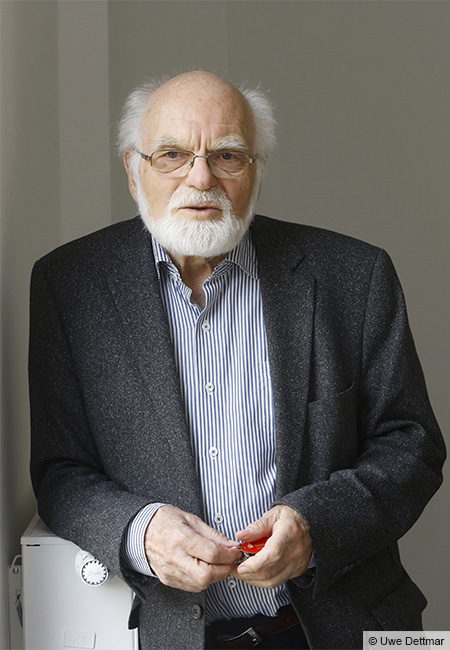
Bereiter-Hahn still recalls the moment in 2009 when Prof. Dr. Müller-Esterl, Goethe University’s President at the time, offered him the opportunity to succeed the by then ailing foundation founder and chair, Hartwig Kelm, and take over the position. “Prof. Schmidt-Böcking had already taken over as managing director from the former Head of Administration and Member of the Executive Board, Dr. Wolfgang Busch,” he recounts.
When asked what interested him about the role, he carefully, diplomatically, and calmly chooses his words – as he is wont to do: “Every leadership transition – while fully appreciating the contributions of the previous generation – creates an opportunity to realign or adapt to the changing conditions of an institution. I found that to be a very compelling challenge.” The chairmanship also complemented his earlier role as Vice President Research, Early-Career Researchers, and Infrastructure (2003–2006). “With responsibility for the International Office and, therefore, part of the university’s internationalization strategy, I was already well-acquainted with the foundation’s tasks.”
But Bereiter-Hahn’s interest in international exchange and the interpersonal significance of guest stays goes back even further. For his research, the cell biologist spent time in the U.S., Sweden, France, and Russia, among other places. He says his experiences in Hradec Králové, Czech Republic, left the most lasting impression: “I organized several international conferences with colleagues from the Faculty of Medicine at Charles University in Prague between 1968 and 1994. The hospitality of the Czech hosts and the opportunities for intensive – and uncensored – dialogue with colleagues from East Germany and Russia gave these meetings a unique character. They were often followed up with us scientists from the West providing essential chemicals to support the research of our peers in the Eastern countries, where such resources were scarcely available.”
In addition to international exchange, the design of the university’s ecosystem has also played a significant role in Bereiter-Hahn’s scientific career. As early as 1975, he undertook a redesign of foundational studies, collaborating with colleagues from botany and zoology to establish a structure that introduced new teaching methods aimed at fostering collaborative student work. Another key aspect of the study reform was equipping lecture halls with appropriate media facilities. As a member of the board of the Didactic Center, he was able to promote these efforts across other faculties as well. All related follow-up activities are today being advanced through studiumdigitale.
Equally valuable were his experiences as dean and professor of cell biology, during which he actively contributed to the development of Riedberg Campus, including the construction and operational planning of the Biozentrum and the Buchmann Institute for Molecular Life Sciences. “Expanding Riedberg Campus required not only the construction of institute buildings but also infrastructure development,” he notes, adding, “The lack of affordable housing for visiting researchers near the institutes really bothered me. Addressing this shortage has been a priority of mine since the beginning of my work with the foundation.”
The Project “International House Campus Riedberg”
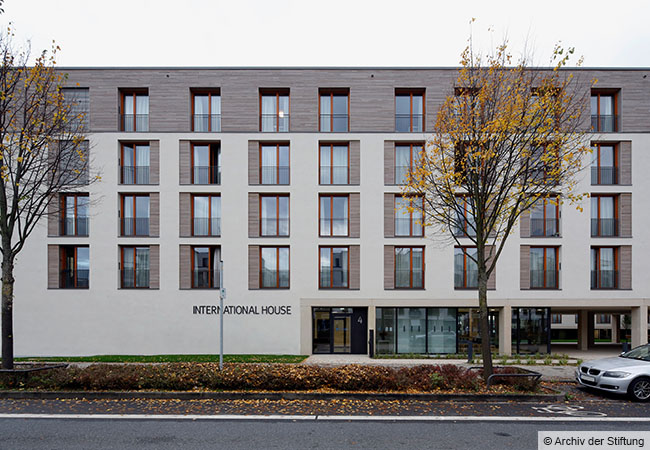
Several obstacles had to be overcome before the guesthouse at Riedberg became a reality. In addition to the necessary financial resources, a suitable plot of land was essential. “After lengthy negotiations with the Ministry of Science and Research in Wiesbaden representing the State of Hesse, which owns the plots at Campus Riedberg, as well as the Frankfurt Student Services, which planned to build a large dormitory at Riedberg, we agreed to jointly construct a building that would serve as both a student dormitory and the International House Campus Riedberg (IHCR). Systematic use of opportunities in the stock market increased the foundation’s capital, and a loan from the university along with subsidies from sponsors covered the remaining gap,” Bereiter-Hahn recalls.

Since September 2022, the IHCR has been offering high-quality accommodation for university guests. “All rooms are air-conditioned, equipped with a refrigerator, dishwasher, cooking facilities, and stocked with dishes and cutlery.” The facility includes 16 single rooms, 9 double rooms, and two three-bedroom apartments, complemented by a large communal rooftop garden.
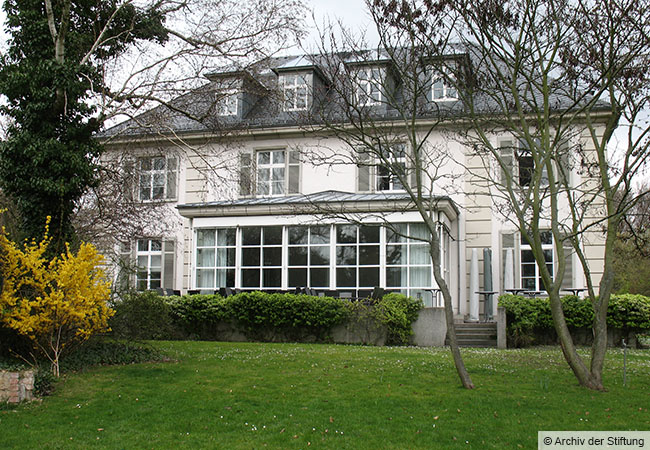
Bereiter-Hahn emphasizes that each of the three guesthouses has its own unique character. “The park surrounding the two architecturally impressive buildings at Ditmarstrasse 4 and Frauenlobstrasse 1 – both constructed in the 1930s – exudes an elegant atmosphere. The rooftop garden of the stylistically austere IHCR serves as a counterpart.”
Artwork plays a defining role in shaping the character of the spaces in all guesthouses. The initiative began with the common rooms in Ditmarstrasse. “Here, you’ll find an outstanding collection of works by Ekkehard Schlesinger, which gives the space a remarkably distinctive character.” Together with artist and art educator Prof. Otfried Schütz, who had been instrumental in the acquisition of Schlesinger’s watercolors, the foundation was able to furnish all rooms in both Westend guesthouses with pieces from the university’s Art Education Institute. “This was an important feature for both the two older guesthouses as well as the IHCR, where artworks by four artists and scholars connected to Frankfurt contribute to the individual design of the otherwise uniformly styled living spaces,” says Bereiter-Hahn.
It’s always about people
While the topic of housing is a matter particularly close to his heart, Bereiter-Hahn emphasizes that “limiting the foundation’s work to providing housing would be too narrow. International relations are always primarily about people – their opportunities for professional and personal growth, sometimes even support to safeguard the independence of researchers against autocratic arbitrariness, and about integrating them into the host institution, including all related societal dimensions.”
In this spirit, and in line with its three core tasks, scientific exchange remains the foundation’s main focus – whether it is by holding joint events on the research projects of visiting scholars or by fostering understanding of Goethe University and the city of Frankfurt. The foundation has also organized cultural offerings, although Bereiter-Hahn points out that these are less frequented due to the time constraints of individual research stays: “That is why the leisure opportunities have not been utilized to the extent I had originally hoped.” The most popular format, he says, is lectures given by visiting scholars: “They provide the best opportunities for intensive and multi-faceted dialogue.”
It’s hard to put into words or numbers just how much the emeritus professor has already done for his university, scientific exchange, and fostering international understanding. An equally impossible task would be to try and cleanly separate his research activities from his contributions to shaping Goethe University and its internationalization efforts. It’s worth noting here that the now 84-year-old – for whom stagnation simply does not constitute an option – played a key role in the first Excellence Initiative. Recently, the foundation introduced its new Goethe International Science Diplomacy Award. Bestowed annually and endowed with €2,000, starting in 2026, the award will recognize a Goethe University member for outstanding initiatives that advance the university’s global scientific networking. Special emphasis will be placed on initiatives with a “sociopolitical impact.”
The guiding principle that has always driven Jürgen Bereiter-Hahn is as clear, logical, and undeniable as the premise that science is inherently international. “For me, the vision of a university has always been interdisciplinary, free of vanity, devoted solely to knowledge, and marked by deep respect for the work of researchers.” Only in this way, he emphasizes, “can we, backed by a solid infrastructure, create an environment where work is enjoyable, successful, and meets the expectations of the society that supports us.”
…
It is September 2025, and Germany is undergoing significant change: The government led by Chancellor Friedrich Merz has announced an autumn of reforms. The Green Party is no longer part of the ruling coalition, and the AfD has emerged as the strongest opposition party. War – in Europe and the Middle East – dominates public discourse, and the impacts of climate change are increasingly felt across the globe. Since Donald Trump’s second term in office, pressure on free scientific exchange has mounted.
It is in these politically dynamic times that Goethe University’s Senate adopts a new Internationalization Strategy, reaffirming the fundamental principle that also guided the decision to establish the foundation 41 years ago: Science is international.
Foundation Website →
Research connects across borders: Commemorative Publication on the occasion of the foundation’s fortieth anniversary