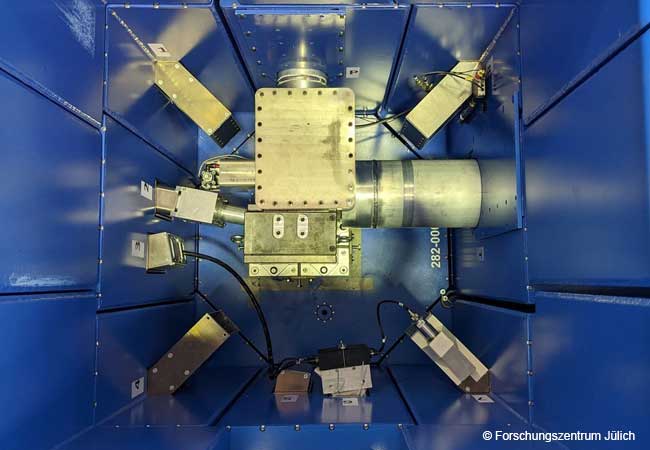
The German Science and Humanities Council has highlighted the scientific and strategic importance of the planned High Brilliance Neutron Source, in the development of which Goethe University is involved. In its statement released today, it expressly recommends that the first phase of the facility, known as HBS-I, be implemented at Forschungszentrum Jülich.
The recommendation marks another important milestone on the path to a new national neutron source, which Forschungszentrum Jülich is developing in collaboration with the Helmholtz-Zentrum Hereon and Goethe University Frankfurt. At the same time, it sends a strong signal regarding the future of neutron research in Germany and Europe, which faces significant challenges in light of declining capacities.
The HBS-I is based on an efficient, accelerator-based concept. Unlike conventional research reactors, it operates without nuclear fuel. The technology generates highly brilliant neutron beams with a small cross-section, enabling investigations of very small samples. This allows the structure, dynamics, and magnetism of materials to be analyzed at the atomic and molecular levels—ranging from basic research in physics, chemistry, and the life sciences to industrial applications.
Source and further information: Press release of Forschungszentrum Jülich