Impressions from 2025 Annual Conference of NAFSA: Association of International Educators
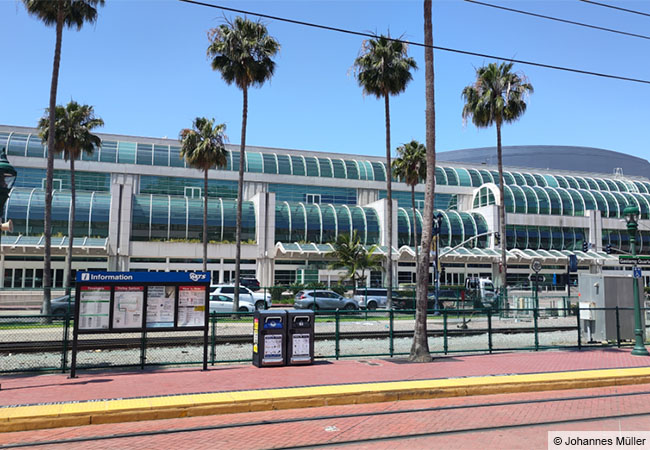
In late May, Dr. Johannes Müller, Head of the Global Office (GO), and Cathrin Rieger, Head of International Partnerships at the GO, traveled to San Diego to attend the NAFSA Annual Conference. News of new student visa restrictions imposed by the U.S. administration reached participants of the networking event for experts in international higher education cooperation and exchange on opening day. In conversation with UniReport, they share impressions from their trip and provide an assessment on how current developments impact academic cooperation and freedom.
What goals did you pursue at NAFSA?
Cathrin Rieger (C.R.): Maintaining and initiating partnerships and networking with our global peers – i.e. the people who organize, manage, and develop international student exchanges and university partnerships worldwide. NAFSA brings professionals from all over the world together – this year around 8,000 participants.
Dr. Johannes Müller (J.M.): I had the opportunity to participate in two panels. Together with colleagues from Tel Aviv University, I co-organized a session on “Internationalization in Times of Crisis”, and I also spoke at the “Symposium on Leadership: Today’s Refugees, Tomorrow’s Students and Changemakers” – a topic especially close to my heart and one that Goethe University has long been committed to.

The same day NAFSA 2025 opened its doors, the U.S. administration announced new student visa restrictions, including the suspension of new visa interviews. In addition, a full entry ban was imposed on citizens from 12countries, and a partial ban on citizens from seven more. How was this news received? [Editor’s note: This interview took place on June 11, 2025. The restrictions on student visas have since been eased and focus on applicants’ social media profiles.]
J.M.: The timing was definitely interesting, to say the least. To the conference’s participants, it felt a bit like a declaration of war.
C.R.: Of course, the restrictions dominated many conversations – depending on the session and conversation, they either cast a shadow or fueled spirited discussions. My general sense was that no one wanted to allow anything or anyone to “rain on the parade” of this important and carefully prepared event. We could sense this spirit of “Now more than ever!” time and again. In general, U.S colleagues are trying to make all kinds of different international student mobility formats possible – some because of and some in spite of the uncertainty –, but most in the hopes that the situation will improve. Whether and how this quintessentially American optimism, often paired with a “let’s get it done” attitude, will prevail is something the coming weeks and months will tell.
There are those who call for an active recruitment campaign aimed at U.S. researchers and potential future international exchange students. Was this also discussed at NAFSA?
C.R.: In my experience, there’s a general unspoken understanding in international higher education cooperation – especially among partners – not to take advantage of others or “poach” during difficult times. But of course, many researchers and students originally headed for the U.S. might now start looking elsewhere. While this certainly creates possibilities for European universities, it is important to approach this matter with the necessary sensitivity.
J.M.: Recruiting U.S. researchers on a large scale cannot be considered the responsibility of any one single university. In addition to lacking the necessary recruitment or welcome programs, we also face an uncertain financial future, as the ongoing negotiations around the Hessian Higher Education Pact show.
Despite the erratic nature of their announcements, recent developments will likely have long-term consequences for scientific collaboration and academic freedom.
J.M.: The visa rules do not affect direct academic exchange, which has not changed much under “Trump 2.0” – if you choose to ignore the fact that citizens of some countries can no longer enter the U.S. Since Germany isn’t on that list, there is no direct impact on our bilateral relations.
There is a new dimension as far as research content is concerned. I am referring here to the exclusion of certain topics from eligibility for state funding. Climate research, minority-related social sciences, and minority rights law are no longer supported by the Trump administration and will in future have to be carried out elsewhere.
The Trump administration’s policies also indirectly affect our ability to fund U.S. research. Whereas aspects of DEI – diversity, equity, inclusion – are now an exclusion criterion for U.S. funding, here in Germany, no grant can be submitted without addressing DEI. This applies to any and all research, including on forward-looking fields like Artificial Intelligence. We can’t, won’t and most importantly don’t want to change that because of the U.S. – but it means we can only bring American partners on board in a limited capacity.