Goethe University’s School Garden: An Established Learning Space for Future Teachers
The School Garden of the Biology Education Department was established in 2016 as part of the “Close to Science – School in the Science Garden” project, funded by airport company Fraport. What was once fallow land is now a permanent feature of Goethe University’s Riedberg Campus – popularly known as Frankfurt’s Science City – and serves as a hands-on learning site for botanical, zoological, and ecological topics. Covering 2,200 m², the School Garden offers numerous teaching opportunities: a wild bee trail with nesting aids, a sandarium, stone and deadwood piles, a pond, and a species-rich meadow provide diverse ecological learning stimuli. Fruit trees, a herb wheel, and a cultivated plant section deepen plant knowledge. Sustainability is a key concern of the Biology Education Department: rain barrels, compost heaps, and the concept of “climate gardening” are firmly integrated into teaching. Students gain valuable first-hand experience here, develop concepts for environmental education, and use the garden for research projects. Numerous theses on questions of biology education have already been written in the School Garden.
The Importance of Outdoor Learning
Even before the COVID-19 pandemic – which highlighted the importance of school gardens as “green classrooms” – the department had developed a summer semester school garden seminar, later supplemented by a winter edition.
In cooperation with Frankfurt’s Palmengarten and the Botanical Garden Westend, the seminar gives students the opportunity to work on topics beyond biology, such as their second teaching subject or remedial education. As a result, use of the School Garden has become increasingly inclusive and versatile.
Theory and Practice Closely Intertwined
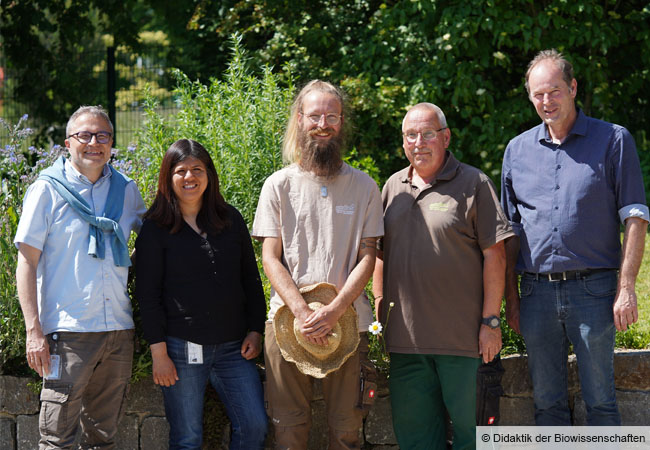
Work in the School Garden combines theoretical content with practical experience. In addition to developing an abstract understanding of ecological connections, students also learn how to communicate their insights using concrete examples. Gardening activities serve as a didactic tool to illustrate theoretical concepts. The design of the School Garden seminar is flexible and adapted to seasonal conditions. Planning begins three months before the new semester, together with head gardener Susanne Pietsch, with discussions centering on planning the plots and selecting crops. Afterwards, Wolfgang Girnus takes care of the seedlings and provides advice on choosing suitable substrates for experiments. The trainer of new gardeners occasionally also involves his apprentices in the process, enabling students to gain practical knowledge while the trainees practice communicating their expertise. This creates a win-win situation: students benefit from hands-on knowledge transfer, while apprentices improve their teaching skills. Girnus also offers an introduction to the safe use of gardening tools and instructions on building a compost heap – a complex task requiring experience, and one of the seminar’s most popular units.
Sustainable gardening knowledge also plays a key role. Daniel Grobbel-Rank, an experienced gardener, shows students how to protect soil biodiversity, create habitats for insects, and apply sustainable plant protection measures. Even in winter, there is much to do: compost is turned, winter onions are planted, and field crops are harvested. Proper fruit tree pruning and vegetative propagation by cuttings are additional practice-oriented contents, always linked with theoretical knowledge.
A Valuable Exchange Between Students and Gardeners
Students particularly value the close collaboration with the gardeners. Reflection sessions help them transfer their insights into classroom teaching. At the same time, gardeners and their apprentices benefit from incorporating their expertise into didactic contexts, thus strengthening their communication skills. The gardeners are not the only ones contributing to the training of student teachers. The other members of the Science Garden team also contribute their expertise, helping to enrich both the School Garden seminars and the development of academic theses. Didactic concepts, including guided tours for school classes in the university’s Science Garden – are evidence of just how fruitful and rich this combination of theoretical education and practical experience is.
In a nutshell
The School Garden provides an ideal link between theory and practice, creating a dynamic learning environment where ecological processes can be experienced first-hand. The close integration of biology education concepts with practical insights into sustainable gardening fosters both students’ subject knowledge as well as their ability to effectively communicate complex ecological relationships – making the School Garden a valuable bridge between university teaching and environmental education in schools.
Marilú Huertas de Schneider