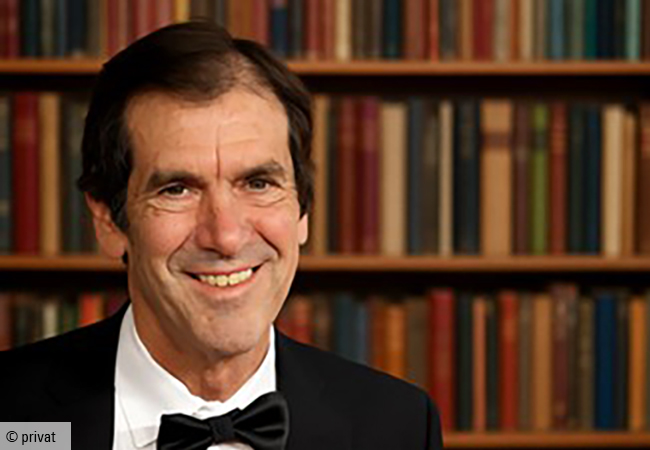
Prof. Dr. Raymond Deshaies from the California Institute of Technology (U.S.A.) will assume the Friedrich Merz Visiting Fellowship in 2025.
Raymond Deshaies is a biochemist and cell biologist known for his work on the mechanism and regulation of protein degradation via the ubiquitin-proteasome system. After having discovered SCFCdc4, the first member of the large family of Cullin-RING ubiquitin ligases (CRLs), his laboratory has since made a number of groundbreaking contributions to understanding how CRL enzymes function and how their activity is controlled. His fundamental research on the regulation of cellular protein degradation led to the development of new drugs such as the cancer medication Carfilzomib. It also laid the foundation for a new class of chimeric compounds known as PROTACs, which promote the targeted degradation of disease-causing proteins by recruiting them to the ubiquitin system.
Born and raised in Waterbury, Connecticut, Raymond Deshaies earned his B.S. in Biochemistry from Cornell University in 1983 and received his Ph.D. in Biochemistry from the University of California, Berkeley, in 1988. After his postdoctoral work at the University of California, San Francisco, he joined the faculty at Caltech in 1994 and was appointed to the Howard Hughes Medical Institute in 2000. In addition to his academic career, Dr. Deshaies founded the biotechnology companies Proteolix in 2003 and Cleave Biosciences in 2011.
Deshaies’ research focuses on protein homeostasis in eukaryotic cells, particularly on the role of protein degradation via the ubiquitin–proteasome system (UPS). This protein degradation via the UPS has two primary functions: it regulates signaling pathways such as the cell cycle and is essential for maintaining the quality of the cellular proteome. Cells express about 600 ubiquitin ligase enzymes (E3s) that catalyze the conjugation of ubiquitin to substrate proteins. Cullin-RING ubiquitin ligases (CRLs) form a family of roughly 250 multi-subunit E3 enzymes involved in many regulatory pathways. The Deshaies group has investigated how CRL enzymes assemble, how their activity is regulated by reversible modification with the ubiquitin-like protein Nedd8, how they catalyze reactions, and what substrates and cellular functions they have. Another research focus is understanding the mechanisms of protein quality control, and how its dysfunction or therapeutic manipulation is linked to human disease. This interest has led to studies on the mechanism, regulation, substrates, and inhibitors of the segregase p97/VCP, which plays a key role in multiple cellular quality control pathways.
Prof. Deshaies’ work is highly relevant for the development of innovative pharmaceuticals. Together with Craig Crews of Yale University, he developed the concept of using heterobifunctional molecules, so-called PROTACs, to tether cellular proteins to a ubiquitin ligase, leading to ubiquitination and targeted degradation of the bound protein. This concept became the foundation for several biotechnology companies, including Arvinas, C4 Therapeutics, and Kymera.
About the Friedrich Merz Visiting Fellowship
The Friedrich Merz Visiting Fellowship was established in December 1985 to mark on the occasion of the 100th birthday of company founder Friedrich Merz by his grandson and then CEO, Dr. Jochen Hückmann. Friedrich Merz, one of the early members of the Senckenberg Society, was closely associated with the University of Frankfurt and actively supported scientific research. The purpose of the endowed visiting professorship is to appoint a particularly distinguished scientist from the fields of pharmacy or human medicine to Goethe University Frankfurt. First awarded in 1987, the visiting fellowship has been granted annually – with only two exceptions. The fellowship and the accompanying symposium, which spans topics from basic research to healthcare research, provide an annual platform for academic and industry researchers to exchange knowledge and foster further collaboration.
This year’s curator and host on behalf of Goethe University is Prof. Dr. Stefan Knapp, Professor of Pharmaceutical Chemistry at Goethe University. Knapp is an internationally recognized pharmaceutical researcher whose laboratory investigates the structural mechanisms regulating cellular signal transduction and develops selective inhibitors known as chemical probes through rational drug design.
Events
In addition to scientific collaboration, the following events will take place in connection with the visiting professorship:
November 4, 7:00–9:00 PM: Public panel discussion with Prof. Raymond Deshaies and researchers from Goethe University. “Cancer, Alzheimer & Co.: A revolution in treatment within reach?” Riedberg Campus, Otto-Stern-Zentrum, Lecture Hall H1, Ruth-Moufang-Straße 2. The event will be held in German and simultaneously translated.
November 5: Lectures for Students
November 6: Scientific symposium “Hijacking the cellular protein degradation system – translating bifunctional molecules into novel therapy”
Registration and further information →