For 20 years, “Herders Bibliothek der Philosophie des Mittelalters” [Herder’s Library of Medieval Philosophy] has been developed at Goethe University. It is edited by Alexander Fidora, Matthias Lutz-Bachmann, Isabelle Mandrella, and Andreas Niederberger. Its volumes 64 through 66 have now been published. These include works by Siger of Brabant (1240–1284), John Duns Scotus (1265/66–1308), and Isaac ben Solomon Israeli (ca. 850–932/50?) that have not previously been available in German. The Middle Ages, as a concept of space and time centered around the Mediterranean and spanning from the collapse of the Roman Empire in the 5th century to the so-called Early Modern Period in the early 17th century, remains a topic of debate in modern scholarship. Herder’s Library adopts a significantly broadened understanding of the Middle Ages, setting new standards in the field.
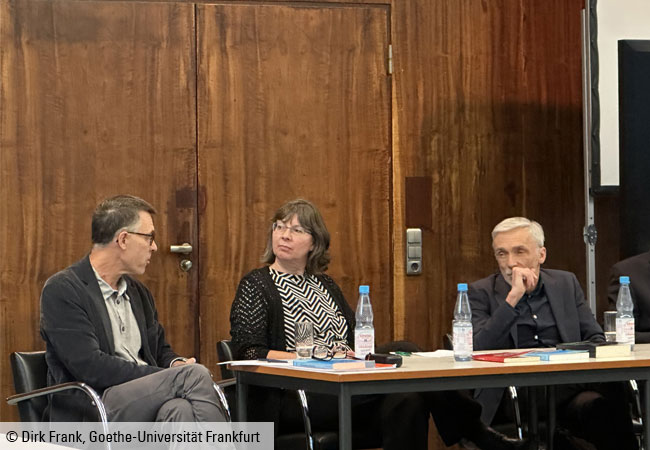
The new volumes were introduced during a workshop discussion followed by a panel, which specifically focused on critically examining the concept of the Middle Ages. The discussion, moderated by Prof. Isabelle Mandrella (LMU Munich), featured Prof. Theo Kobusch, Prof. Hannes Möhle (both from the University of Bonn), and Prof. Andreas Speer (University of Cologne), who shared insights into their approaches to the history of philosophy and their publications. The opening question was: “What inspired you to present medieval philosophy in this way in your publication?” Hannes Möhle downplayed the idea of presenting a comprehensive history of medieval philosophy in his book but acknowledged the importance of clarifying the criteria for selecting topics and defining the subject matter. Regarding the study of medieval philosophy, he emphasized the need to demonstrate how strictly rational forms of argumentation were developed in a deeply religious era. Andreas Speer agreed that the concept of the Middle Ages and its philosophy is problematic. He noted that it took a long time for the history of philosophy to fully embrace Jewish and Arabic philosophers, adding that the dominance of Latin often obscured the view of intercultural connections. According to Speer, the Middle Ages were more philosophically diverse than any other era. Theo Kobusch highlighted that the institutional separation of philosophy and theology only occurred in the 13th century; before that, the two disciplines need to be considered as one. Progress in philosophy, Kobusch argued, primarily occurs in the realm of methodology rather than in its subjects.
Moderator Isabelle Mandrella observed that contemporary debates often raise the question of what should be included in the canon. She also emphasized the need to address the role of women in medieval philosophy. Theo Kobusch highlighted the significance of female mystics, who played an important role. Andreas Speer, on the other hand, pointed out that while medieval culture was clearly shaped by men, this makes it all the more important to give special attention to female philosophers.
The “Library of Medieval Philosophy” project, based at Goethe University’s Faculty of Philosophy, emerged from the former Collaborative Research Center 435 (“Knowledge Culture and Social Change,” spokesperson: Johannes Fried, co-spokespersons: Moritz Epple and Matthias Lutz-Bachmann).