Findings support injury prevention and highlight the physical demands of the profession
Professional dance is a high-performance discipline that carries significant risks of injury and physical wear. Researchers at Goethe University Frankfurt have now provided the first precise measurements of strain on the musculoskeletal system. The study involved 28 professional dancers wearing sensor-equipped suits during ballet training. The data revealed high levels of strain across all phases of training. The findings support the development of injury prevention measures and highlight the high physical demands of the profession.
Ballet is an art of illusion: dancers seem to float across the stage and, in their leaps, appear to defy gravity for a moment. The effort behind this lightness and grace usually remains invisible to audiences. “Professional dance is a high-performance sport,” says Professor Eileen Wanke of the Institute of Occupational, Social and Environmental Medicine at Goethe University Frankfurt. “It requires exceptional physical control and athleticism, developed through many years of intensive training.”
Wanke brings personal experience to this research, having previously performed as a professional dancer. Today, she examines her former field from a medical perspective. The physical demands of training, rehearsals, and performances take a clear toll: around half of all dancers experience at least one occupational accident each year. Common injuries include strains and sprains affecting the legs, ankles, and feet, as well as lower back problems. Many continue working despite pain, driven by their commitment to the profession. By their late twenties, 25 percent have already developed osteoarthritis – a high number compared to well below 5 percent in the general population.
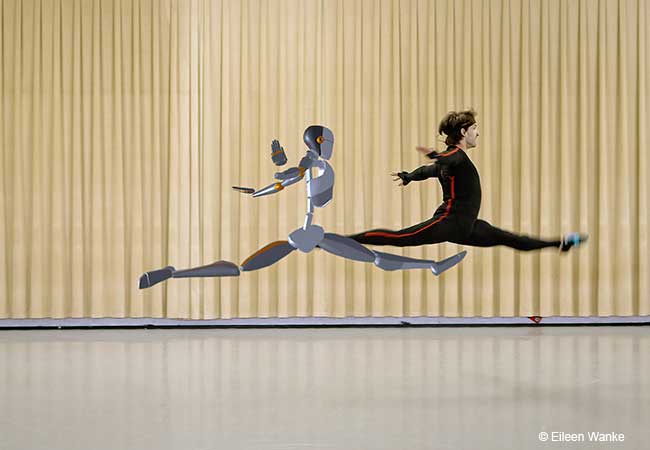
Sensor-equipped suits
Objective measurements of the physical demands of professional dance have so far been scarce. The new study addresses this gap and was conducted in collaboration with the German Dance Film Institute Bremen and the accident insurance institutions of North Rhine-Westphalia, Hesse, and Lower Saxony. For data collection, Wanke and her team – together with Austrian physicist and biomechanist Dr. Christian Maurer-Grubinger – used an innovative method: 16 female and 12 male dancers from Oldenburg State Theater and Theater Kiel wore sensor-equipped suits during training. These recorded acceleration and body positioning for the head, torso, arms, wrists, legs, and feet at a rate of 240 measurements per second. The data were transmitted wirelessly to a computer for analysis.
“We used a system widely applied in occupational medicine to assess physical strain,” Wanke explains. “Typically, trained observers evaluate characteristic movements in specific professions, for example through video analysis. In our approach, data are instead captured by a program developed specifically for this project.” Each movement or posture is assigned a score: the greater the strain on joints, muscles, ligaments, and tendons, the higher the “Rapid Entire Body Assessment” – or REBA – score.
Risk of injury during training
“Our participants spent more than 60 percent of their training time in a moderate-risk, and a further 30 percent in a high-risk range,” Wanke says. Even during training, the level of risk is therefore considerable – although training is intended not only to maintain technique but also to prevent injuries. Female dancers spent more time in higher-risk ranges than their male counterparts and were thus exposed, on average, to greater ergonomic stress. This may partly be explained by differences in body structure, meaning that certain movements or postures place greater strain on them.
Classical dance training has changed little over the past 300 years. It follows a three-phase structure: Phase 1 consists of exercises at the barre, while Phases 2 and 3 take place in open space – beginning with slow movement sequences, followed by pirouettes, and culminating in large jumps. As the training progresses, the exercises become increasingly dynamic, placing greater demands on the cardiovascular system as well as on concentration, coordination, and physical control. “Studies show that concentration tends to decline in Phase 3, leading to more frequent errors and inaccuracies,” explains Wanke.
Optimization opportunities
Overall, the data suggest that particularly demanding dynamic exercises should be scheduled earlier in training sessions, as is common in other sports. Training could also be adapted in a more gender-specific way to reflect differing physical demands. Organizational changes at performance venues may further help reduce the risk of injury and wear-related conditions. During jumps, bones, muscles, and joints are subjected to high forces – especially upon landing. Specialized dance floors can significantly reduce this strain. While many institutions have such flooring in training spaces, rehearsal and performance stages often still lack it.
Existing flooring may be further optimized. However, which structural measures are most effective in reducing forces in dance has not yet been systematically studied. “This would be an important focus for future research,” Wanke concludes.
Publication: Verena Fehringer, Christian Maurer-Grubinger, Fabian Holzgreve, Daniela Ohlendorf, Eileen M. Wanke: Ergonomic Risk Assessment of Professional Dance Using Motion Capture with Ergonomic Evaluation by the Rapid Entire Body Assessment (REBA). Sensors (2026) https://doi.org/10.3390/s26010070
The German Dance Film Institute Bremen has produced two films about the project:
Short version: https://www.youtube.com/watch?v=31u-bdz1yR0 (in German)
Long version: https://www.youtube.com/watch?v=Iu2gcviNzcs (in German)
Further Information
Professor Dr. Dr. Eileen Wanke
Institute of Occupational, Social and Environmental Medicine
Goethe University Frankfurt
Wanke@med.uni-frankfurt.de