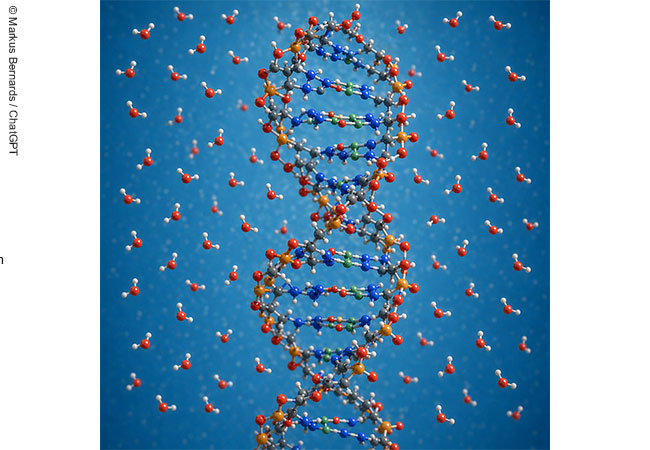
In the hope that they might be used in the future to cure illnesses, stem cells are still being preserved – despite low utilization rates.
The idea behind stem cell banks is to freeze and preserve biological material so that it can be used in the future. Many people still place their hopes in the potential of this technology, although the preserved material is rarely used, at least in Germany. Ruzana Liburkina is examining the reasons for this from a social science perspective as part of the “Cryosocieties” project funded by the European Research Council (ERC).
When a child is born, hope blossoms, especially for the parents. But there are many decisions to make before the birth, which might sometimes be motivated by anxiety rather than hope. Should I have a private stem cell bank freeze my child’s umbilical cord blood in case it needs medical treatment in the future? Or should we donate the blood to a public stem cell bank instead so that doctors around the world can use it? At a private stem cell bank in Leipzig, for example, freezing biological material for personal use costs €3,090 for 18 years and €5,190 for 50 years. Donating cord blood to a public cell bank, on the other hand, is free of charge.

Stem cells from umbilical cord blood are a kind of genetic “champion”. When the umbilical cord is cut after a child is born, some of the placental blood remains in the cord. Scientists have known for over 30 years that this blood is rich in hematopoietic stem cells that are able to restore the hematopoietic system. Blood stem cells are the greatest source of hope for people suffering from leukemia or other blood diseases, and stem cells from cord blood can be used much more flexibly than adult stem cells from bone marrow.
What, then, could be a better solution than collecting, storing and utilizing these cells to cure serious illnesses? As soon as the potential of hematopoietic stem cells had been recognized or at least suspected, the first stem cell banks began to emerge: they use cryotechnology, the procedure for freezing biological material to preserve valuable cells for future use. Stem cells are particularly suitable for treating close relatives, as this is where compatibility is the greatest. As a consequence, services were quickly established that offer expectant parents the opportunity to preserve cord blood from their newborn child so that it is ready to hand, for example if a sibling develops leukemia. Due to the small number of stem cells contained in cord blood units, the stored material is usually not sufficient to treat adults.
And yet, surprisingly, these precious cells are rarely used. The initial enthusiasm surrounding stem cell preservation has given way to great disillusionment and a sense of futility. Dr. Ruzana Liburkina, an anthropologist and researcher in the project “Cryosocieties: Suspended Life – Exploring Cryopreservation Practices in Contemporary Societies,” funded by the European Research Council (ERC) and led by Professor Thomas Lemke, is looking at the causes and the context in her subproject. She describes this situation as the liminal state of “non-failure” – a particular indefinite state between success and failure conditioned by the suspension of failure enabled by cryopreservation.
Many of the promises made by private cell banks, such as treating diabetes, autism or neurological diseases like Parkinson’s or Alzheimer’s, or even growing replacement organs from stem cells, are still a distant dream. However, when people are urged in promotional material to “take personal responsibility for the health of the family”, they are unlikely to thoroughly investigate the probability of future need. A certain discrepancy arises between the technical and financial expense and parents’ hopes on the one hand and medical relevance on the other.
The situation is much the same for public stem cell banks – albeit for different reasons. While in most countries only private providers exist, Germany is home to one of the largest stem cell donor registries in the world, with an extensive network and considerable expertise in regulatory, logistical and technological requirements. Germany’s stem cell banks enjoy a positive international reputation and established relationships with hospitals and universities. Despite these good conditions, those responsible for public umbilical cord blood banks are equally disillusioned, as German hospitals rarely request this biomaterial. Research on the use of donated umbilical cord-blood-derived stem cells is also rather scarce. “Germany is a wasteland when it comes to the treatments for which stem cell banks were set up in the first place,” says Liburkina. As the last doctor who actively transfused (transplanted) cord blood stopped practicing in 2007, this method is mainly used as a last resort in generally hopeless cases, she says. Demand from other countries is higher.

While such lukewarm demand would long have led to the discontinuation of other technologies, cell banks are obliged to serve the purpose for which they were created. Cord blood is currently cooled in nitrogen to -170 °C or lower in public cell banks for up to 23.5 years and in private ones for up to the entire lifespan of the newborn child. Destroying valuable human cells that have been preserved at significant expense and could be used in treatment is unacceptable, which places cell banks under pressure. To avert failure, they are launching new services based on existing technologies and expert knowledge and formulating new narratives.
Ruzana Liburkina’s research took a closer look at this liminal state of “non-failure”. What are the consequences of cryotechnology raising high expectations for the future that are then not fulfilled? Liburkina focused not only on expectant and new parents but above all also on the staff at companies offering cryogenic freezing and the management who determine the company or institution’s fate. Since stem cell banks were introduced, the market for cord blood preservation has significantly decreased. Only a few of the many small providers at the outset have survived: larger corporations have acquired the inventories and continue to store the frozen cells. But there is much more to operating a cell bank than storage: constant quality control and quality assurance necessitate extensive human and infrastructural resources.
Liburkina spent 14 weeks as a participant observer in two stem cell banks – one private and one public. Like an intern, she helped where she could – and learned a lot that would certainly not have been discussed in an official interview. She had to deal with very different categories of employees. “The job profiles in such stem cell banks are very varied. There are MTAs and CTAs, biologists, doctors, lawyers, technicians, businesspeople and marketing experts,” Liburkina explains. At the end of each day, she noted down her observations from her conversations, these extensive records ultimately feed into scholarly reports. Liburkina also attended conferences and trade fairs on stem cell research and kept abreast of the topic via newsletters from associations.
“Cryovalue” encompasses far more than the potential therapeutic benefit
Social science research has reached a consensus: the value that is crucial for the stem cell industry and its survival is not defined by the frozen cells alone. Liburkina calls this “cryovalue” – a term that also encompasses the potential and options generated by the necessary technologies and the handling of the cell material. As the huge potential offered by stem cells obtained from umbilical cord blood has not yet been tapped, applications fall far short of the promises made by private providers, while the lack of infrastructure in Germany prevents donated cord blood from being used to any significant extent.
Failure was already on the cards as early as in the 2010s, which has also affected staff in the cell banks. “I certainly observed an ongoing vulnerability in my conversations with them,” says Liburkina. Managers were more concerned, she says, with finding new sources of revenue using existing equipment, procedures and staff. New routines were constantly being adopted.
The situation of private cell banks differs slightly from that of public ones: parents have not only paid for the preservation of stem cells but for peripheral services such as quality management and documentation, which means the show must somehow go on. To keep the system going, the banks are obliged to constantly recruit parents wanting to preserve umbilical cord blood. This form of cross-financing is reminiscent of the German pension system and designed as a long-term strategy. Private banks are also looking at the possibility of using existing expertise and infrastructure for other types of cryo-products. So far, however, this has mostly been exploratory.
Public cell banks are equally under economic pressure, as preserved cells are used rarely or not at all. “As one of the managers told me, his public cell bank was facing closure when he and another board member decided to use the infrastructure they had set up to store another type of biomedical cryofact. Unlike umbilical cord blood, they reasoned, these other cryofacts would be in high demand from transplant centers and bring the entire endeavor back into the black,” as Liburkina reported in an article. Representatives of the cell bank subsequently convinced the board of their umbrella organization that their cryo-infrastructure was important for public health and as a source of income if it could be used for purposes beyond stem cell preservation. In fact, this cell bank has managed to generate a considerable flow of funds from a rather hopeless situation.
What both private and public cell banks have in common is that they cannot simply sit back and wait. They need to stay in the news, conduct research and inspire hope – a somewhat arduous task. For Liburkina, her observations are typical of our times: “In today’s market economy, promises are no longer the primary mode of relating to the future. High expectations have given way to the need to continue against all odds.”
In another part of the study, Liburkina wants to shed light on the situations parents find themselves in. “Social-science literature often features very conscientious people who have reflected on their individualized responsibility as it is facilitated through the neoliberal appeals of regenerative medicine,” says Liburkina. Meanwhile, she has the impression that many of the parents who have chosen to freeze their baby’s umbilical cord blood have not given it much thought at all. “Cell banks thrive off spontaneous decision-making and a lack of time for reflection,” she suspects. Frequently, the vague feeling that disease could occur just when parents have decided against stem cell preservation also plays a role, whereby only people with a certain income can afford cryogenic preservation anyway. So far, finding interviewees has proved difficult: the cell banks are not allowed to disclose data, and new parents tend to be busy with other things. That is why Liburkina used an online survey to analyze expectant parents’ decision-making processes.
Life on hold /In the project “Cryosocieties: Suspended Life – Exploring Cryopreservation Practices in Contemporary Societies”, for which the EU has awarded an ERC Advanced Grant, Professor Thomas Lemke, the Principal Investigator and a sociologist at Goethe University Frankfurt, and his team are examining how cryopreservation influences our understanding of life. Cryobiology has experienced an enormous boom in recent decades. It is now possible to freeze, store and thaw more and more types of tissue and cellular material without an apparent loss of vitality. These cryopreservation practices enable new medical applications and life science innovations – they also create a specific form of “suspended life”. The project is divided into three parts, one of which is concerned with preserving stem cells from umbilical cord blood. The other two subprojects deal with oocyte cryopreservation for assisted reproduction and cryobanks for the preservation of endangered or already extinct animal species.

About / Ruzana Liburkina studied Social & Cultural Anthropology and European Ethnology in Berlin and earned her doctoral degree in European Ethnology/Cultural Anthropology at Humboldt-Universität zu Berlin. She conducts ethnographic research at the interface between science and technology studies and economic anthropology. In 2019, she joined the ERC project “Cryosocieties” at the Institute of Sociology, Goethe University Frankfurt, as a research associate. Since October 2024, she is Assistant Professor of Cultural Anthropology at the University of Hamburg.
liburkina@soz.uni-frankfurt.de

The author / Anke Sauter, born in 1968, is a science communication officer and editor of Forschung Frankfurt.
sauter@pvw.uni-frankfurt.de