From virtual patients to simulated embryos and intelligent chicks: the applications of digital twins are expanding rapidly. These possibilities were at the center of the 7th International Giersch Conference 2026, which also served as the kickoff event for the new Cluster of Excellence SCALE. Its central theme: “Towards Digital Twins for Structural Cell Biology – Criteria, Chances, and Challenges.”

Photo: Anja Störiko
The research alliance SCALE (SubCellular Architecture of LifE) has been part of the Excellence Strategy of the German federal and state governments since this year. Scientists from Goethe University Frankfurt, the Max Planck Institutes for Biophysics and Brain Research, Saarland University, Johannes Gutenberg University Mainz, and FIAS aim to uncover the principles of self-organization within cells and to understand how cellular architecture develops and then enables the many diverse functions of a cell. To gain deeper insights into these processes, the researchers will combine experimental data with theoretical approaches to create digital twins of cell segments. These computer-based models are designed to observe, analyze, and predict dynamic processes within cells. In the long term, they could help researchers influence – or even redesign – cell functions in targeted ways. High-performance computer simulations at FIAS are at the heart of this digital twin project.
The four-day conference, supported by the German Research Foundation (DFG) and the Frankfurt-based Giersch Foundation, marked the official launch of the Cluster of Excellence. It brought together international experts in computational science, structural biology, and systems biology to discuss the challenges and opportunities of digital twins in cell biology. The program focused on new scientific approaches, interdisciplinary collaboration, the integration of artificial intelligence and diverse data types, as well as concepts for open science and the open exchange of research data – key goals of the SCALE consortium. Some 130 participants attended the presentations and discussions, including candidates for newly created group leader positions.
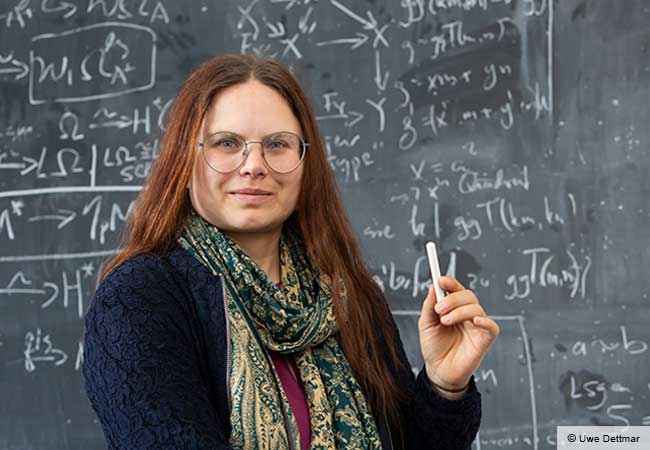
SCALE spokesperson Michaela Müller-McNicoll opened the conference together with FIAS Fellow Sebastian Thallmair. In his welcome address, Goethe University’s Vice President Bernhard Brüne described SCALE as a “flagship initiative in a unique environment with outstanding partners.” FIAS Director Jan Wörner highlighted the institute’s new motto, “biologically inspired computation,” which aligns closely with SCALE’s objectives.
Dagmar Iber from ETH Zurich opened the lecture series with a fascinating look at digital twins of the female hormonal cycle, lung development, and bladder cancer formation. Max Bonomi from the Institut Pasteur presented his vision of integrative structural biology in the age of artificial intelligence, showing how different scales and data types can be brought together.
The following days explored the potential of digital twins across multiple levels of life: from individual molecules to cellular machines, membranes, and cell-to-cell communication in organs and neural systems, all the way to the development and health of entire organisms. Andrej Sali (University of California), Martin Beck (Max Planck Institute for Biophysics and SCALE spokesperson), and Jan Kosinski (EMBL) demonstrated how combining mathematical and structural biology models can simulate complex transport pathways through nuclear pores. Sacha van Albada (Forschungszentrum Jülich) and Stephan Preibisch (HHMI Janelia) presented different approaches to developing digital twins of the brain. Loic Royer (Biohub) described how artificial intelligence and large language models such as ChatGPT are transforming image data analysis and enabling the creation of digital embryos. Marcel Schulz (German Centre for Cardiovascular Research/Goethe University) and Annalisa Marsico (Helmholtz Munich) presented their work on modeling and simulating gene expression networks. Samantha Wood (Indiana University Bloomington) uses digital twins to study how intelligence emerges and how chicks develop perception and social behavior in artificial environments. Liesbet Geris (University of Liège) highlighted the potential of human digital twins in healthcare, presenting successful applications in intensive care, pacemaker monitoring, and medication management.
In a lively panel discussion moderated by Michaela Müller-McNicoll, Loic Royer, Liesbet Geris, Sacha van Albada, Sebastian Thallmair, and Stephan Preibisch explored where a simulation ends and a digital twin begins. Together with the audience, they discussed both the challenges that still need to be overcome and the opportunities that lie ahead. In addition to the invited talks, participants also presented their own research in short talks and poster sessions, further enriching the exchange on the criteria, opportunities, and challenges of structural cell biology.
Anja Störiko/FIAS, Michaela Müller-McNicoll/SCALE