Even at nearly 79 years old, retired biologist Rüdiger Wittig is still actively conducting research. He has a particular fascination with the moors of his home region, Westphalia.
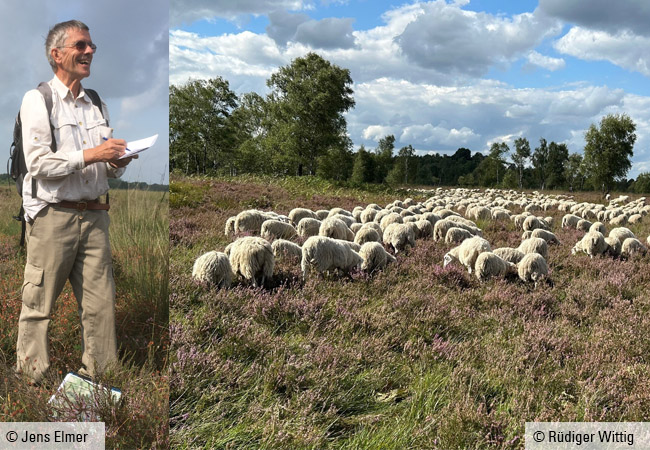
Rechts: Flock of sheep in Amtsvenn. © Rüdiger Wittig
The Amtsvenn is a moor area in the northwestern Münsterland. For a long time, the local farming community heavily extracted peat there, which did not exactly benefit the stability of this unique landscape. It wasn’t until the early 1980s that the area, which is now only a remnant of a once much larger raised bog region, was placed under nature conservation. How has it developed since? Has the moor been able to regenerate?
Biologist Rüdiger Wittig, professor of geobotany and ecology at Goethe University Frankfurt, emeritus since 2013, is particularly well-suited to answer these questions. His habilitation thesis on the topic of moors and oligotrophic (nutrient-poor) waters includes numerous care recommendations and served as a foundation for the management of these areas.
Wittig is in what he calls “active retirement,” engaging in numerous research projects since his retirement. “I always wished that after my career, I could return to topics that are especially close to my heart. As a biologist at a university, you mainly focus on research topics that gain international attention these days. The moors of Westphalia don’t necessarily fall into that category. From a university perspective, my work on the effects of acid rain and heavy metal deposits, on Urban Ecosystem Sciences, and the studies conducted as part of an interdisciplinary special research project on the significance of vegetation in the West African savanna for local populations were naturally more interesting. Since my profession is also my hobby, I’ve been able to dedicate myself to topics that are, in a way, right on my doorstep since my retirement.” In the case of the Wolbeck Deer Park, this is quite literal: it’s just a stone’s throw from Wittig’s home. In a recently published study, the biologist was able to demonstrate, among other findings, that this former aristocratic hunting ground has been forested for over 800 years, making it the oldest woodland in the Westphalian Basin.
Natural and Human Influences
Moor landscapes, deeply rooted in cultural memory due to their often barely visible water surfaces and wetlands – just think of the many adventure films and crime stories set in moors – have long fascinated biologists. “If you know your way around a raised bog, you won’t risk sinking. You just need to recognize the well-vegetated areas that provide some stability.” Wittig has just returned from a multi-day exploration of the Amtsvenn, a site that was placed under protection after the completion of his habilitation thesis and was still being partially harvested for peat until the late 1980s. He was accompanied by an expert in mosses, Dr. Carsten Schmidt, as the various species of sphagnum moss, which are not easy to distinguish, form the most important component of bog vegetation and serve as key indicators of the condition of moors in terms of regeneration, degeneration, and eutrophication.
So, what is Wittig’s assessment? “First of all, it’s important to note that the regeneration of drained, partially harvested raised bogs depends on numerous factors, with sufficient moisture being absolutely essential. This means a wet climate and nutrient-poor groundwater at a high level are top priorities. If peat was extracted on a small scale by local farmers, a narrow, band-like mosaic of small peat pits and ridges was created as a result: the narrow excavated pits quickly filled with water and were shielded from the wind by the adjacent ridges used for transporting the peat, preventing wave action in the water.” This environment allows floating sphagnum mosses to settle, form a stable layer over the water, and create the foundation for cotton grass to grow. The roots of cotton grass stabilize the moss layer, enabling the establishment of the characteristic sphagnum moss species of raised bogs, followed by bell heather and rosemary heath. In contrast, industrially harvested moors, which are cleared on a large scale, develop correspondingly large, wind-exposed bog waters without a moss layer. These waters also attract waterfowl, particularly geese, whose droppings contribute to the eutrophication of the water. “As picturesque as flocks of geese over a bog may seem from a tourist perspective, it’s far from beneficial for the moor’s preservation,” Wittig emphasizes.
The moors of Northern and Central Europe are sensitive ecosystems that require significant effort to preserve. In the Amtsvenn, a specially acquired flock of sheep plays a crucial role in preventing trees from taking root. “Trees consume a lot of water, and the moors in northwestern Germany can’t handle that,” Wittig explains. However, the most critical factor for bog regeneration is also tied to climate change, he stresses. The past few years have seen too little rainfall. “A typical feature of raised bog regeneration is the alternation between wet and intermittently dry areas. During my last visit to the Amtsvenn, I could hardly find any wet areas. In the past, I had to wade through the bog in knee-high boots, but now regular boots are sufficient. This clearly shows that, from a climatic perspective, the development of a raised bog in the Amtsvenn is rather unlikely,” Wittig says, somewhat disappointed.
Other human factors have also impacted the water balance in the Amtsvenn. Necessary measures to curb the drainage of the bog area were evidently not implemented adequately. Wittig also touches on agriculture, noting that heavy fertilization in some areas contributes to the eutrophication of soils and waters. While he understands that farmers sometimes act in environmentally unfriendly ways due to strict market pressures, he stresses, “Nitrogen inputs are too high, and I hope that my research can make a small contribution to preserving or regenerating such a highly sensitive landscape form as the raised bog.”
The European Bison – Not Integratable After All?
The challenges of reconciling ecology and economics, nature conservation and agriculture were also evident in another project that gained significant popularity in Hesse, as Wittig experienced firsthand. In April 2013, a group of European bison was released into the wild in the Wittgenstein forests. Shortly before his retirement, Wittig was tasked with investigating whether these European bison posed a potential threat to meadows and forests. “We conducted our study on an eight-hectare forest area designated for this purpose. Based on our findings at the time, there was no threat to the flora.” Unfortunately, things turned out differently: From the very first day, the released herd began stripping bark from trees. “It’s possible that a new lead cow was responsible for introducing this behavior to the herd,” Wittig speculates. Additionally, the bison frequently left the designated forest area, which had been made available by the late Prince Richard of Sayn-Wittgenstein, and ventured into neighboring forests, prompting protests from private forest owners. Currently, the herd is back in an enclosed wildlife enclosure, and the future of the rewilding project remains uncertain.
Research on Ski Slopes and in Forests
What does the biologist wish for in his research? Are there specific challenges one faces as an emeritus professor, especially outside university structures? “Some retirees spend their time on hobbies, go golfing, or own a sailboat. I just head out into the field,” he says with a laugh. Occasionally, he also receives a bit of financial support, for example, from the Academy for Ecological Regional Research in Westphalia, which covers some of his travel and accommodation costs. “My greatest wish is to stay healthy for as long as possible and to continue carrying out research. Walking through the moors was quite strenuous at times, as I realized – you occasionally fall into a waterhole. Getting myself out of it takes much longer now than it used to.”
One project Wittig is eager to carry out together with his wife, who is also a biologist, is a bit less physically demanding: they want to map the populations of clubmoss species in the Rothaar Mountains. A few years ago, the two of them published an article on the topic, and now they’d like to update their findings. “Interestingly, the transformation of ski tourism has also contributed to changes in clubmoss populations,” Wittig explains. Initially, it had a positive effect, leading to an increase in rare species or even the reappearance of previously extinct species from the group of flat clubmosses. However, since the introduction of artificial snowmaking, the impact has been negative, resulting in a gradual decline and now the complete disappearance of this group of species in the Rothaar Mountains. Since all native clubmoss species require a cool climate, it’s important to determine how the populations of the remaining species (spike, creeping, and fir clubmoss) that grow in the forests have developed.