The Working Group on Semitic Languages at Goethe University Frankfurt demonstrates how language can serve as a bridge between disciplines. By linking research, teaching, and early-career support, the group fosters a culture of academic exchange and diversity across theological, historical, and linguistic fields.

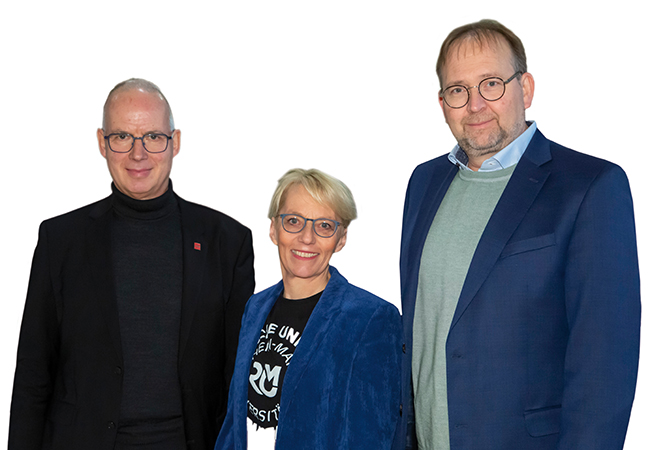
The first meeting at which the decision was made to establish the Working Group on Semitic Languages took place in early summer 2023, recalls Nadja Aboulenein. An Arabic instructor and research associate at the Institute for the Study of Culture and Religion of Islam at Goethe University Frankfurt, Aboulenein speaks with enthusiasm about the group’s beginnings: “Our first step was to identify which disciplines actually work with Semitic languages. At the time, we had no idea how many people at Goethe University were involved – and not only linguists. We sat around a large table and planned the establishment of the group with great enthusiasm. That was when the idea for a lecture series emerged. After the first round of the series in the 2024/25 winter semester, we applied for QSL funding in spring 2025 – and were fortunate to be successful.” 1 Today, the Working Group on Semitic Languages brings together researchers and students from a broad range of disciplines, including Islamic Studies, Protestant and Catholic Theology, African Studies, Ancient History, Empirical Linguistics, Jewish Studies, and Archaeology. The group pursues several key objectives: promoting cross-disciplinary collaboration, strengthening networks among researchers, and enabling joint research initiatives. A particular emphasis lies on high-quality teaching that fosters a culture of diversity and interconnected thinking among students.
In addition, the disciplines represented in the working group actively support early-career researchers, for example by supervising interdisciplinary theses and involving them in research projects at an early stage. Semitic languages form a subgroup of the Afro-Asiatic language family and include Arabic, Hebrew, and Aramaic. Approximately 260 million people in the Middle East, North Africa, and the Horn of Africa speak a Semitic language.
Losing Sight of Shared Connections
How did the close relationships between the Semitic languages come to be overlooked? “The study of these languages developed in divergent directions over the course of the 20th century, a process closely linked to the increasing specialization of academic disciplines,” explains Dr. Johannes Diehl, a Protestant theologian. Wilhelm Gesenius, a prominent 19th-century theologian and scholar of Semitic languages, was still fluent in Arabic, Diehl notes. Over time, however, interest in and knowledge of neighboring languages diminished, and new disciplinary boundaries emerged. “Today, specialization has progressed to the point where classical Hebrew and modern Hebrew are treated as entirely separate fields of research,” adds Dr. Annelies Kuyt, a research associate in Jewish Studies.
The founders of the working group seek to bring the shared and connective dimensions of the Semitic languages back into focus and to use them productively for both research and teaching. “Our aim is to encourage young scholars in particular to broaden their perspectives and, in doing so, gain insight into other cultures,” emphasizes Nadja Aboulenein. Johannes Diehl adds: “My field, Protestant Theology, is not a linguistic discipline. Yet at the most recent faculty conference, there was a clear commitment to the importance of ancient languages and to strengthening engagement with them. Such engagement enables a deeper understanding of different worldviews. Reflection on language plays a crucial role, for example, in exegesis, religious education, and even in worship.”
„Our aim is to encourage young scholars in particular to broaden their perspectives and, in doing so, gain insight into other cultures.“
Strong Interest in the Lecture
How does the interaction of different languages and cultures unfold in the classroom? And do political tensions – particularly in the Middle East – lead to conflict? “No, quite the opposite,” reports Annelies Kuyt. “Students from different denominations show strong interest in one another.” Her colleagues in the working group share this assessment. “In my courses, I have always tried to highlight connections between the Quran and the Bible through specific passages. In one reading seminar, at the students’ request, we read the story of Joseph from the Quran (Surah 12) and then studied the biblical account of Joseph in Arabic translation, analyzing both texts linguistically. This often leads to real ‘aha’ moments,” says Nadja Aboulenein.
In the interdisciplinary lecture series on Semitic languages – now offered for the second time – a range of languages is introduced using transliteration, ensuring that all participants can follow. “We then demonstrate how similar sentence structures or conjugation patterns are across Semitic languages,” explains Aboulenein. Johannes Diehl is particularly interested in spatial concepts: “In Indo-European languages, reference points are usually anchored in the speaker. In many Semitic languages, however, the reference point is more often tied to the object. Temporal distinctions between past, present, and future also play a less central role in verb forms.” For the upcoming summer semester, the working group is planning a workshop introducing participants to different writing systems. “QSL funding allows us to invite internationally recognized instructors. One of the topics will be the so-called Cairo Geniza – a collection of fragments dating from the 8th or 9th century to the 17th century, often written in Arabic but using Hebrew script (commonly referred to as Judeo-Arabic). Preserved in part due to favorable climatic conditions, these fragments are invaluable sources that offer insights into the historical coexistence of religious communities,” Aboulenein explains.
1 QSL = Quality of Study Conditions and Teaching
Lecture Series on Semitic Languages
2025/26 Winter Semester, Wednesdays from 4:00 to 6:00 PM (c.t.) in Seminar Building 2.104.
Additional dates for the current semester:
– January 21, 2026
– January 28, 2026
– February 4, 2026
– February 11, 2026
Go to the event overview →