How to trick cancer cells
Oncologist Jan-Henning Klusmann is testing a new type of therapy against AML, a particularly perfidious form of leukemia. It attacks cancer cells but spares healthy ones. Following successful tests on mice, clinical trials are now to follow.

Our blood cells’ days are numbered. White blood cells (leukocytes) and platelets (thrombocytes) survive just 8 to 12 days, red blood cells (erythrocytes) 120 days. This necessitates not only constant but also substantial replenishment, which is why our body produces several billion new mature blood cells every day. Blood formation – hematopoiesis – takes place in the bone marrow, the soft fatty tissue with a rich supply of blood found in the cavities of flat bones (pelvis, spine, sternum, ribs) and the ends of long bones (thigh and upper arm). The starting point for this process, which unfolds in several stages, is multipotent hematopoietic stem cells, which develop into lymphoid or myeloid progenitor cells. The lymphoid progenitor cells form a subgroup of leukocytes (B, T and NK cells), while the myeloid ones develop into erythrocytes, thrombocytes as well as granulocytes and monocytes, two further leukocyte subtypes.
A perfidious type of cancer

Sometimes, however, something goes awry during this development process: Myeloid progenitor cells mutate into leukemia cells that multiply uncontrolled and displace healthy, mature cells, which promptly leads to a shortage of blood cells. The symptoms of this disease, called acute myeloid leukemia (AML), are anemia, greater susceptibility to infections and an increased tendency to bleed. In children and adolescents, it is the second most common form of leukemia after acute lymphoblastic leukemia (ALL).
“AML is a complex and aggressive cancer,” says Jan-Henning Klusmann, director of University Hospital Frankfurt’s Department of Pediatrics. “What makes it particularly perfidious is its ability to spread rapidly in the bone marrow and blood.” A patient’s chances of survival depend on the AML subtype and their condition at the time it is diagnosed. With intensive chemotherapy, the current standard treatment, which is, however, associated with severe side effects, 60 to 70 percent of children and adolescents survive the first five years after diagnosis.
Journey through the bloodstream
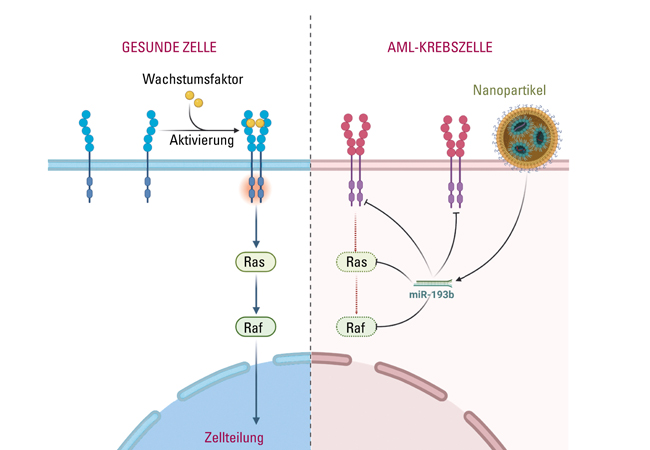
Oncologist Klusmann wants to increase their chances of survival. He is testing new forms of therapy that combat AML more effectively than previous ones and might even make chemotherapy superfluous at some point. He is placing his hopes in a substance that halts the uncontrolled proliferation of leukemia cells in AML from within, targeting them where they are most vulnerable. Klusmann delivers special RNA molecules to this destination that fight the cancer. They are packaged as fat-like nanoparticles that cancer cells can easily absorb.
Using high-precision equipment, Klusmann produces the nano “packages” out of lipid particles and RNA in his lab. First, the lipids and RNA molecules are mixed in a device resembling a kitchen blender. This is done in such a way that the lipids completely encapsulate the ribonucleic acids – a principle similar to that used for the RNA vaccines against COVID-19. The end product is tiny spheres just 50 to 200 nanometers in diameter, a thousand times thinner than a human hair. However, to be transported through the bloodstream, the spheres must also have the right physicochemical properties, which is why a special device measures, with the help of laser light, whether particle size and surface charge are correct.
The journey can then begin: The lipid-RNA package is injected intravenously and carried by the bloodstream to wherever cancer cells have spread in the red bone marrow. Here, the lipid coating performs a dual function: On its way, it forms a protective sheath around the active substance, which would otherwise rapidly degrade. Once it has arrived at its destination, it channels the RNA into the cancer cell. This process is called endocytosis: As the nanosphere docks, the cancer cell encapsulates it in a membrane vesicle and transports it inside the cell. The fatty sheath coalesces with the lipids in the membrane of the cancer cell. Once inside, the RNA is then released, completing the delivery of the precious molecular cargo. The active substance can commence its work.
No possibility for evasive maneuvers
The RNA that comes into play in this process is a particular type: the tumor suppressor miR-193b, a small RNA molecule that belongs to the group of microRNAs (miRNAs). miRNAs can curb the activity of certain genes and play an important role in regulating gene expression in cells. “What’s special about miR-193b is that it helps regulate the balance of cell division and growth in healthy cells by suppressing certain signaling pathways important for cell proliferation,” explains Klusmann. And these signaling pathways are in the spotlight because they are overactive in cancer cells and one of the main causes for cancer developing and spreading. At the same time, however, the concentration of miR-193b in cancer cells is very low. When outnumbered, the tumor suppressor is unable to offer sufficient opposition to the dividing cancer cells. Introducing the nanospheres raises the concentration of miR-193b in the cancer cells again and reins in the overactive signaling pathways.
This causes the cancer cells to die or at least stop multiplying. An important factor here is that miR-193b attacks not just a single point within a signaling pathway but several points simultaneously. “This means that cancer cells cannot simply adjust their signaling pathways slightly in order to evade the therapeutic effect,” explains Klusmann.
He believes that the RNA nanosphere package offers great potential for the effective treatment of AML. As far as side effects are concerned, miR-193b has clear advantages over chemotherapies. It inhibits the division and uncontrolled growth of cancer cells, “but normal, healthy hematopoietic stem cells remain unperturbed, as they hardly need the cancer cells’ signaling pathways to perform their tasks and therefore barely use them.” Tests in which nanospheres were injected intravenously in mice with AML have shown that miR-193b can halt cancer. All animals survived for a significantly longer time, and some were even cured.
Klusmann is now planning to test the RNA-based therapy in clinical trials. For this he is currently seeking collaboration partners from industry with experience in clinical tests and pharmaceutical development. He stresses that such tests must be designed and customized especially for humans. Compared to tests in mice, immune response and possible side effects must also be considered in more detail.
Neue Entdeckungen mit Multi-Omics
Klusmann’s plans go beyond the development of miR-193b therapy. He wants to collate data from different “sections” within the genome, and calls his approach “multi-omic”, meaning that he is looking at such sections in their entirety, all proteins (proteome), all protein apparatuses that splice RNA (spliceosome) and all changes in the genetic material (epigenome) that do not affect the base sequence.
To study the proteome, he uses mass spectrometry. “It helps us identify which proteins are produced in greater or lesser numbers in cancer cells in comparison to healthy cells – an indication of possible targets for therapeutic interventions.”
Spliceosome analyses by means of nanopore sequencing go in a different direction. The spliceosome is the molecular machine that “glues” the coding sections of RNA together, a process known as splicing. “This is where we find changes in the way genes are transcribed into mRNA and then translated into proteins.”
In his third approach, Klusmann is examining the epigenome, all the changes in gene activity caused by environmental factors. Such changes are triggered, for example, by a different packaging of DNA or by chemical modifications of the genetic molecule and can thus influence gene activity without altering the DNA sequence itself.
Combining the data from the three “omics” has already led to considerable scientific advances. “It has enabled us to unveil some previously unknown biological interrelationships that have to do with how leukemia actually develops in the first place.” Klusmann is certain that multi-omics is the right approach for developing further new therapies against AML, be it RNA-based therapies or other forms of treatment. Furthermore, RNA molecules, especially miR-193b, are veritable allrounders, as they are also suitable for treating other types of leukemia and perhaps even other cancers.

About / Jan-Henning Klusmann,born in 1979, has been Director of University Hospital Frankfurt’s Department of Pediatrics since 2021. Before that, he was a Senior Consultant at the Clinic for Pediatric Hematology and Oncology at Hannover Medical School and Director of Pediatric Department I at University Hospital Halle (Saale). The leukemia expert studied medicine in Lübeck and based his doctoral dissertation on his work at Children’s Hospital Boston, a teaching hospital of Harvard Medical School. Klusmann has received numerous awards for his research work, among others from the American Society of Hematology and the Society for Pediatric Hematology and Oncology.
klusmann@em.uni-frankfurt.de

The author / Andreas Lorenz-Meyer, born in 1974, lives in the Palatinate and has been working as a freelance journalist for 16 years. His areas of specialization are climate research, renewable energies, digitalization and biology. He publishes in daily newspapers, specialist newspapers, university and youth magazines.
andreas.lorenz.meyer@nachhaltige-zukunft.de