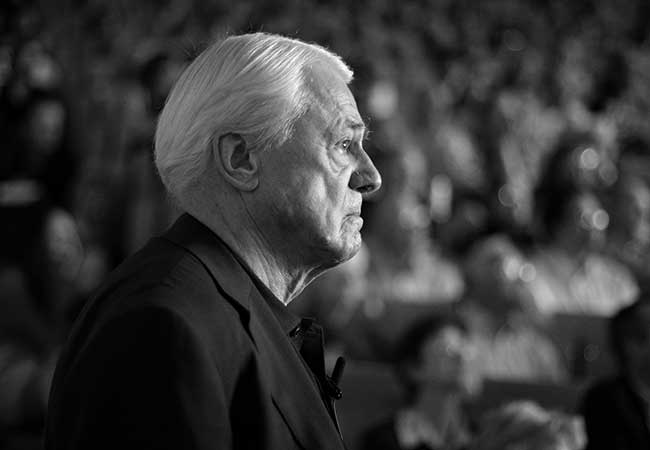
Ladislaus Ludescher on the decline in funding for development work and for combating hunger at a time when military budgets are growing
UniReport: Dr. Ludescher, the fact that armaments spending is rising worldwide – including among NATO members – is hardly surprising given the threats Europe is currently facing as well as the numerous other ongoing global crises, isn’t it?
Ladislaus Ludescher: I don’t believe an arms race can be the answer to global problems. The current military build-up is primarily about sending a signal of the “West’s” strength to other powers. However, this very costly signal will very likely prompt other powers (such as China and Russia) into demonstrating their strength, resulting in further rearmament on their part, which in turn will challenge the “West” again.
NATO countries already account for more than half of all global military spending. According to the Stockholm International Peace Research Institute (SIPRI), global military expenditure reached an unprecedented record of $2,718 billion in 2024 – representing an increase of almost 10 percent over the previous year. At the same time, about 730 million people worldwide are suffering from hunger. For comparison: in 2024, the resources of the United Nations World Food Program (WFP) amounted to just under $10 billion – a mere 0.3 percent of global military spending. The total resources for Official Development Assistance (ODA) from OECD countries amounted to $212 billion, not even 8 percent of global military spending. I think it is obvious that the proportions here are not right. And the trend clearly shows that the gap is widening further.
Are the funds for combating hunger and for development work stagnating or shrinking in relative or also in absolute terms?
It is also a decline in absolute terms. In 2024, ODA funding fell by more than $11 billion compared with the previous year. The United Nations Office for the Coordination of Humanitarian Affairs also pointed to the largest funding cuts ever, with existential consequences for millions of people worldwide.
What role does Germany play in this context? Is the Federal Republic following these trends or is it opposing current developments?
Germany is one of the pioneers in massively increasing military spending while at the same time cutting back funding for development cooperation. In 2024, ODA funds from OECD countries fell by about 7 percent, but in Germany by as much as 15 percent. At the same time, the military budget was massively expanded. Germany is currently following the increase in military spending to 5 percent of GDP demanded by US President Donald Trump for NATO countries. This means an increase in the country’s military budget to a figure that today would amount to around $260 billion. In 2024, Germany had a military budget of $88.5 billion. For comparison: funding for development cooperation, at $32.5 billion, was about one-third of that. Germany already ranks fourth in global military spending, ahead of the nuclear powers India, France and the United Kingdom. With the 5-percent-GDP target, Germany would even overtake Russia. With these enormous sums, we must keep in mind that every 13 seconds a child dies of hunger somewhere in the world – around 2.5 million children per year. Germany’s contribution to the UN World Food Program amounts to just under $1 billion. I can only repeat: it is extremely evident that the proportions here are in a fundamental imbalance.
You have been studying the “media neglect of the Global South” for several years. Faced with other dominant issues – which, as in the case of climate change, run the risk of slipping down or off the agenda – does one not feel like a voice crying in the wilderness? Or can you (also) discern an impact of your research on the public and in politics?
I believe there are many people who react with great shock when you show them these figures. The feedback I have received from both the public and from politics generally describes these figures as a scandal that should actually provoke a media outcry. Unfortunately, the decision-makers currently in power worldwide tend not to prioritize humanitarian issues. But rather than be discouraged, one should repeatedly remind the public, the media and politicians of the actual situation to raise awareness of the issue and thereby make a difference. When future generations look back on our time, they will see that there were other voices as well.
Dr. Ladislaus Ludescher is a Research Associate at Goethe University Frankfurt and an Associate Researcher at Heidelberg University. The exhibition “Vergessene Welten und blinde Flecken” [Forgotten Worlds and Blind Spots], which he co-designed, is a travelling exhibition on the study of the same name about the media neglect of the Global South, currently on display at the Journalism Centre in Herne and in several other locations. The website also contains numerous analyses, including on the increase in military spending and cuts in development cooperation.