Polytechnische Gesellschaft and Goethe University sign cooperation agreement for the newly built Honeybee Reseach Center in Oberursel
Polytechnische Gesellschaft and Goethe University Frankfurt have signed a new cooperation agreement that provides the renowned Honeybee Research Center in Oberursel with a solid, long-term foundation and significantly improves the conditions for research work at the jointly managed center. The relocation of researchers and the apiculture activities to the newly constructed premises, built by Polytechnische Gesellschaft, can now begin.

The close cooperation between Polytechnische Gesellschaft – Germany’s Polytechnic Society – and Goethe University Frankfurt at the Honeybee Research Center began in the 1960s with research on the Varroa mite, a dangerous parasite for bee colonies. In 2007, the collaboration was restructured through a formal agreement: for the first time, Polytechnische Gesellschaft established an endowed professorship at Goethe University. The Center became a subsidiary of the Polytechnic Society and part of Goethe University’s Faculty of Biosciences. In 2008, Prof. Dr. Bernd Grünewald was appointed to the endowed chair and has been leading the research institution ever since. The latest cooperation agreement further redefines the collaboration: Polytechnische Gesellschaft commits to annually supporting the endowed professorship, including its staff and facilities, thereby ensuring its funding is secured. Additionally, it will make available to Goethe University the building and the adjacent insect garden free of charge for an indefinite duration, with the university covering the associated costs for research-related equipment, maintenance, and ongoing operations.
“Polytechnische Gesellschaft has been an important friend and partner to Goethe University since its foundation,” says Goethe University President Prof. Dr. Enrico Schleiff. “Our collaboration reflects the firm roots of our foundation university within the civic tradition that makes Frankfurt and the Rhine-Main region such a unique hub for science. Biosciences research is currently under significant pressure internationally. Through this cooperation, we are providing a secure and long-term perspective for an important branch of the biosciences. By funding the center’s new building, Polytechnische Gesellschaft has created essential conditions for excellent research, and we are very grateful for that.”
Prof. Dr. Dr. h. c. Volker Mosbrugger, President of Polytechnische Gesellschaft and former Director General of the Senckenberg Society for Nature Research, says the new building for bee research opens up completely new possibilities: “At our new location in Oberursel, we are bringing research, teaching, apiculture, and education together under one roof. The building also meets the highest standards of climate-friendly and ecological construction. We have created a flagship project with significant impact far beyond the Frankfurt Rhine-Main metropolitan region.”
“The cooperation between the university and us is not only unique in Germany,” emphasizes Honeybee Research Center Director Grünewald, “it also guarantees an excellent research and teaching infrastructure, as well as modern apiculture, making it a truly polytechnic endeavor with both tradition and future!”
More than one-third of the funding provided by Polytechnische Gesellschaft to support its affiliated institutes is allocated to the endowed professorship for bee research. The provision of the building, which cost the organization around €15 million, constitutes an even more significant financial commitment than the expenses for the endowed professorship. From the polytechnic organization’s perspective, this underscores the high value it places on science, and on biodiversity research especially.
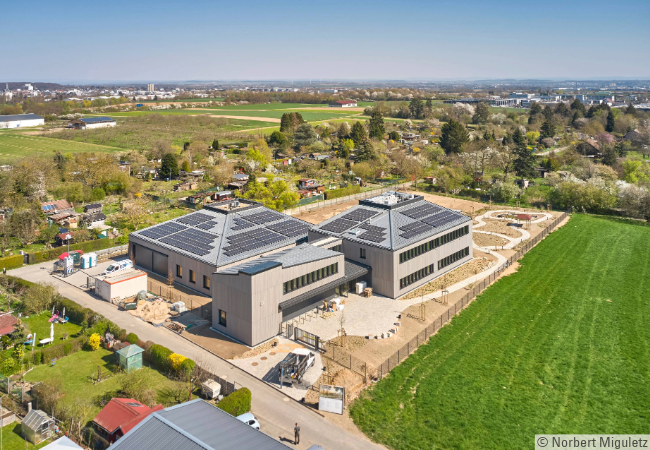
Until recently, bee researchers worked in a single-family house acquired by Polytechnische Gesellschaft in 1956, to which a 300-square-meter addition was added in the 1960s. As this building complex no longer met the requirements of modern bee research, it decided to pursue a new construction project. In September 2021, construction began on a 6,500-square-meter site on the outskirts of Oberursel, with the project successfully completed in mid-2025. Moving forward, more than 2,000 square meters of usable space will be available to bee researchers and apiculture.
With the new agreement in place, Goethe University can now acquire the technical equipment. During the transition period until the new laboratories are installed, researchers will use laboratory spaces in the Biologicum on Riedberg Campus. The Honeybee Research Center’s move will take place in several phases: First, the center’s management, administration, and beekeeping operations will relocate to the new premises on Ebertstraße in Oberursel. Just in time for spring next year, the bees will be able to swarm from their new home. The official opening is planned for the first half of 2026, when Polytechnische Gesellschaft, Goethe University, and the team at the Honeybee Research Center will celebrate the completion of this major construction project. The laboratory equipment will be installed over the course of 2026.
For a look at the new building, visit here →
About the Honeybee Research Center: Bees are of fundamental importance to ecosystems worldwide. Through their pollination, they play an indispensable role in safeguarding biodiversity and maintaining food chains. The Oberursel-based Honeybee Research Center, founded in 1937 by Polytechnische Gesellschaft, conducts research on the bee’s brain, its learning, and social behavior, as well as the effects of environmental factors and pesticides on the physiology and behavior of honeybee colonies. The Center also houses the world’s largest scientific collection of honeybees from across the globe and has been studying honeybee biodiversity for over 70 years. Under the leadership of renowned researchers, it has built an outstanding international reputation since its foundation. A distinctive feature of the Center is its unique combination of university-based fundamental research, practical apiculture, and its own beekeeping operation serving as a training facility.