Launched in response to the refugee movement of 2015, the Academic Welcome Program at Goethe University Frankfurt has become a lasting model for academic integration. Its tenth anniversary highlighted both its achievements and the future of refugee support in higher education through the Academic Bridge Program.

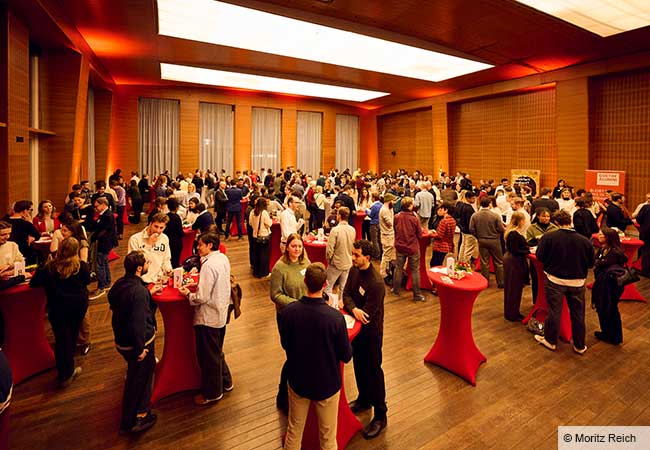
Since 2015, the Academic Welcome Program for highly qualified refugees (AWP) has supported refugees on their path to studying at German universities through language courses offered by the International Study Center (ISZ), preparatory workshops, individualized advising, and social integration initiatives. More than 800 individuals have participated in the program since its launch. Currently, over 120 AWP alumni are enrolled at Goethe University; many others have begun or successfully completed their studies at universities across Germany. These achievements and the program’s long-term success were celebrated in October 2025 in the festive hall of the Casino building on the occasion of the AWP’s tenth anniversary.
“Coming together here today sends a powerful message,” said Dr. Rebekka Göhring, Head of Academic and Global Affairs (SLI), at the opening of the celebration. “Establishing the AWP at that time was truly pioneering work, driven by extraordinary commitment. It is all the more remarkable to see the sustainable outcomes we are celebrating today.” Ten years after its founding, the anniversary provided not only an opportunity for those who supported, accompanied, shaped, or participated in the program to come together, but also a moment for collective reflection.
A Decade of Commitment to Education and Integration
The AWP was launched in autumn 2015 as a rapid university response to the refugee movement of that period. In that year alone, approximately 1.5 million people fled to Europe, escaping civil war, persecution, and hardship, often deprived of prospects and participation in their countries of origin. In Germany – and at Goethe University in particular – a central question emerged: how should society, institutions, and individuals respond to this challenge?
With the AWP, the university developed a swift and effective way to offer refugees with academic aspirations a new perspective. “Goethe University created a program for refugees with academic qualifications. Access to the education system at an appropriate level is a key factor for adults in achieving participation, self-determination, and social integration,” said Prof. Dr. Viera Pirker, Vice President for Academic Affairs and Teaching, in her welcome address. At the same time, the program represents a tangible expression of the societal responsibility that Goethe University embraces as part of its civic tradition.
The idea for the AWP emerged in 2015 within Goethe University’s International Office. A central figure in the founding phase was Hanna Reuther, who initially managed the program in the International Office and now oversees it as Deputy Head of the Division for Academic and Global Affairs. She played a key role in designing and developing the program, continuously securing third-party funding and, together with the initial and subsequent program coordinators, shaping its current structure. Financial support – particularly from the state of Hesse and later from the German Academic Exchange Service – ensured the program’s long-term, high-quality implementation. Dr. Rainer Gruhlich, Head of the Department for International Affairs at the Hessian Ministry of Science and Research, Arts and Culture (HMWK), expressed his appreciation during the celebration for both the program’s implementation and its sustained impact.
In retrospect, the speed and decisiveness with which Goethe University acted become particularly evident. Within just a few months, initial language courses were organized, structures established, and partnerships formed – including collaborations with the Goethe Law Clinic (GLC), the Psychosocial Counseling Center for Refugees (PBF), and, as key partners, Mattheus Wollert, Matthias Schramm, and Sigrid Körner from the ISZ – as Hanna Reuther recalled during a panel discussion with former program coordinators. The program’s growth underscores its success: from an initial cohort of 30 participants in the winter semester of 2015/16, the AWP expanded to more than 300 participants within only a few semesters. Many of them came from Syria, Afghanistan, or Iran and were able to make a fresh academic start in Frankfurt.
The years following the program’s launch brought new challenges. During the COVID-19 pandemic, language courses and advising services were shifted to digital formats. Julia Jochim, then program coordinator, initiated a laptop donation campaign to enable digital participation. Following Russia’s invasion of Ukraine in February 2022, the AWP once again responded swiftly, welcoming 48 Ukrainian refugees as early as the summer semester. The program’s capacity to adapt flexibly and continue supporting participants even in times of crisis has become one of its defining characteristics.
Success Stories: Former Participants Share Their Experiences
During the anniversary celebration, three alumni illustrated the lasting impact of the program. Two graduates spoke about their educational paths following participation in the AWP during a panel discussion. Diaa Bek Shkeer, a 28-year-old from Syria who completed the program in the summer semester of 2017, studied law at Goethe University and successfully passed the First State Examination in December of last year. Yuliia Serhiienko, 29, who had previously completed a degree in software engineering in Ukraine, achieved the highest possible score in the final DSH examination last summer semester and is now preparing for further studies in Germany. “The AWP made this path possible for me,” she said.
Following the panel discussion, Behzad Fotoohi delivered a speech of thanks. Originally from Iran, Fotoohi earned a master’s degree in educational sciences at Goethe University and now works as deputy director of a daycare center in Frankfurt. Addressing current program participants, he emphasized: “Learn the language, stay disciplined, and make full use of the support the AWP offers. You can achieve more than you might imagine today.”
Fotoohi, Serhiienko, and Shkeer represent many similar trajectories: individuals who took their first steps in a new education system through the AWP and went on to find their place at the university.
In her concluding remarks, Viera Pirker connected the anniversary to the tradition of “key allocation,” referring to the first entries in the key logbook of the newly built Institute for Social Research in 1951. These entries document the return of scholars who had been banned from teaching, dismissed, or forced into exile during the Nazi dictatorship. “Just as Horkheimer and Adorno once held their keys, today you hold yours – taking on responsibility now and in the future, whether here in Germany, in the countries you had to leave behind, or in entirely new places.”
With this anniversary, one chapter comes to a close and another begins. Funding from the European Union for the new Academic Bridge Program (ABP) ensures the continuation of academic preparation for refugees through June 2028, combining proven elements with new approaches. What began in 2015 as a short-term initiative has evolved into a long-term and integral component of Goethe University’s internationalization and integration efforts.
Contact:
Johannes Nebe,
Acting Program Director ABP
j.nebe@sli.uni-frankfurt.de
AWP Partners and Supporters
In the summer of 2015, a working group led by then Vice President Prof. Dr. Tanja Brühl developed the initial structure of the AWP and created practical solutions to provide refugees with access to German language courses, the guest auditor program, and university infrastructure. This effort involved collaboration between the former International Office, the Student Services Office, the University Computing Center HRZ, the University Library, ISZ, the Office for Gender Equality, the Central Student Advisory Service, AStA, and the AE Worldwide initiative, which was founded in 2013. The Office of Private University Funding and the RMV transportation network also contributed their support. Important internal and university-affiliated partners soon joined, including the Goethe Law Clinic, the psychotherapeutic counseling center for refugees, the (International) Career Service, the “Start ins Deutsche” initiative, the Protestant and Catholic university congregations (ESG and KHG), and the Frankfurt Student Services. External partners included the Garantiefonds Hochschule, the Employment Agency and Job Center, the Welcomecenter Hessen, Frankfurter Arbeitsmarktprogramm Beratungszentrum Agentur gGmbH, the IHK Chamber of Commerce and Industry and the HWK Chamber of Skilled Crafts, berami e.V. – berufliche Integration e.V., the Recognition Counseling IQ Network Hessen, as well as Caritas Frankfurt, Volkshochschule Frankfurt, and the Walter Kolb Foundation.