Prof. Lisette Gebhardt reflects on an exciting event with 350 participants.

From August 20 to 22, 2025, Goethe University’s Japanese Studies department hosted the 19th German Conference on Japanese Studies [Deutschprachiger Japanologentag]. Held at the seminar building on Westend Campus, the conference featured seventeen sections and four panels covering topics ranging from ethnology to economics, showcasing the current spectrum of German-language Japanese studies. The Frankfurt Japanologists chose the theme of academic and knowledge archiving – a fitting focus considering that the conference coincided with the 100th anniversary of Asian studies at Goethe University, which can be traced back to 1925, when the institution founded by scholar Richard Wilhelm (1873–1930) was officially recognized as the “Seminar for Chinese Studies and Research at the University of Frankfurt.”
This year’s conference welcomed Abe Ken’ichi from Tokyo. Abe, a professor at the prestigious University of Tokyo and currently in charge of the recently established Ōe Kenzaburō Archive there, accepted the invitation to serve as the keynote speaker. The literary scholar previously already had collaborated with Frankfurt’s Japanese Studies department on a publication about the world-renowned author Ōe Kenzaburō. In his opening lecture, delivered in Japanese and supported by visual materials, Abe discussed digital text processing and the new possibilities it offers for exploring Ōe’s works. The archive’s goal is to digitize all available documents, making them accessible to a wider audience for the first time. The Nobel Prize-winning author, considered the literary representative of his country until his passing in March 2023, bequeathed his entire literary estate to the university where he studied Romance studies in the 1950s and from whose intellectual environment he benefited. Using illustrations of Ōe’s manuscript pages, often marked with fountain pen and blue colored pencils, Abe vividly explained the principle of Ōe’s text design through “deletion.”
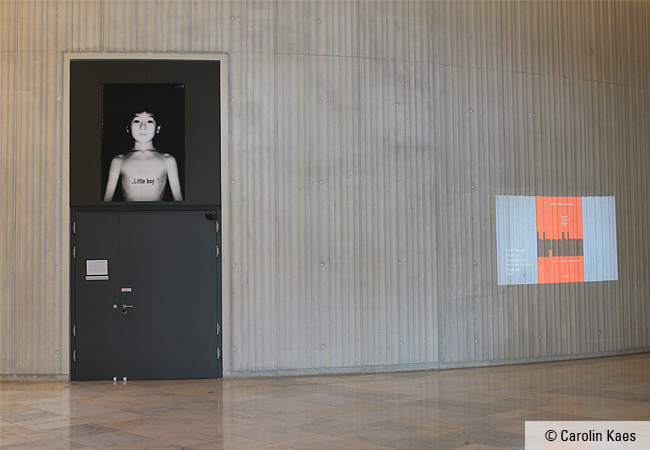
The audience gathered in the large lecture hall A of the SKW building listened attentively to the guest speaker’s presentation. The central theme of archiving, which generally received widespread approval, resonated in other contributions as well. Like Abe, the other speakers also addressed both practical aspects, such as technical dimensions and contemporary archiving standards, and the communication of living knowledge. Notably, the conference, held in August 2025 in recognition of the 80th anniversary of the Hiroshima bombing, featured an art installation in the foyer of the SKW building. The installation was created by Stefan Soltek, emeritus professor of the Klingspor Museum Offenbach. Graphic designer Uwe Loesch had lent Soltek an original poster featuring the iconic photographic image of “Little Boy” (1994) for the duration of the Japanology conference. During the opening evening, Soltek provided the guests with a brief commentary on the implications of the work, which depicts a small, forlorn-looking bare-chested boy against a black background, before discussing the general visualization of the atomic bomb in graphic art.
The following two days saw lively conference activity in the seminar building. The ethnology section explored an “Anthropology of the Future,” while Ancient History examined “Diseases in Historical Perspective” and Modern History focused on “Peace and War in Modern Japan.” The Information and Resource Sciences section addressed the conference theme and, among other topics, came out against digital monolingualism (Cosima Wagner). The art history section followed the theme “Exhibiting, Digitizing, Discarding, Returning?” The organization of older literature (theme: “The Challenge of Translation”) did not entirely rely on AI, while modern literature (Lisette Gebhardt and Christian Chappelow) engaged with the topic of archiving in various ways. Meanwhile, the media section turned its attention back to AI. The philosophy and history of ideas section (Michael Kinski and Raji Steineck) revisited “Concepts of Humanity and Nature.” The politics section examined “Japan’s (Inter-)Nationalization Trends,” while the law section, led by Moritz Bälz and Ruth Effinowicz, focused on the “New Role for Japan’s Courts.” The religion section reflected on techniques for “Preserving and Conserving Religious Knowledge.” “Loneliness and Social Isolation” were the central topics of the society section. In the theater section, presentations focused on the documentation of performances. The economics section, which included four sessions, was overseen by Cornelia Storz, among others.
With some 350 guests, including numerous scholars from Japan, Goethe University’s Japanese Studies Conference was extremely well attended. Its panels and accompanying program offered plenty of inspiration and material for academic discussions. Notable panels included “Records as Sources for Historically-Oriented Japan Studies” and “80 Years Later: Memory Culture and Peace Education in Hiroshima Today.” Participants consistently praised the conference’s organization and also expressed their admiration for Westend Campus. The pleasant, sunny weather undoubtedly contributed to the positive atmosphere. Abe Ken’ichi also expressed admiration for the setting, especially during the rooftop barbecue at the Casino. The informal, personal conversations that emerged beyond the academic topics were facilitated by the fact that Abe-sensei (Japanese honorific: “respected teacher Abe”) proved to be a linguistic virtuoso, effortlessly switching between Japanese, English, Czech, and German. By the end of the evening, many business cards had been exchanged, visits planned, and new collaborations envisioned. The students, who had worked tirelessly for months preparing for the conference, were also able to establish their first important contacts.
At the end of the event, the student organizing team, led by Christian Chappelow, drew an overwhelmingly positive conclusion. “Our hard work really paid off!” said Ike Brede, a young Frankfurt-based Japanese Studies scholar with an interest in manga. “It was also great to finally put faces to all the names from the secondary literature,” added Nastasja Scholl, who specializes in Japanese literature.