New Koselleck Project at Goethe University Frankfurt: Neurobiologist Prof. Amparo Acker-Palmer Secures €1.25 million for Neurovascular Research
Blood vessels are more than just pathways for oxygen and nutrients; they also host communicative processes that guide brain development and sustain its function. These vascular-neuronal interfaces are at the core of new research led by Prof. Amparo Acker-Palmer, which will receive €1.25 million as a German Research Foundation (DFG) Koselleck Project.
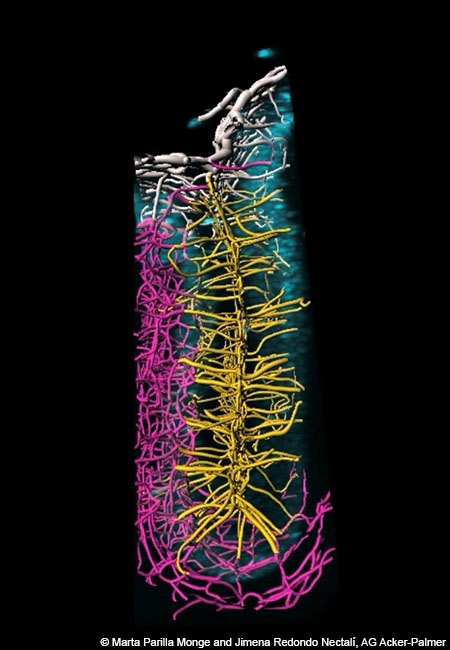
Within blood vessels, specialized endothelial cells, which form the inner lining of all vessels, exchange signals with neurons and glial cells that decisively influence the formation of brain circuits and the development of brain architecture. Disruptions to this exchange can result in developmental disorders or neurodegeneration. In her newly approved, DFG-funded Koselleck Project, Prof. Amparo Acker-Palmer aims to explore the hidden functions of vascular-neuronal interfaces. Using cutting-edge imaging techniques, molecular profiling, and genetic models, she seeks to uncover where and how endothelial cells interact with neurons and other brain cells, as well as the principles by which these interactions shape brain connectivity and structure. A particular focus is on the cerebellum, which plays a key role in movement and certain cognitive processes, and on the role of blood vessels in brain folding, a process that diversifies and enhances brain functions. Defects in brain folding can lead to neurological disorders, including intellectual disabilities, epilepsy, and motor impairments.
“By bringing together vascular biology and neurosciences, we are opening a new chapter in neurovascular research. Understanding how blood vessels regulate brain development is crucial not only for fundamental biology but also for developing new therapeutic strategies to address diseases caused by disrupted communication between vessels and neurons,” says Professor Acker-Palmer, adding that the study has the potential to revolutionize neurovascular biology and unlock previously unknown therapies. Acker-Palmer holds the professorship for Molecular Neurobiology at Goethe University Frankfurt and is internationally recognized for her groundbreaking research on neurovascular communication. Her work has earned her several prestigious awards, including an ERC Advanced Grant.
Acker-Palmer’s lab is distinguished by its collaborative and interdisciplinary approach, bringing together vascular biologists and neuroscientists to ensure seamless knowledge exchange, innovation, and discovery. According to the neurobiologist, this creates an ideal environment for tackling the ambitious project. The project aligns well with the overarching goals of the German Research Foundation’s (DFG) Koselleck Program, which aims to support visionary, high-risk research with the potential to open entirely new scientific fields.
The Reinhart Koselleck funding line, awarded since 2008, is named after Reinhart Koselleck (1923–2006), one of the most important German historians of the 20th century and a co-founder of modern social history. Reinhart Koselleck Projects are awarded to “researchers distinguished by outstanding scientific achievements.” The prerequisites for approval are particularly innovative research approaches and a certain degree of risk.