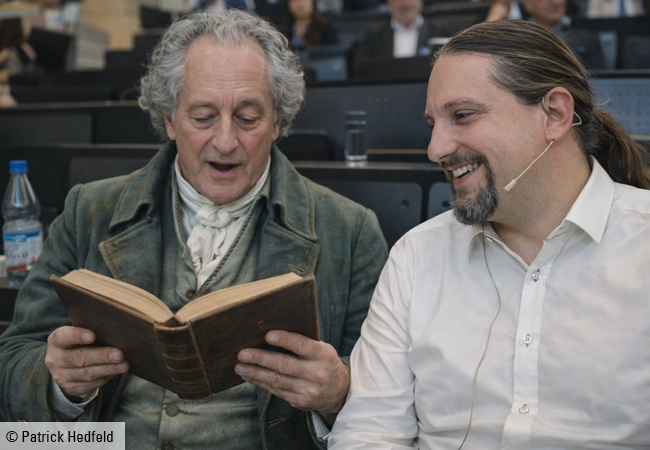
Die Chaincourt Theatre Group stages David Mamet’s “Glengarry Glen Ross”
Dimmed lights, candlelight, small tables, and clusters of seats: this is the atmosphere that greets visitors at Chaincourt Theatre, located in a side building of the IG Farben House on Goethe University Frankfurt’s Westend Campus. A seminar room – used by day for teaching – has been transformed into an intimate performance space, with the feel of a small independent theater or an art-house cinema foyer. Conversation fills the room. There is wine, there are snacks, and there is a clear sense that theater is being made here with real commitment. A bell rings. The doors to the auditorium open. As the audience finds its seats, soft jazz plays in the background. After a brief welcome from theater director James Fisk – covering practical matters such as exits and facilities, naturally in English, as Chaincourt Theatre is based at the Institute for English and American Studies – the performance begins. The stage design is deliberately minimal: black floor, black drapes, two standing tables. The acting, however, is anything but restrained. In the first act – there is an interval – the stage is dominated by confrontations that feel less like dialogues than dueling monologues. Responses come, but mostly as brief interruptions, questions, or gestures of forced attention. One voice always takes control. And it does so with remarkable energy. Characters complain, shout, boast, and push themselves forward. This is a world of sales, targets, and the fear of losing one’s job.
But what is the play actually about? The Chaincourt Theatre staged “Glengarry Glen Ross” during the recent winter semester. Written by David Mamet, the play premiered in 1983 at London’s Cottesloe Theatre and explores questions of humanity within capitalism. Four real-estate agents receive a dressing-down from their boss: things are clearly not going well at the office. She then announces that in one week’s time only the two people who have brought in the most money will still have their jobs. That is the premise. What follows is a portrait of men and women trying to obtain leads by any means possible – and that should be taken literally, as the second act revolves around the theft of supposedly valuable contacts. They celebrate their successes, though not in any sympathetic way, but by congratulating themselves for manipulating and deceiving others until contracts are signed and cheques handed over. We watch different characters trying to form conspiracies, cheat one another, and secure advantages for themselves – doing all kinds of things out of desperation and fear to keep their jobs. All of this is delivered through monologues in which there is always a calmer counterpart on stage, someone the audience can identify with. These monologues are not only powerful; they are often long, drawn out, sometimes ridiculous, and occasionally even tedious. One can begin to feel sorry for the person who has to listen to them – only to realize that, voluntarily, so do we. And gladly so. The performance itself is thoroughly convincing. Far from becoming dull, it remains gripping throughout. The cast’s compelling acting draws the audience into their world, invites empathy and antipathy in equal measure, and leaves us hoping that the least unlikeable characters will be the ones allowed to keep their jobs. Although perhaps they would be better off working somewhere less toxic.
The Chaincourt Theatre has created a production that leaves a lasting impression and invites reflection. The real-estate agents are driven to sell or rent ever more properties at ever higher prices. It is difficult not to think about the consequences of such business practices – practices that can be found in many sectors. From there, the path leads quickly to present-day issues such as the shortage of student housing as well as constantly rising rents and property prices. The play offers no solution. That is left to each member of the audience.
Lena Woyton, student of Theater, Film and Media Studies