The influential French intellectual discussed the topic of aging at Goethe University.
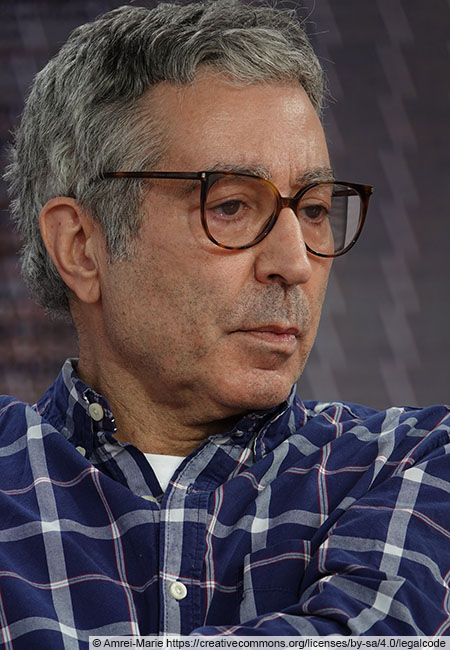
On the evening of October 28, 2025, French author Didier Eribon visited Goethe University Frankfurt. Born in 1953, Eribon is a sociologist, philosopher, and prominent intellectual. His visit focused on his latest book, “The Life, Old Age, and Death of a Working-Class Woman” (2024). In this work, he tells the story of his mother, a working-class woman. The book combines biographical storytelling with sociological insights, highlighting the realities his mother faced as a working-class woman in old age. Eribon addresses topics such as social and epistemic injustice, the need for care, and the process of dying. Eribon was welcomed in the ceremonial hall on the Westend Campus, with the line of attendees stretching from the foyer out onto the forecourt even before the doors opened. All told, some 450 guests attended, who were provided with headphones to follow the simultaneous translation of the German-French discussion.
Following the welcome address by organizer Julia Kaufmann (Research Associate at Goethe University’s Faculty of Educational Sciences), opening remarks were given by Sabine Andresen (Vice President of Goethe University) and Xenia von Tippelskirch (Director of the Institut Franco-Allemand). In addition to Eribon, the panel included six participants. Bachelor’s student Franziska Schulze was particularly impressive that evening, as she took on both the moderation and the reading of selected passages from Eribon’s book. The evening event was connected to the educational science seminar “Theoretical References in the Work of Didier Eribon,” taught by Julia Kaufmann. Franziska Schulze was one of its students and contributed to shaping the event throughout the course of the seminar.
The panel discussion alternated between different formats: passages were read aloud, questions were posed, and Eribon responded to each one extensively. To start, Julia Kaufmann provided a thematic introduction to the book and asked Eribon about his motivation to engage with the topic of aging. Eribon clarified that the topic of aging is not avoided everywhere. He referred to Annie Ernaux, Simone de Beauvoir, and Norbert Elias. Jonas Lang (research associate at Goethe University’s Faculty of Social Sciences) inquired about the specifics of the genre of auto-sociography. Eribon described the worker in his book as a social type that helped him describe the world in his own way. Milena Feldmann and Karla Wazinski (research associates in the Emmy Noether Group Linking Ages at the Faculty of Educational Sciences) asked questions about moves into nursing homes and the sometimes violent experiences people face there. They critically questioned whether Eribon’s perspective on aging was one-sidedly negative and whether it overlooked certain aspects. Eribon emphasized that he had described what he had observed. For him, aging was not something beautiful but rather a state in which people lose their abilities. Background and the type of work people had done in their lives were relevant factors in this context. Anna Wanka (head of the Emmy Noether Group) addressed the issue of “age blindness” in theory and academia. Eribon argued that all philosophical concepts need to be rethought because they exclude older people as well as those who are physically and cognitively frail. Furthermore, there are no political movements advocating for the rights of older people. According to the French intellectual, those affected remain invisible because society simply has no interest in engaging with them. How Eribon sees himself as an older person remained unanswered.
Following the panel discussion, questions from the audience were addressed, submitted both via QR code and in person. Naturally, by the end of the evening, there were more questions for Eribon than could be answered during the two-hour event, which was funded by general QSL resources, the Franco-German Institute, and the Faculty of Educational Sciences.
Julia Kaufmann, Institute of Special Education