Goethe University is a partner in the international research initiative to generate open protein-ligand data, and lay the foundation for AI-driven drug discovery.
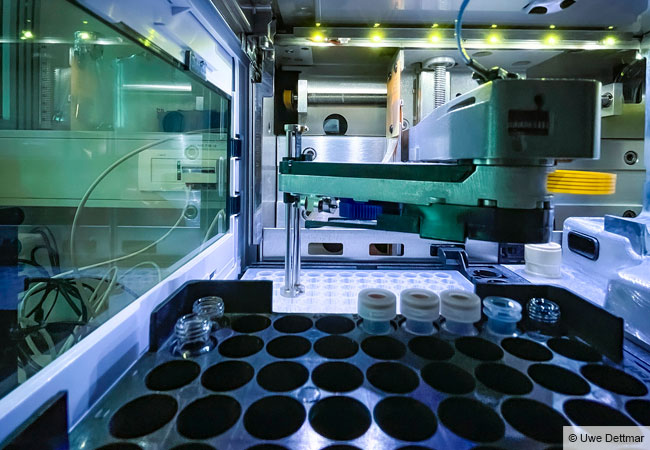
Artificial intelligence has the potential to greatly improve drug discovery, but there is a lack of open data to train the models. A new international consortium LIGAND-AI brings together academic, industry and technology partners to generate large-scale, high-quality open data describing how small molecules interact with human proteins. The data will then be used to develop and train artificial intelligence (AI) models for hit discovery and optimization, addressing one of the most significant bottlenecks in early drug discovery. LIGAND-AI will be supported over the next five years by the Innovative Health Initiative with more than €60 million and Goethe University is leading the medicinal chemistry arm of the project.
The early phase of drug discovery is a lengthy and costly process with an uncertain outcome. Particularly for targets that have been little studied, identifying the first validated binders – also known as “hits” – is often time-consuming, error-prone and difficult. The partners of the international LIGAND-AI consortium are convinced that AI models could significantly accelerate this process. However, the necessary experimental data for training such learning systems have so far been lacking.
LIGAND-AI, which is under the leadership of the pharmaceutical company Pfizer and the non-profit organization Structural Genomics Consortium (SGC), aims to change this: Thousands of interactions between small molecules and proteins that are relevant to the development of various diseases will be characterized within the project, including rare neurological and oncological disorders. The data generated will be made available to the AI community in a publicly accessible database, called AIRCHECK.
In addition to playing a key role in data generation, SGC-Frankfurt at Goethe University is leading the medicinal chemistry component of the project, with the aim to rapidly improve the identified binders into potent inhibitors.
Stefan Knapp, Professor of Pharmaceutical Chemistry at Goethe University and Chief Scientific Officer of SGC-Frankfurt, is convinced: “By linking data obtained from experimental observations with AI models, we are creating a powerful lever for pharmacological research. Moreover, in line with our open-access strategy, the database will be made available to researchers worldwide.”
About LIGAND-AI:
The LIGAND-AI project partners: Structural Genomics Consortium, European Molecular Biology Laboratory (EMBL), Goethe University Frankfurt, Universidade Estadual de Campinas, University College London, University Health Network, Vall d’Hebron Institute of Oncology (VHIO), Abcam Limited, AstraZeneca UK Limited, Chemspace LLC, Enamine Germany GmbH, IBM Research Israel – Science and Technology LTD, Novo Nordisk, Nuvisan ICB GmbH, Pfizer Inc, The Hospital for Sick Children in Toronto, Thermo Fisher Scientific GmbH and Vernalis (R&D) Limited.
LIGAND-AI is a flagship project of the Target 2035 initiative. It is supported by the Innovative Health Initiative Joint Undertaking (IHI JU) under grant agreement No 101252959. The JU receives support from the European Union’s Horizon Europe research and innovative programme, COCIR, EFPIA, EuropaBio, MedTech Europe, Vaccines Europe, Enamine, and The Hospital for Sick Children. Views and opinions expressed are, however, those of the author(s) only and do not necessarily reflect those of the aforementioned parties. Neither of the aforementioned parties can be held responsible for them.
Links:
– Structural Genomics Consortium (SGC) →
– Innovative Health Initiative (IHI) →
– News Release marking the launch of LIGAND-AI →
– AIRCHECK database →
Contact:
Professor Stefan Knapp
Institute for Pharmaceutical Chemistry
and SGC-Frankfurt Chief Scientific Officer
Goethe University Frankfurt
knapp@pharmchem.uni-frankfurt.de
https://www.uni-frankfurt.de/53483664/Knapp
Structural Genomics Consortium
Sofia Melliou, Research Communications Specialist
sofia.melliou@thesgc.org