Ahead of Valentine’s Day, the European cultural broadcaster Arte turned its attention to a familiar yet surprisingly complex human gesture: the kiss. In the hour-long documentary “Warum wir küssen” [Why We Kiss], Professor Catherine Whittaker of Goethe University’s Institute for Ethnology shares her research on the cultural diversity of love and intimacy.
The documentary places the kiss at the center of its exploration – as an emotional, cultural, and biological practice. In many societies, kissing signals affection between parents and children, friends, and especially romantic partners. It often appears so natural that it is assumed to be universal. From a physiological perspective, kissing can also have measurable effects: it may stimulate the immune system, lower blood pressure, and enhance overall well-being.
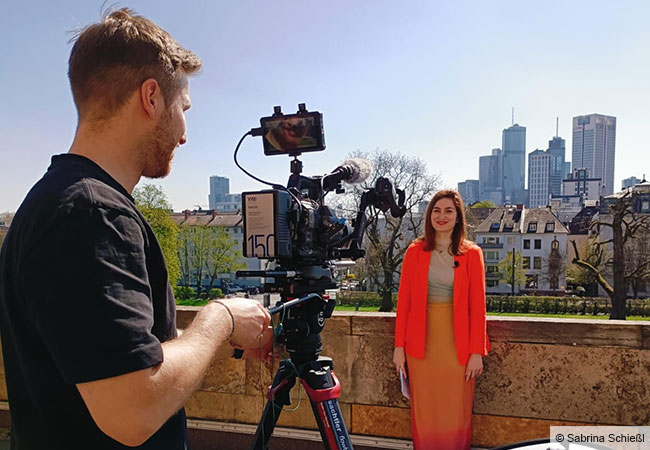
Yet the Western European-style kiss is far from universal. Anthropological research suggests that fewer than half of all cultures practice kissing. In some societies, kissing is linked less to romance than to spirituality or ritual. In others, intimacy is expressed differently – or discussed less openly in public. Catherine Whittaker brings this broader perspective to the documentary. Her research on love in Mexico illustrates how meanings and practices of intimacy vary across cultural contexts. Filming with editor Sabrina Schießl took place on the terrace of the IG Farben Building at Goethe University’s Westend Campus, where Whittaker spoke about the assumptions many people make when they view kissing as a universal expression of love.


The documentary “Warum wir küssen” aired on February 12, 2026, on Arte and is available in the broadcaster’s media library.
Further Information:
Prof. Dr. Catherine Whittaker
Department of Social & Cultural Anthropology (Faculty 08)
E-Mail: Whittaker@em.uni-frankfurt.de