Workshop in cooperation with Frankfurt community education center explores “Religious Neighborhoods”

The main building of Frankfurt Volkshochschule (VHS) is a plain, modern structure with little to remind visitors of religion. The surrounding buildings near Ostendstraße have a similarly functional appearance. Instead of a church steeple, the striking landmark here is the glass tower of the European Central Bank. However, if you take the time to explore the area, you’ll find that within walking distance of the community education center are a Jewish cemetery, a mosque, and at least one church. The neighborhood is a true reflection of the religious diversity that defines Hesse – and a prime example of the second glance required to discover these religious neighborhoods in the city.
This summer, “Schnittstelle Religion” (“Religion Interface”) hosted a photo workshop in collaboration with the research alliance “Dynamics of the Religious,” the Academy for Islam in Science and Society (AIWG), and Frankfurt Volkshochschule. Through dialogue with researchers from “Dynamics of the Religious” and photojournalist Julius Matuschik, participants were invited to explore religious neighborhoods through photography and present their findings in individual projects. The concept of “Religious Neighborhoods” is not only a thought-provoking notion but also the central research concept for the “Dynamics of the Religious” alliance, which brings together researchers from Goethe University and the universities of Marburg, Giessen, and Mainz.
Conceptual Interconnectedness
The notion of “Religious Neighborhoods” originates from the American historian David Nirenberg, who closely linked the concept to the three major monotheistic religions. According to Nirenberg, Judaism, Christianity, and Islam have not only historically lived in close physical proximity to one another. More importantly, this constant coexistence, collaboration, and even opposition has led to the development of these three religions in deep conceptual interconnectedness.
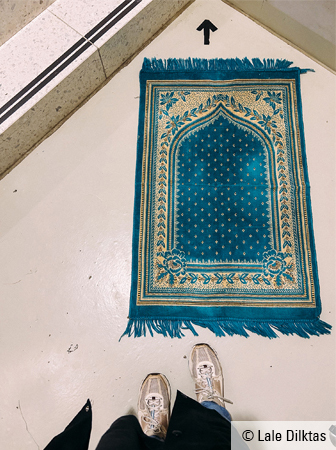
But what ideas do citizens associate with the notion of “Religious Neighborhoods”? What new perspectives emerge when exploring them through the lens of a camera? These and similar questions are addressed by the projects of the workshop participants, which will also be featured in an exhibition at the VHS next year.
The workshop began with an opening weekend during which the principal investigators of “Dynamics of the Religious” introduced the academic background of the project. Armina Omerika, Professor of the History of Ideas of Islam, outlined the conceptual framework of the “Dynamics,” Xenia von Tippelskirch, Professor of Religious Dynamics, presented the Huguenots in Friedrichsdorf as a local historical example of a religious neighborhood, and Susanne Fehlings, Associate Professor at the Institute for Ethnology, discussed the use of photography in ethnology, including its historically and colonially problematic aspects.
Depiction Without Stereotypes
This seamlessly transitioned into the second part of the workshop, led by photojournalist Julius Matuschik. In addition to technical and aesthetic considerations, Matuschik focused on how religious life can be depicted without reproducing stereotypes. These reflections culminated in an initial practical tutorial that leveraged the location of Frankfurt Volkshochschule: a photo walk that included visits to the Catholic Church of All Saints, the former Jewish cemetery on Battonnstraße, and the independent Sunni Hamidiye Mosque.
In July and August, participants presented initial findings from their own projects. Lively discussions arose, particularly around a project that explores religious neighborhoods by highlighting the problematic role of women in all major religions from the photographer’s perspective. There was consensus that the photographic treatment of religion must also enable critical engagement with it, though there were differing viewpoints on what constitutes an appropriate form of representation. How can points of critique be conveyed without reducing religion and those portrayed to a single facet? One route that emerged as accommodating both aspects was addressing the topic through artistic collages: this approach can emphasize both the fragmentary nature of the representation and the photographer’s unique perspective.
Looking at the other projects, this critical perspective on religion is further expanded by completely opposite approaches: For example, there is a project that views religious spaces as “welcoming neighborhoods” and highlights the unifying appeal of places like churches and mosques. Another project illustrates what would be missing in an urban neighborhood if religion no longer had a place, by omitting religious symbols and buildings. Meanwhile, a third project focuses on peaceful religious coexistence within families.
Boundary with Culture?
Despite their differing approaches, participants shared one common experience: discovering just how much religion, religiosity, and religious symbols are visible in urban spaces when observed through the lens of a camera – an exploration that also raised questions of distinction. If religions are always shaped by the neighborhoods where they develop and leave traces within them, where exactly is the boundary with culture? Participants also described their experiences during their photographic exploration, including the feeling that religion is a deeply personal subject, their limited personal interaction with religious spaces, and the challenges of observing religions in actual interaction or “co-creation.”
Louise Zbiranski, “Dynamics of the Religious” research alliance
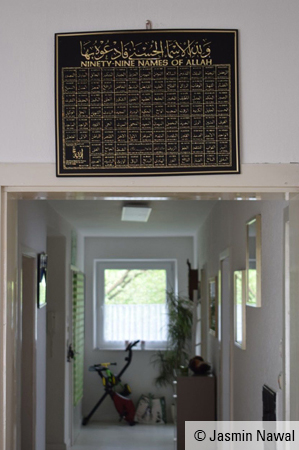
Insight into the Project by Jasmin Nawal
“In my photo series, the connection between religions and neighborhoods is portrayed not in public spaces but in private ones. This aligns with the idea that lived religion is not always visible in public but often shifts into private spaces. Religion is no longer necessarily the primary reason people come together; instead, shared activities connect people of different or similar faiths. This raises the question of how visible religion is today. Has the religious aspect moved into private spaces? And what does this say about religious neighborhoods? The concept stems from personal experiences where religion was less expressed through outward symbols and more through lived values such as compassion, generosity, and helpfulness, becoming a connecting element in everyday interactions.”