
When a cell is infected, SARS-CoV-2 not only causes the host cell to produce new virus particles. The virus also suppresses host cell defence mechanisms. The virus protein nsP3 plays a central role in this. Using structural analyses, researchers at Goethe University in cooperation with the Swiss Paul Scherrer Institute have now discovered that a decomposition product of the virostatic agent remdesivir binds to nsP3. This points to a further, previously unknown effective mechanism of remdesivir which may be important for the development of new drugs to combat SARS-CoV-2 and other RNA viruses.
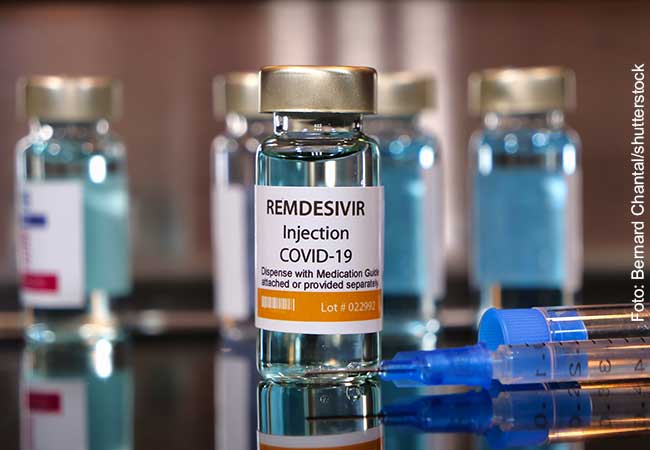
The virostatic agent remdesivir was developed to disrupt an important step in the propagation of RNA viruses, to which SARS-CoV-2 also belongs: the reproduction of the virus’s own genetic material. This is present as RNA matrices with which the host cell directly produces virus proteins. To accelerate the production of its own proteins, however, RNA viruses cause the RNA matrices to be copied. To do so, they use a specific protein of their own (an RNA polymerase), which is blocked by remdesivir. Strictly speaking, remdesivir does not do this itself, but rather a substance that is synthesized from remdesivir in five steps when remdesivir penetrates a cell.
In the second of these five steps, an intermediate is formed from remdesivir, a substance with the somewhat unwieldy name GS-441524 (in scientific terms: a remdesivir metabolite). GS-441524 is a virostatic agent as well. As the scientists in the group headed by Professor Stefan Knapp from the Institute for Pharmaceutical Chemistry at Goethe University Frankfurt have discovered, GS-441524 targets a SARS-CoV-2 protein called nsP3. nsP3 is a multifunctional protein, whose tasks include suppressing the host cell’s defence response. The host cell is not helpless in the face of a virus attack, but activates inflammatory mechanisms, among other things, to summon the aid of the cell’s endogenous immune system. nsP3 helps the viruses suppress the cell’s calls for help.
Professor Stefan Knapp explains: “GS-441525 inhibits the activities of an nsP3 domain which is important for the reproduction of viruses, and which communicates with human cellular defence systems. Our structural analysis shows how this inhibition functions, allowing us to lay an important foundation for the development of new and more potent antiviral drugs – effective not only against SARS-CoV-2. The target structure of GS-441524 is very similar in other coronaviruses, for example SARS-CoV and MERS-CoV, as well in a series of alphaviruses, such as the chikungunya virus. For this reason, the development of such medicines could also help prepare for future virus pandemics.”
Publication: Xiaomin Ni, Martin Schröder, Vincent Olieric, May E. Sharpe, Victor Hernandez-Olmos, Ewgenij Proschak, Daniel Merk, Stefan Knapp, Apirat Chaikuad: Structural Insights into Plasticity and Discovery of Remdesivir Metabolite GS-441524 Binding in SARS-CoV‑2 Macrodomain. ACS Med. Chem. Lett. 2021, 12, 603−609 https://pubs.acs.org/doi/10.1021/acsmedchemlett.0c00684