Five events in one week: The RMU policy dialogue projects connect academics and practice
Researchers who want to contribute their findings to political decision-making processes require more than intelligence. They need connections, must understand the other side’s needs, and must ensure their own ideas are understood. Conversely, staff working in political and/or public authorities benefit from a trusted network with universities, which allows them to get in touch with key experts and request their opinion. The Rhine-Main Universities’ (RMU) Mercator Science-Policy Fellowship Program and the Erasmus+ project ENGAGEgreen work at exactly this intersection. The initiatives provide spaces to foster dialogue between academia, politics and administration, develop solutions for what are often highly complex challenges, and develop personal skills. Just how well this works in practice was showcased at the end of January during five Policy Dialogue events hosted by the RMU.
Policy Meets Science: How We Work – What We Offer
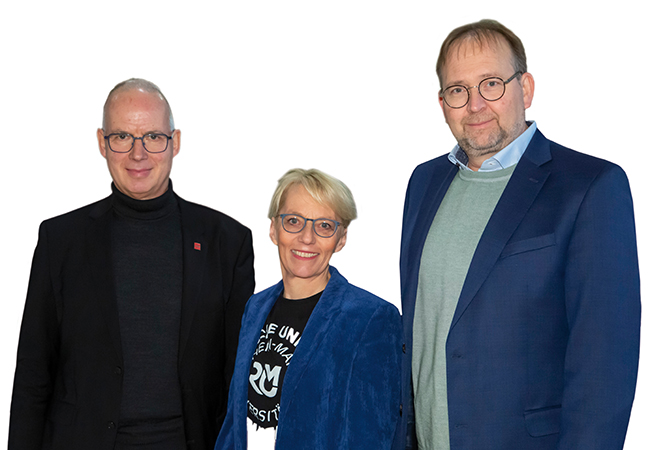
The starting point was the “Science Meets Policy” workshop organized by TU Darmstadt’s Science Communication Centre on January 23. The first part of the workshop featured various exercises that offered the 35 participating researchers an overview of policymaking and tools for academic policy advising. In the second half, Policy Fellows Dr. Elena Sondermann (Hessian Ministry of Agriculture and Environment, Winegrowing, Forestry, Hunting, and Heritage), Dr. Michael Schulze-Jackowski (Hessian Ministry of Finance), and Prof. Anke Weidenkaff (TU Darmstadt, Material and Resources), shared their views of and experiences with the exchange between academia and politics/administration. “Researchers often perceive politics and administration as a kind of black box. The workshop, and especially the insights offered by the external guests into the practice of policy advising gave participants a better understanding of the working methods and knowledge needs in politics and administration,” said Tome Sandevski, coordinator of the RMU Policy Dialogue Projects, who also led the workshop.
What You Want (to Know): Visiting the Rhine-Main Universities
Throughout January, 25 fellows from federal and state ministries, non-governmental organizations, and media outlets visited the Rhine-Main Universities, where they engaged in 142 discussions with 111 researchers from the RMU as well as collaborating scientific institutions. The fellows’ areas of interest ranged from education, security, and the future of democracy to religion, social cohesion, climate change, digitalization, and quantum technologies.
Exploring Future Technologies
On January 29, 2026, Darmstadt hosted an event focused on “Future Technologies for Energy and Security.” Thirty participants from politics, government agencies, associations, and business gathered on-site to learn about the potential of metals as climate-neutral energy carriers and innovative solutions for digital resilience. The day was organized by the Technology and Transfer Center Metal Energy Hub and TU Darmstadt’s Application and Transfer Center Digital Resilience Xchange (DiReX) . Additional cooperation partners included Darmstadt’s RMU Policy Dialogue Projects.
Birthday Celebration and Looking Back
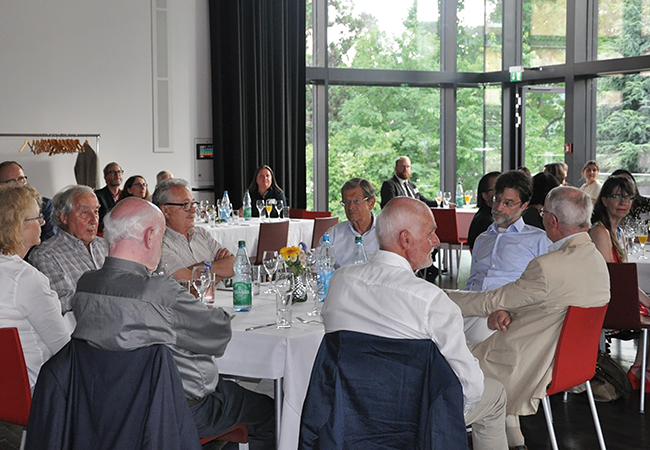
The closing event of the Mercator Science-Policy Fellowship Program and the Erasmus+ project ENGAGEgreen also took place that evening at Goethe University Frankfurt. Under the theme “Building Bridges – 10 Years of Science-Policy Dialogue Projects at the Rhine-Main Universities,” policy fellows and RMU representatives reflected on their experiences with the policy fellowship in two panel discussions.
The first panel focused on the topic “Science-Policy Dialogue Today: Between Evidence, Communication, and Trust.” It was moderated by the head of the Transfer and Contract Management unit within Research Support, PD Dr. Simone Haasler. Dr. Patrick Honecker (Chief Communication Officer, TU Darmstadt), Florian Meesmann (MDR), Rebecca Schmidt (Research Institute for Social Cohesion, Goethe University Frankfurt), and Prof. Daniel Schunk (Economics, Johannes Gutenberg University Mainz) discussed the challenges of dialogue between scholars and practitioners. They also shared how the conversations organized as part of the dialogue projects laid the foundation for numerous follow-up activities, including joint publications or residency programs. Journalist Florian Meesmann, who is also a member of the Research Institute for Social Cohesion’s Practice Advisory Board, encouraged researchers to not only share their findings with academic audiences but also to contribute to media platforms that reach a broader public.
The second panel, “From Exchange to Impact: Experiences from Academics and Practice,” focused on showcasing concrete examples of how productive the dialogue format ultimately is and the extent to which the discussions influence the ongoing work of those involved. Representing academics in the panel were Prof. Henner Hollert (Biosciences, Goethe University), Prof. Michèle Knodt (Political Science, TU Darmstadt), and Prof. Georg Krausch (President of Johannes Gutenberg University Mainz). On the practice side, the fellows Dr. Jens Martin-König and Peter Hanisch from the Hessian Ministry for the Environment and Agriculture participated. The focus of this second panel was on efficacy, centering around the question of whether the science-policy program has led to new professional briefings for participants from ministries or to legislative regulations, and to what extent the exchange has influenced scientific work. Both sides spoke very positively about their experiences. In the words of ecotoxicologist Henner Hollert: “What’s special about this program is that we realized we share common interests. In this protected space, we were able to develop and work on things together. We also learnt that we can achieve significant impact together. That personally inspired me a lot.“
A Career Outside of Academia?
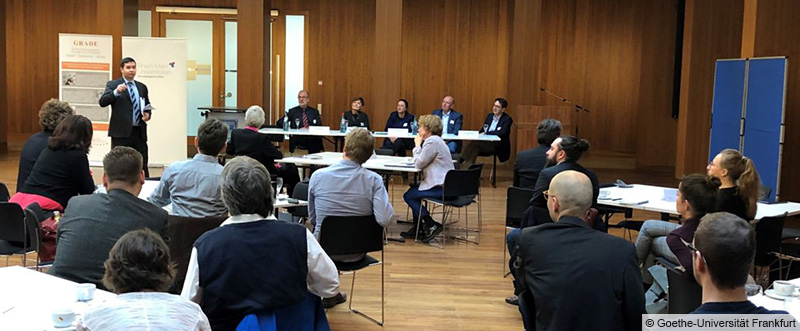
On January 30, 2026, the Policy Dialogue Projects, in collaboration with the (Post-)Graduate Academy of Goethe University (GRADE), hosted the event “From Academia to Ministries/Authorities, Media, or NGOs?” Nearly 50 Early Career Researchers engaged in discussions with Policy Fellows from federal and state institutions, MDR, and Stiftung Warentest about career paths in these practical fields and their needs for academic expertise. (Here is the link to the article in the web magazine →)
Simone Haasler, Head of the Transfer and Contract Management Division (Research Support) at Goethe University Frankfurt, was satisfied with the events: “Within the Rhine-Main Universities network, we are able to plan and implement cross-departmental and interdisciplinary dialogue formats that generate significant interest among participants from both academia and practice. This was made possible thanks to the support of Stiftung Mercator over the past ten years, which laid the foundation for various new projects like ENGAGEgreen.”
What’s Next?
The activities within the Mercator Science-Policy Fellowship Program and the ENGAGEgreen project will continue until mid-2026. That is when the funding from the Mercator Foundation will end. However, the RMU remains committed to supporting dialogue between science, politics, and administration. In fact, a Policy Engagement Toolkit is set to be introduced as early as April 2026.
Tome Sandevski, Imke Folkerts
The Rhine-Main Universities’ Policy Commitment Toolkit will be published become available in April →