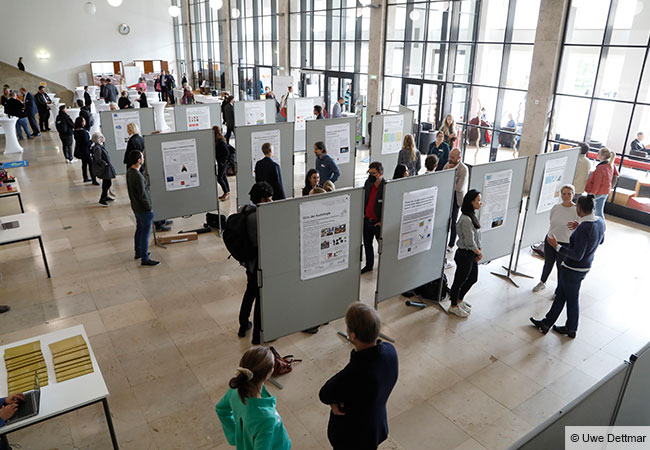
“Learning from Sports? Preventing Antisemitism in Sports Organizations – Ideas for the University”: A symposium hosted by the Faculty of Sports Sciences at Goethe University Frankfurt addressed a topic that is both pressing and timely.

Researchers, students, and representatives from the world of sports came together to discuss the current state of efforts to combat antisemitism – not only in sports, but also on university campuses. At the heart of the event was a shared goal: to transfer strategies and prevention approaches from the field of sports to the university, thereby fostering a sense of shared responsibility.
Increase in Incidents Since October 7
The conference opened with academic presentations, followed by workshops on fan engagement by clubs, antisemitism in schools, and antisemitism in sports. It concluded with a panel discussion that brought together and summarized the key findings. The panel featured Prof. Dr. Sabine Andresen, Vice President for Diversity and Equality at Goethe University, Alon Meyer, President of Makkabi Deutschland, Lennox Skalieris, a medical student and soccer player, and Lasse Müller, a sports scientist and former project manager of the prevention initiative Zusammen1. The discussion was moderated by Leonie Schultens from the Office for PR and Communications.
The conference provided a clear overview of antisemitic incidents, which have increased significantly not only in the Middle East but also in Germany since October 7, 2023. For many Jewish individuals – whether in schools, at universities, or on the soccer field – this escalation has led to a noticeable decline in their sense of security. Only a fraction of these hostilities are reported; the number of unreported cases is significantly higher – whether on the soccer field, as Meyer noted, or on campus. This societal reality served as the starting point for the discussion: How can antisemitism be identified before it becomes entrenched? And what, in turn, can universities learn from sports when addressing this issue?
From the Field to the Classroom – Parallels Between Sports and Academia
The conference explored this connection by linking sports – as both a focal point and a laboratory for social dynamics – with the university as a space for critical reflection. Lasse Müller, who has been actively involved in prevention work for many years, emphasized that sports in Germany have made notable progress in recent years, moving “from mere remembrance to action.” While early efforts in many clubs focused primarily on addressing the history of National Socialism under the motto “Never Again,” attention has increasingly shifted toward combating contemporary forms of antisemitism. Projects such as Zusammen1, initiated by Makkabi Deutschland, combine empirical research with educational initiatives and are closely linked to ongoing societal developments.
The sports science surveys presented by Müller paint a clear picture. According to one survey, 68 percent of Makkabi members reported having experienced antisemitic hostility at least once. These incidents primarily involve verbal insults, although physical attacks are not uncommon. Only 29 percent of respondents believe that sports clubs are adequately prepared to deal with such incidents. At the same time, organized sports are widely recognized as a field in which prevention efforts can have a tangible impact. For example, nearly one-third of clubs in the top four soccer leagues have implemented antisemitism-related initiatives over the past five years, ranging from commemorative projects to workshops with fans and young people.
To achieve sustainable outcomes, Meyer added, prevention work must be structurally embedded in club operations and extended into broader areas of society.
The Number of Unreported Cases Is Even Higher
Another challenge, Meyer explained, is that antisemitism in sports can only be partially captured through statistics. Many discriminatory remarks or gestures never appear in match reports and therefore do not enter the official statistics of the German Football Association (DFB). “Only a fraction of actual incidents are reported,” he emphasized, noting that the same applies across other areas of society. Antisemitism, he stressed, is a complex phenomenon that cannot be fully understood through numbers alone.
During the discussion, Prof. Sabine Andresen highlighted forms of antisemitic discrimination that have become increasingly visible on campus: “Since October 7, we have observed an escalation – not only in discussions, but also in intimidation and verbal attacks.”
For Andresen, the university’s task is now to examine the structures and cultures that enable antisemitism or contribute to its downplaying. This includes addressing which “structural weaknesses” can be tackled and how the university can communicate a clear and unambiguous stance when incidents of discrimination occur. She emphasized that the university must resist the temptation to leave the interpretation of public discourse to external actors. “We see attempts to dominate discussions and restrict spaces for dialogue. This creates a climate of intimidation – one we must actively counteract,” Andresen underscored.
“We Build Bridges”
Alon Meyer, President of Makkabi Deutschland, vividly described how the security situation for Jewish organizations has intensified since October 7. “At times, we have had to cancel training sessions or games,” he explained. “But withdrawal is not a solution.” What is needed is more interaction, not less: “We build bridges – bridges of connection, togetherness, and understanding. Many of our members are not Jewish.” For Meyer, the true potential of prevention work lies in the social power inherent in sports. It is about acting together, approaching one another, and overcoming obstacles as a team.
Fellow panelist Lennox Skalieris, a medical student and soccer player, also emphasized the emotional dimension of sports: “The star on the chest is a symbol of unity from within, but it is also often a target for hostility from the outside.” Sports, Müller added, entail “both risks and opportunities due to their emotional and physical nature.” “We are dealing with highly dynamic, often escalating situations – yet it is precisely in these moments that learning opportunities emerge.” When such experiences are transferred to educational institutions, they can foster approaches that emphasize connection over distance, building bridges through shared experiences.
Learning from Sports: Understanding – Communicating – Changing
The project Zusammen1 serves as a representative example of such an approach. It combines research, education, and organizational transfer in three steps: Understanding (analyzing and monitoring antisemitic incidents), Communicating (workshops, training sessions, and interactive tools such as the Antisemitism Barometer), and Changing (structural measures, responsibilities, and networks). The goal is to transfer this logic to the university context.
While a recent survey shows that 85 percent of universities have established contact points for addressing discrimination, only 7 percent offer specific training or tailored guidelines for instructors and students. This reveals a significant gap between perception and practice, with existing structures often underutilized or barely visible.
As in sports, clear rules, team spirit, and the courage and solidarity to stand up against discrimination are essential. Anyone who has ever played on a sports team knows that an attack on one team member is an attack on everyone. The team stands together, defends one another, and takes a clear and collective stance. Or, as Prof. Andresen put it: “We need to think of the university as a team.” Responsibility is shared – among students, instructors, and administrators alike – and everyone is affected and obligated to act.
Outlook: Toward a University-Wide Team Spirit
What can universities learn from sports, and what insights did the symposium hosted by Goethe University’s Faculty of Sports Sciences offer? First: Create opportunities for connection wherever distance exists. Antisemitism prevention must not remain purely theoretical; it needs to be experienced – through seminars, dialogue formats, or collaborative projects with partners such as Maccabi. Second: Strengthen institutional structures by establishing clear responsibilities, accessible reporting channels, and dedicated points of contact. Third: Make room for emotion. Building values does not occur through facts alone, but through empathy, dialogue, and shared experiences.
From the playing field to the university, from prevention work in clubs to educational engagement on campus, antisemitism, as all participants agreed, affects us all and requires collective strategies. When sports and academia collaborate closely, this fosters not only the transfer of methods, but also a sense of togetherness – a culture of awareness, listening, and collective action.
Kevin Knöss