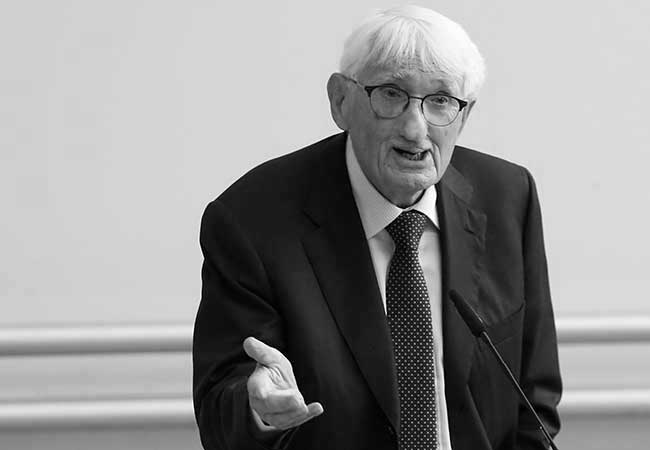
Alfons Weichenrieder, Professor of Public Finance at Goethe University Frankfurt, argues in a recent study that Net Domestic Product (NDP) offers a more realistic picture of how incomes are actually growing and which resources are truly available for distribution.

UniReport: Gross Domestic Product (GDP) is widely regarded as the central measure of economic performance. In a recent paper, you argue that it can paint an overly optimistic picture. Why is that? What has changed – and is this insight new?
Alfons Weichenrieder: It is less a new theory than an observation that can be verified using official data. The starting point is simple: GDP includes depreciation – that is, the loss in value of the capital stock. But those resources are not available for income or consumption. They are needed to replace machines, buildings, and infrastructure. Anyone concerned with long-term economic sustainability can therefore be misled by GDP. The key point is that depreciation has risen significantly in Germany – from around 15.6% of GDP in 1991 to roughly 20.6% in 2025. As a result, GDP is growing systematically faster than the income that can actually be distributed. Measured by GDP alone, economic growth appears stronger than it really is from the perspective of disposable income.
What advantage does Net Domestic Product (NDP) offer instead?
NDP subtracts depreciation from GDP and therefore comes closer to the income that can actually be distributed without shrinking the capital stock. If you want to know how strongly incomes are growing and what resources are genuinely available, NDP provides the more realistic picture.
Why, then, does GDP still dominate economic policy debates, even though these distortions should by now be clear? Is politics simply reluctant to give up a flattering indicator?
No, it is not a matter of bad faith. GDP remains a useful indicator when assessing the cyclical utilization of production capacity. It has been the central measure in national accounts for decades and is deeply embedded in policymaking, statistics, and public debate – not just in Germany, but worldwide. NDP also reacts more strongly to changes in relative prices. That means it can shift even when the underlying economic cycle has not. For short-term economic analysis, GDP therefore still has clear advantages.
Where do you see the risks – especially at a time when Germany’s economy is already under pressure and growing only weakly?
The main risk is that the economy may be overburdened. A focus on GDP obscures the fact that, measured against NDP – the economy’s actual net output – debt, social spending, and public expenditure have risen far more sharply than GDP-based indicators suggest. Take total public expenditure: in 2024 it amounted to around 49.5% of GDP. That is the familiar expenditure ratio often used to show the scale of state involvement in the economy. Since 1991, it has increased by a moderate 2.9 percentage points. But if the same ratio is calculated using NDP, the picture changes substantially. It rises to 62.2%, with an increase of 7.1 percentage points since 1991. In recent years, public spending has therefore expanded markedly relative to the income actually available in the economy. People may differ politically on how to assess that development – but the conventional indicator does not capture it adequately.
Does rising depreciation generally point to an economy that is increasingly occupied with maintaining its capital stock rather than creating new wealth?
Yes and no. On the one hand, depreciation rises because the capital stock has become older on average because of weak new investment. Older capital goods have shorter remaining lifespans and therefore higher depreciation charges. On the other hand, intangible investment – in research, software, patents – now plays a much larger role. These assets are often shorter-lived than physical capital and are therefore written off more quickly. What is clear is that a rising depreciation share means a larger portion of economic output must be devoted simply to maintaining the existing capital stock.
Is this growing problem with GDP also visible in other European countries? Could it point to a broader economic crisis across the West?
With the exception of many Eastern European countries, a similar trend can be observed in numerous advanced economies – across the EU, but also in the United States, Canada, and Japan. This suggests gross indicators such as GDP should increasingly be complemented by net indicators internationally in order to provide a more realistic picture of welfare and prosperity. Weak or slower growth does not automatically amount to a crisis. But economic policy often tries to mask problems through debt. That becomes dangerous when economies are no longer able to grow their way out of those debts. In countries with high explicit public debt and large implicit liabilities embedded in social security systems, sustainable economic policy should pay particular attention to growth. If society has already loaded a heavy backpack onto younger generations, it should be careful not to make that burden heavier still through growth-hostile policies.
Questions: Dirk Frank
Study
»Abschreibungen und die wachsende Kluft zwischen Brutto- und Nettoinlandsprodukt«
von Alfons Weichenrieder: https://doi.org/10.1515/pwp-2025-0045