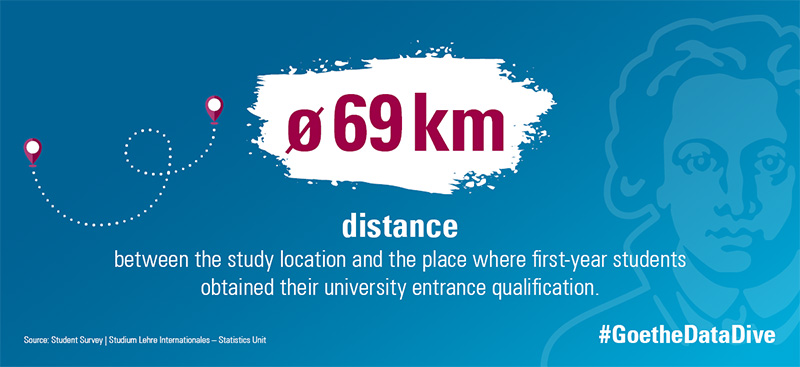
On average, there are 69 kilometers between Frankfurt, where students attend Goethe University, and the location where first-year students obtained their university entrance qualification (HZB).
However, the distances vary significantly depending on the type of degree program. According to official statistics, teaching degree students tend to stay closer to home after high school, with over 85% of students training to teach at elementary schools, high schools, and middle schools coming from within a 50-kilometer radius of Frankfurt. For special education teaching degrees and bachelor’s programs, 75% of students earned their HZB within 50 kilometers of Frankfurt.
In contrast, master’s students and students pursuing a state examination in medicine commute much more, studying on average 113 and 118 kilometers away from their hometowns, respectively.
Many universities in Germany have regional catchment areas (Hüsch, 2023; Data-CHECK 2/2024). The reasons for this can include economic factors or the stability of staying close to home — especially at the beginning of one’s studies. At the same time, the significantly greater distances for some groups (e.g., master’s students, medical students) can be explained by academic requirements, admission quotas, or individual life plans. These patterns highlight that choosing where to study is a complex decision, influenced by proximity to home, financial considerations, social connections, and long-term goals.
What does student mobility mean for Frankfurt as a location?
The extent to which Goethe University ties skilled professionals to the region is highlighted in the graduate study. The analysis identifies four groups based on the relationship between where students earned their university entrance qualification (HZB) and their employment 1.5 years after graduation:
Stayers: They earned their HZB in Frankfurt and continue to work there after graduation.
Newcomers: They moved to Frankfurt for their studies and stayed on to work afterward.
Leavers: They earned their HZB in Frankfurt but work in another region after graduation.
Pass-throughs: They came to Frankfurt from elsewhere for their studies and left the city after graduation.
The results show a positive migration balance across all types of degrees. In other words, Frankfurt gains more graduates from other regions than it loses young people with Frankfurt-based university entrance qualifications after their studies. Around one-third of bachelor’s, master’s, and doctoral graduates remain in Frankfurt after graduation — even though they originally earned their HZB elsewhere. This makes Goethe University a regional magnet for qualified professionals. At the same time, the high proportion of pass-throughs — especially in state examination programs (excluding teaching degrees) at 65.1% — indicates that many students deliberately choose Frankfurt for their studies but later pursue careers nationwide or internationally.
The data clearly highlights: For many students, proximity to home plays a key role in choosing their place of study — especially for bachelor’s and teaching degree students. In these cases, the Goethe University’s catchment area is primarily within a 50-kilometer radius. Master’s students and medical students pursuing state examinations tend to choose Goethe University for academic reasons or due to the nationwide allocation of study places, and they are more likely to accept greater distances from home. Moreover, when students come to Frankfurt for their studies, they often stay afterward to work. The positive migration balance of graduates underscores the importance of Goethe University for the regional job market.
Team QUIKKS
1 Students enrolled in their first semester in the specified degree programs with German higher education entrance qualifications during the winter semester 2025/26
2 Graduate studies cooperation project (KOAB), combined examination years 2018–2023
3 Teaching degree programs were excluded from this analysis, as most graduates are in their teaching internships 1.5 years after graduation, which KOAB does not classify as employment.
For more information about the coverage of the semester ticket or upgrading to the Germany ticket:
Semester ticket →
Literature:
Hüsch, M. (2023), University choice among students in Germany: How important is proximity to home, and where do international students prefer to study? (CHE Impulse No. 16). CHE Center for Higher Education Development.