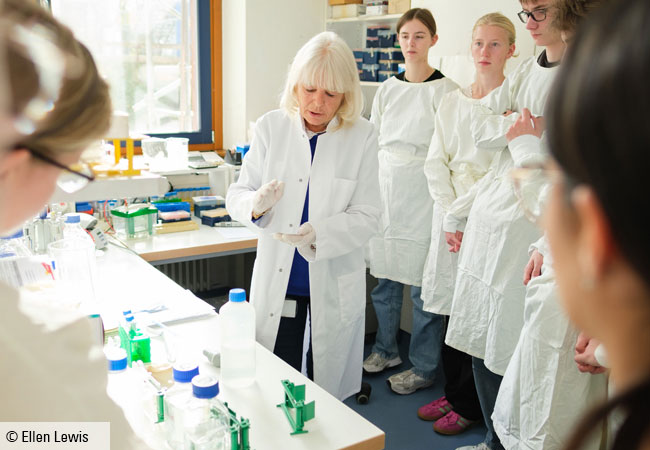
How a novel drug against ovarian cancer is being developed at Universitätsmedizin Frankfurt was something students from the Olsberg Vocational College (Berufskolleg) in the Hochsauerland district, Germany, were able to learn during a laboratory visit to the Department of Gynecology in early November. Ovarian carcinoma — a tumor of the ovary — is, with around 7,400 cases per year in Germany, a relatively rare form of cancer, but one that is usually detected late, when secondary tumors have already formed in the pelvic region and abdominal cavity. Prof. Klaus Strebhardt from the Department of Molecular Gynecology and Obstetrics explained to the class that surgeries and chemotherapy unfortunately often fail to completely destroy all tumor cells — with fatal consequences: More than half of patients with ovarian carcinoma die within the first five years after diagnosis.
In the search for new therapies, Strebhardt and his team are pursuing a technological approach that has already been used as the basis for producing vaccines against SARS-CoV-2: synthetic messenger RNA, or mRNA, which is introduced into cells and used there as a blueprint for producing proteins. The team introduced synthetic mRNA for a protein called p53 into ovarian cancer cells. p53 protects healthy cells from becoming cancerous, but it does not function adequately in 95 percent of affected patients. With the help of synthetic p53 mRNA, the researchers were able to replace the defective p53 in cultured cancer cells, in cultivated ovarian tumors (organoids), and finally in mice, causing the cancer cells to disappear almost completely.
After the laboratory visit, the prospective biological and chemical technical assistants were welcomed by a very special guest for a discussion session: Nobel laureate Prof. Katalin Karikó. Together with Drew Weissman, she received the highest scientific honor in 2023 for developing this very mRNA technology. The class had won the visit to Frankfurt in a nationwide competition held by the initiative “Tierversuche verstehen (“Understanding Animal Testing”), and thus the conversation with the Nobel laureate also revolved around animal experiments. If one wanted to avoid them, Karikó said, one would have to test directly on humans — or do nothing at all. Working in science, she said, is both a blessing — she can conduct experiments to understand how things work and fit together — and a curse, because she is constantly driven by the thought that people may be dying from diseases her research could potentially help combat. What advice does she give young people? “Find a way to cope with stress — I, for example, go running every morning. And don’t worry about what you can’t change.” Her parents, an accountant and a butcher by profession, were always role models for her: “They taught me that life is hard work — and how to make good sausages.”
For the students from Olsberg, it was a day that gave them insight into cutting-edge cancer research — and showed them the paths that can lead from the laboratory bench all the way to the Nobel Prize.
More information:
– mRNA therapeutic against ovarian cancer →
– CARMA fund invests in mRNA treatment →