Order and disorder in the University Library
by Jonas Krumbein
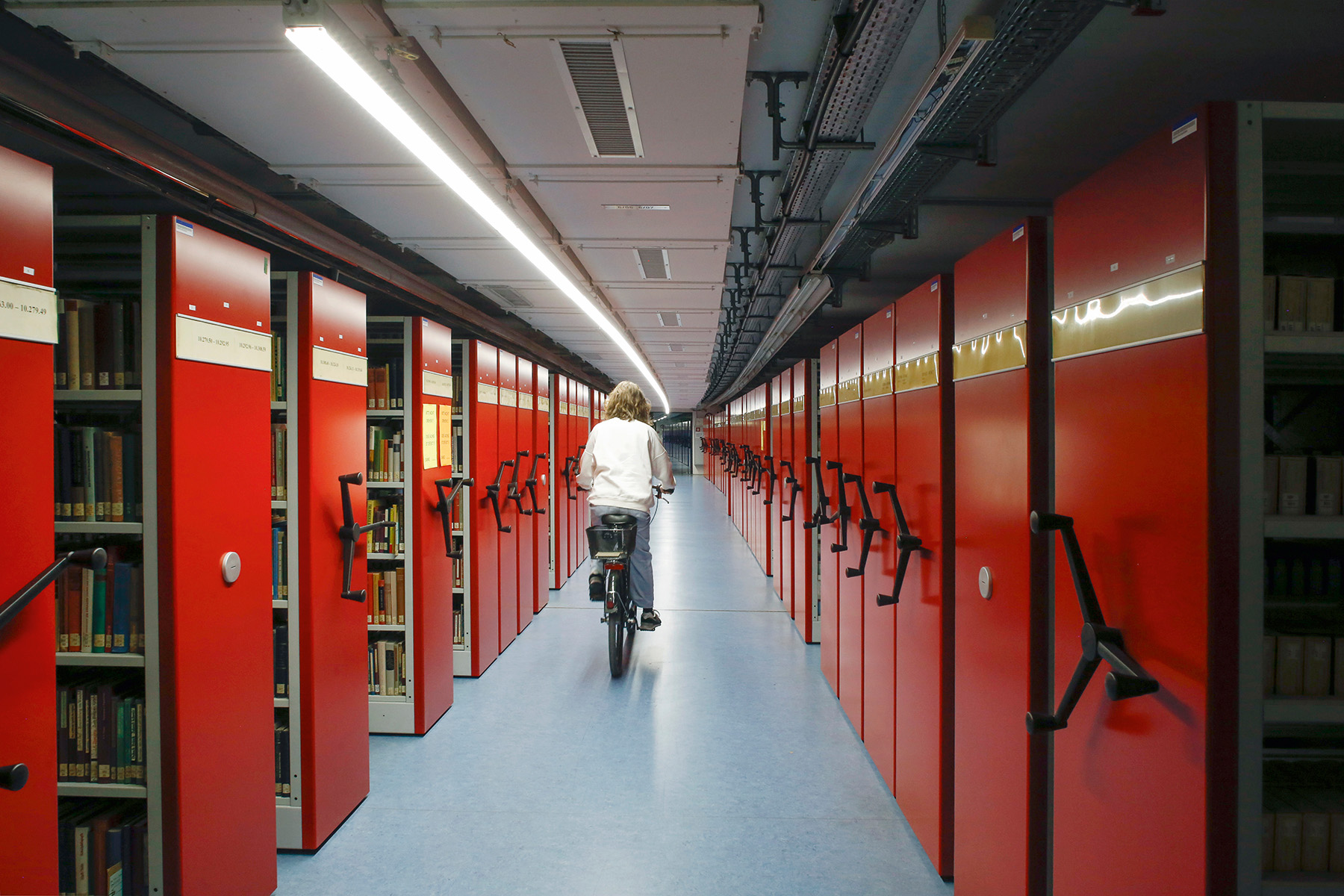
Photo: Uwe Dettmar
With over eleven million printed and digital media, the University Library Johann Christian Senckenberg is one of the largest university libraries in Germany. How does the team keep the vast collection in order? How do they find what they are looking for?
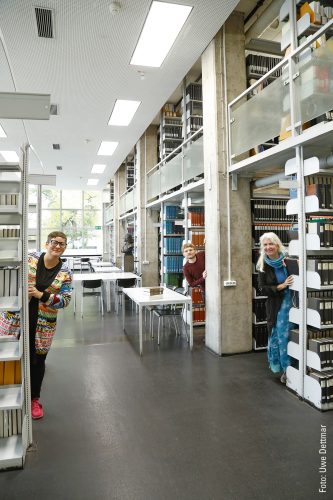
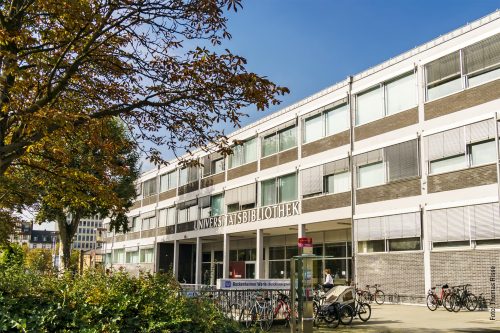
Angela Hausinger, Deputy Director of University Library Johann Christian Senckenberg, welcomes us to her office on the first floor of the Central Library’s main building on Bockenheimer Warte. The three-story building, which looks like a simple office block, was designed by Ferdinand Kramer, one of the architects of the “New Frankfurt” of the 1930s. Banned from working in Germany by the Nazis, Kramer emigrated to the USA in 1938, where he met Theodor W. Adorno and Max Horkheimer, the directors of the Frankfurt Institute for Social Research. When Horkheimer returned to Goethe University Frankfurt as its president after the Second World War, Kramer was appointed as the university’s director of building. Today, Horkheimer’s legacy can be found in Kramer’s library building, which thanks to its system of reading rooms and study cubicles reminiscent of American libraries was celebrated as the most modern in Europe when it opened in 1965 and is now a listed building. For Hausinger and her team, however, the Kramer Building will soon be obsolescent, as the Central Library is due to move to Westend Campus at some point in the next few years. A mammoth task for the library staff.
In competition with Google
For Hausinger, the University Library is also confronted with mammoth tasks in its day-to-day business: “Digitization is generating a flood of data that can never be fully cataloged. Google, however, gives the impression that it can answer any query whatsoever. As a university library, we are in competition with Google.” Google, the global brand under the umbrella of Alphabet, one of the most profitable, most valuable and most innovative companies in the world. A company that invests billions of dollars in artificial intelligence. How does Hausinger hope to survive this competition, how does she want to convince students and researchers that University Library Johann Christian Senckenberg can sometimes provide better quality answers to their queries? “With the core expertise of libraries,” says Hausinger: “We endeavor to steer our users through the flood of information – and away from fake news – to information whose quality is assured and to help them distinguish what is important from what is not.”
A catalog system that only finds what users are actually looking for
If you enter “Thomas Mann” in the Google search mask or that of a conventional library catalog, results will pop up that are not only related to the Nobel Prize laureate himself. Instead, they will contain everyone whose name is Thomas Mann, or who has published something about him, or who has otherwise left their footprint on the internet, such as an American actor, a German lawyer and economist, and even two politicians. Therefore, anyone seeking information about the author Thomas Mann for a presentation or research project must first filter the results. Franziska Voß, theater studies graduate and a member of the library staff, calls this “weeding out ambiguities”. She is working for University Library Johann Christian Senckenberg on a collaborative cataloging system, known as the Integrated Authority File (“Gemeinsame Normdatei” (GND)), an online knowledge hub. “Authority data,” write the project leaders, a consortium led by the German National Library, on the GND website “is used for the secure identification of the entities they describe, ensuring the disambiguation of entities with the same name.” In other words: A user conducting research on the Thomas Mann who won the Nobel Prize for Literature should not be shown any other Thomas Mann. This is how it works: A unique identifier, called the GND ID, is assigned to people, e.g. the author Thomas Mann, corporate bodies, e.g. theaters, or geographic units, e.g. the City of Lübeck, that clearly flags them. It is also possible to search by subject term, such as the First World War or works such as Thomas Mann’s social novel “Buddenbrooks”, via the ID incorporated into library catalogs. And when scholars discuss Thomas Mann’s novels and their adaptation for the theater at a conference and publish the results in conference proceedings, a GND ID is allocated to these proceedings, too.
IN A NUTSHELL
• Through customized services, University Library Johann Christian Senckenberg facilitates access to online knowledge by making relevant collections available to user groups such as researchers. An example is the “Performing Arts” search portal, which can be used to search for stage performances, among other things.
• University Library Johann Christian Senckenberg houses over eleven million items, of which 8.7 million are physical media. There are around 5.9 million (physical) items at the Central Library, which can be borrowed or at least ordered for use in one of the reading rooms.
• If an item that a user has ordered cannot be found in the stacks, for example because it has been shelved in the wrong place, and the user says they need it urgently, colleagues with a special talent for finding things go into action.
Even circus programs can be found
But the Integrated Authority File can do more than just produce unambiguous search results. For example, Franziska Voß can use it in her work at the library to link knowledge resources. Anyone conducting research on Mann’s Buddenbrooks, for example, will also find a stage version by the author and playwright John von Düffel. And it is even possible to click on external knowledge resources such as Wikipedia via the GND reference system.
But that’s not enough for Franziska Voß. Her specific task at the library is to take care of researchers’ requirements – for example those working in theater and dance studies. She also looks after their interests and heads the “Performing Arts Working Group” of the GND cooperative, which brings together libraries, archives, museums and associations in the performing arts, for example. The aim is to make it easier to find performing arts such as theater performances or circus shows, which are documented in programs or stored as collection objects. To achieve this, these cultural events would also have to be flagged with a GND ID – just like works or persons.
Rules like a peer review procedure
However, anyone wanting to set up a new cataloging category and record rules must first convince the GND Committee. The German National Library, the library networks of the German-speaking countries and their participating libraries, the German Union Catalogue of Serials (ZDB), and many other institutions are represented on this committee. It is a self-administration and quality control system similar to the peer review process, where experts in the same field review research papers for compliance with the rules of good scientific practice before they are published. Franziska Voß must therefore justify to her GND peers why a specific event is needed as a new cataloging and search category in the GND system. Voß argues: “Theater scholars are interested in individual performances, for example if they have caused controversy or a scandal.” Neighboring disciplines also benefit, she says, from events being easier to find in libraries, archives and collections – for example, a historian who is interested in local differences in the reception of a traveling exhibition.
The University Library as a digital information provider
Franziska Voß’s work shows how close to science and how specialized the work of a large university library is today, how digital its services are – and how diverse the user groups and their needs are that the team at University Library Johann Christian Senckenberg, with almost 220 full-time staff, must meet. There are specialized information services for specific fields such as “Performing Arts”. Via the corresponding search portal, Franziska Voß and her colleagues responsible for the service draw together knowledge resources from archives, collections, museums and libraries, for example, which were previously difficult to access, and make them available even from the computer at home. The German Research Foundation (DFG) funds over 40 such specialized information services for various scientific disciplines nationwide – from African studies to biodiversity research and theater studies, six of them alone at University Library Johann Christian Senckenberg.
The diversity of tasks in a modern university library is also mirrored in the staff working there, which includes specialists in librarianship as well as experts in a wide variety of specialist disciplines and information technology. Together, they provide an information infrastructure that supports research. “Technologies and concepts such as linked data or natural language processing are adapted and integrated in subject-specific services,” explains Thorsten Fritze, software developer, Specialised Information Service Linguistics.
For the University Library, the possibility for scientists to enter, store and publish research data from experiments, measurements, simulations or surveys, for example as part of the Goethe University Data Repository (GUDe), is a logical extension of its mandate, as cataloging research data follows similar rules to cataloging books. For around 50 years now, the University Library has no longer used card indexes to sort these, but instead a database that informs staff which items are out on loan and who has borrowed them. Beyond that, it enables users to retrieve online resources with just a few mouse clicks, reserve books that are already out on loan and order books from the stacks for borrowing or use in the reading rooms.
Recollections of disorder from the life of a librarian
Libraries are – or are even always – based on collections. And it is possible to introduce order into collections – or else not. My collection of champagne corks, for example, is a case in point. It once started out after a few drinks, and now a jumble of corks gathers dust in a large jar. There is no need for me to create any kind of order or to sort them because I’m going to use them as insulation at some point anyway (am I really?). The stamp collection of my youth is a different matter: It’s hard to imagine it without some kind of order, even if not a single girl has ever come home with me because of it.
A library is also a collection that is hard to imagine without order. For a long time, cataloging in German libraries followed the “Prussian Instructions” (PI), which contained an extensive set of rules and regulations as to how books should be cataloged. The PI were first published in 1899 and still frequently applied in the 1980s. When cataloging books, for example, librarians were obliged to take appositions and the “first independent noun in the nominative case” into account. The rules governing cataloging in libraries are meanwhile international and called “Resource Description and Access” (RDA). And naturally there are now even more rules, instead of fewer.
But whether PI or RDA – the human factor sometimes negates even the strictest rules. In the 1960s, for example, there was a librarian at the University Library in Frankfurt who did his own thing. He specialized in “Frankfurt Literature”, and his passion for collecting knew almost no bounds. If there was an exciting article about Frankfurt in a magazine, he would remove it from its usual place in the stacks and catalog it in the “Frankfurt Collection”. After that, the magazine was lost to any user requesting it. It wasn’t until much later that the library team realized what had been going on and order was restored.
One of the gentleman’s predecessors was also an ardent collector: Arthur Richel, head of the “Frankfurt Department” at the City Library from 1906 to 1933, the precursor of the University Library. He collected simply everything connected with Frankfurt that he could get his hands on. The rule that libraries only collect books and magazines, and possibly maps, clearly failed to interest him. That is why the “Frankfurt Collection” today still contains unique unbound collections such as one on the “International Airship Exhibition 1909” in Frankfurt: booklets, brochures, leaflets, letters from the organizing committee, admission tickets, orderlies’ armbands, and so on and so forth.
Such “special collections” are not uncommon in a large library. They wait patiently for a librarian, trainee, professor or student to set eyes on them and introduce some kind of order. The time of their discovery is unpredictable and eludes all attempts at order. Just a few examples from our University Library: several thousand bookplates, camouflaged publications from the Nazi era, lithographed correspondence from the 1848/49 revolutions, memorabilia of music and theater personalities … But perhaps the old order is also a thing of the past, and books lying around unsorted will soon cease to upset the librarian’s happy disposition? Anyone planning to sort and line up eight million books naturally requires a lot of shelves. Unused space must be kept free to accommodate new additions, which – according to the existing order – belong exactly there. But does it have to be like that? A countermodel is organized disorder, the “free floating library” where books have no fixed place on the shelf. A new book or a book returned from the reading room after use is simply placed in the next free space. Library 4.0 makes this possible: The electronic library management system must remember each time where the book is now located. Successful retail giants operate their warehouses in a similar way. Will “free floating books” be the rule in the University Library’s new building in future?
Bernhard Wirth
Searching for misplaced books
But the University Library is not always able to “deliver”. Books and journals are not always where they should be. Time to bring in the detectives! That’s what they jokingly call colleagues at the Central Library with a special talent for finding misplaced items. Michaela Schöneborn, for example. She trained as a media and information services assistant at University Library Johann Christian Senckenberg and now works in the “Information” team at the Central Library. However, it is Schöneborn’s experience and intuition, rather than her training, that tell her where misplaced books might be.
On a Monday in August, she hurries through air-conditioned corridors in the bowels of the library that seem to stretch for kilometers. Books are stored here in the stacks until someone orders them. Schöneborn is holding three search slips. An atlas with the Slovakian title “Atlas krkonosských mechorostu a hub”, a book about Kenya’s military intervention in Somalia and a pamphlet about the forced eviction and destruction of Kurdish villages by Turkish security forces are missing. The pamphlet and the book are still registered to users’ library accounts, but both claim to have returned them. The atlas should in fact have been in the stacks but had already remained elusive during a first search. “After an item has been ordered twice or when users say they need it urgently, we investigate,” says Schöneborn, explaining the criteria that one of the millions of library items must fulfil before a search begins.
To the bookshelves by bike
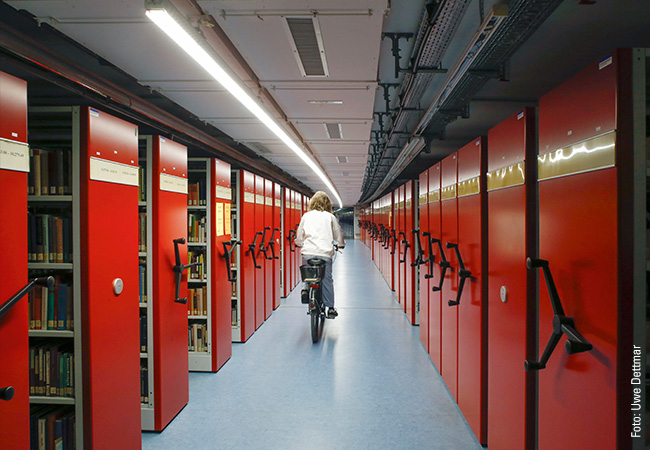
The long underground corridors of the stacks house seemingly endless rows of shelves filled with millions of books. Only staff have access to this area. Those less fit than Michaela Schöneborn or in an even greater hurry go by bike. The duty rota reveals whether oncoming traffic can be expected, but this is easy to hear anyway in the silence of the stacks.
In search of the three books, Schöneborn casts her eyes right, left, up and down from where they should have been – in vain. Next, she follows the scent of transposed digits. In the case of the atlas – book number 90.874.19 – she checks 90.874.91. Again, in vain. Something else then occurs to her: “Atlas” sounds like a big book. And big books are sometimes labeled with the letter “Q” (for quarto) in the Central Library. But when book size is gauged by eye as they are stacked on trolleys to take them to their shelves, one might end up in the “Q” category that doesn’t belong there. Schöneborn marches past bookshelves, along corridors and up and down stairs to the Zeppelin Stacks (thus named because they are located under Zeppelinallee, above the No. 4 underground tram line). When a train passes by, the floor vibrates. It smells of dust and old leather book covers. She stops at Q 90.874.19, and, sure enough, there it is: “Atlas krkonosských mechorostu a hub”, a Slovakian atlas about fungi. “It really is quite big,” says Schöneborn, “maybe I’ll add a ‘Q’ to its number so that it doesn’t get misplaced again.” But the atlas goes first to the lending desk – and the good news for the user: “We’ve found it!”
Schöneborn will not set eyes on the other two books today. And because she or her colleagues have already hunted for them for the third time and they are not recorded as returns in the lending system, the “searches” now become “replacements”. This is the term used when the person to whose library account the book is registered is obliged to replace it.
This does not always have to be expensive. “We advise people to replace lost books themselves. This is usually cheaper because we also accept used copies as replacements if they are in good condition,” says Michaela Schöneborn. She is satisfied with the outcome of today’s search. After all, “Detective Schöneborn” has found the misplaced atlas and brought some order to the vast collection of around eleven million items.
The author
Jonas Krumbein, born in 1985, studied history of science and political science in Freiburg and Durham (England) and works part-time as a freelance journalist.
The author
Bernhard Wirth,born in 1964, is a qualified librarian and in charge of the Central Library Staff Departments for PR and Personnel Development.