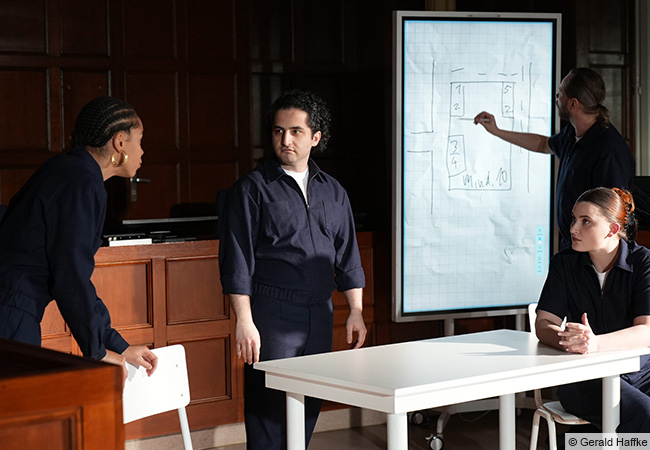
Six years have passed since February 19, 2020 – the day a 43-year-old mentally disturbed perpetrator from Hanau shot and killed nine of the city’s residents and seriously injured six others before killing his mother and then himself. Racist hatred sparked the deadly killing spree. One of the severely injured victims succumbed to his injuries in January 2026.
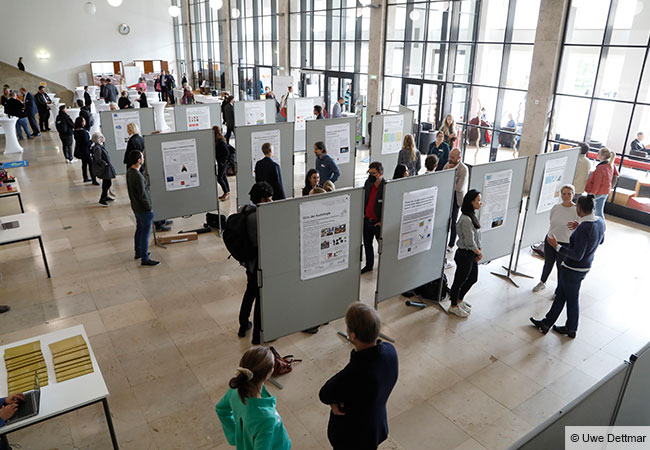
While it was not possible to hold the perpetrator himself accountable, the panel discussion and theater performance organized by Goethe University’s “Criminology and Criminal Law” department showed how essential it is to process these events from a judicial, social, and political perspective. The play and discussion were organized by Prof. Tobias Singelnstein and Dr. Justine Diebel, in collaboration with the Institute for Social Research, to mark the sixth anniversary of the attack. Written by Tuğsal Moğul and produced by the Mainz State Theater, the play “And Now Hanau” has already been performed at various venues. Goethe University’s Casino Ballroom now counts as one of them.
The performance featuring Vincent Doddema, Flora Udochi Egbonu, Anneke Gies and Sabah Qalo vividly brought the events of February 19 back into focus. Based on two years of research by the author and director, “And Now Hanau” unfolds the sequence of events as documentary theater. The play makes it unequivocally clear that the lasting trauma was caused not only by the horrific act itself but also by the (in)action of the police. A distress call from one of the eventual victims was not answered, relatives of victims were treated like suspects, and they were left in the dark for hours about what had happened. An emergency exit was blocked – allegedly to prevent escape during police raids. Efforts to come to terms with the events and honor the victims have fallen far short of expectations. The victims later founded the “Initiative 19. Februar”, advocating for a lasting culture of remembrance for victims of right-wing terrorism and launching the campaign “Say Their Names.”
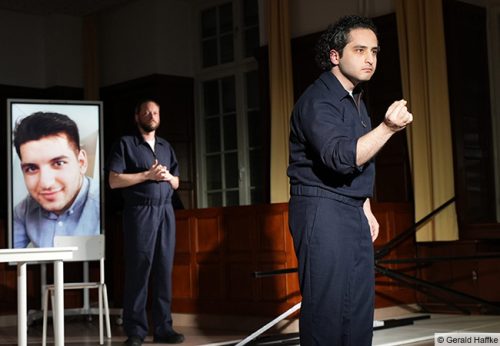

The performance was preceded by a panel discussion moderated by Dr. Justine Diebel (Goethe University Frankfurt) and Dr. Felix Trautmann (Institute for Social Research). Attorney Waltraut Verleih, racism researcher Lorenz Narku Laing, author, physician, and director Tuğsal Moğul, and Armin Kurtović from the Hanau “Initiative 19. Februar”, who lost his son in the attack, shared their individual perspectives on the incident and the responses from the police, the judiciary, the political establishment, and society. Central to the discussion was the question of how artistic engagement with far-right extremist acts can contribute to their broader reckoning.
The panel unanimously agreed that in the case of Hanau, as in other cases, many mistakes were made in the police, political, and societal handling of the situation. They also agreed that society still exhibits many racist behaviors, regardless of how well-integrated a person may be. “We need to work on remembrance,” explained director Moğul, describing what motivated him to create his play. The financial resources of the theater allowed for an immediate experience, fostering greater emotional engagement.
The response to racially motivated crimes is always the same: a loud outcry, but no adequate follow-up, said racism researcher Lorenz Narku Laing, professor at the Protestant University of Applied Sciences Bochum. Right-wing extremist acts are still portrayed as isolated incidents, and the majority of society does not feel sustainably affected. For attorney Waltraut Verleih, the search for justice is not primarily a legal matter. She emphasized that it is more important to encourage the public to confront the issues at hand — something that artistic engagement with the topic can also effectively support. There were differing views on the role of the state. Only nuanced criticism can lead to change, stressed Prof. Laing. After all, this state enables racism research and a play that addresses the events. However, Laing called for the judiciary to take a more active role in addressing right-wing extremist violence. He also advocated for greater diversity in state institutions. Contributions from the lecture hall revealed that not everyone places hope in this form of representation. Armin Kurtović, a family member of one of the victims, expressed hope for success in his lawsuit before the Federal Constitutional Court. What matters most to him is that authorities acknowledge their mistakes and take responsibility. “We’ve hardly had time to grieve; we’ve only been fighting,” he said.
Criminal law professor Tobias Singelnstein was pleased with the event, stating, “The attempt to bring together scientific, legal, artistic, and civil society perspectives in a constructive dialogue has, in my view, been successful.”