Introducing the “Critical Computational Literacy @ GU – Future Skills and Beyond” project to develop a modern, scalable, and certifiable course offering on AI & Co. for all Goethe University members.
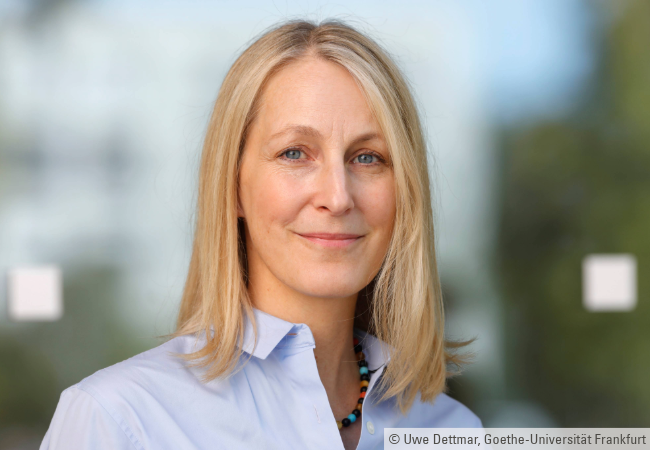
When Franziska Matthäus recalls the genesis of the project, it almost sounds like a fortunate coincidence: On the one hand, Santander Universities had shown strong interest in bringing the topic of “Future Skills” to Goethe University Frankfurt. On the other, the Center for Critical Computational Studies (C3S), founded in 2023, had already begun working on building teaching structures that not only reflect the growing importance of computational approaches, but also combine basic technical skills with critical reflection on the impact digital technologies have on society and power relations. “It was a perfect fit,” Matthäus emphasizes. “Our basic idea was to anchor teaching formats within the university in such a way that they achieve the widest possible reach – which also aligned with the interests of Santander Universities.”

Introductory Courses on Programming, AI, and Critical Reflection – Open to All
The idea behind the new certificate program is to provide Goethe University students and staff with foundational knowledge and technical skills, as well as basic competencies for critical engagement with computational methods. The goal is for participants to experience computation as something applicable to their own academic development and malleable in service of societal values and goals. On the technical side, the program covers an introduction to data & algorithms; basic programming, mathematics and statistics skills; as well as foundations of AI. The aim is to enable participants to independently solve computational problems and reduce reliance on commercial or non-transparent external software. The course offerings seek to demystify emerging technologies and empower users to engage with them independently – including with European-developed language models that individuals can train themselves. What’s more, engaging in these topics is often less difficult than one might think.
In the area of critical reflection, the focus is on societal, ethical, and legal issues related to data, algorithms, and AI. Planned offerings include courses in philosophy, ethics, and law – all of which help encourage a critical reflection on our interaction with computational tools, analyze the social implications of select practices, and discuss their impact on power dynamics and social structures.
The foundational competencies are also intended to foster the interdisciplinary dialogue between Goethe University’s different academic cultures, giving both student and employee participants insights into both new technical possibilities and the societal challenges associated with them. While technical courses are especially aimed at students and scholars in the humanities and social sciences, critical reflection courses are designed to complement those in STEM fields. This lowers the barrier to engaging in discourse on societal challenges as well as on the new opportunities offered by modern technology.
Low-Barrier Entry
The voluntary courses are easily accessible, designed for all university status groups, and will also integrate scalable external resources, such as Massive Open Online Courses (MOOCs) and Open Educational Resources (OER). These self-learning resources offer many advantages: they are often free, high-quality, and allow unlimited participation with flexible access, enabling learners to acquire knowledge and skills exactly when they are needed. This supports students who work part-time or have caregiving responsibilities, as well as anyone who benefits from asynchronous learning. An additional advantage is that users can explore the content first and repeat course units as often as they like.
“This is also attractive for instructors,” says Matthäus. “Online courses can be embedded into existing in-person classes as part of a flipped-classroom model or serve as supplementary resources. Ultimately, the program opens up new opportunities for research, as metadata from usage can help continuously improve and expand the offering.”
Recognition for online courses can be provided via digital badges. Matthäus adds: “We’re also keeping an eye on European initiatives that seek to link certificates and transcripts to a secure digital ID” – directly linking the credentials for individual courses to the learner’s ID. The learner, in turn, can easily access the certificates via the app.
Ten Faculties and Counting
In her role as founding director of the C3S Teaching Division, Matthäus had previously initiated discussions with various deans of studies. Together, they explored where there was an urgent need for computational and critical skills and what forms of cooperation were feasible. “The outcome was clear: almost all faculties expressed a desire for such offerings but often lack the capacity to add extra teaching. When the opportunity for a certificate program through Santander Universities arose, I returned to those initial conversations – and that’s how the initiative was born.” So far, 10 faculties are participating, along with staff from studiumdigitale, the methodology centers, the University Library, and students of course. The initiative is currently working in subgroups to define the program’s learning objectives and content modules. At the same time, studiumdigitale is developing a Moodle platform to host the content. Plans also include an automated testing system for the certificate, potentially using language models to generate content-based test questions.
Integration into Degree Programs
The certificate will consolidate the learning modules into a formal qualification. This is particularly relevant for students who want to document extracurricular learning alongside their formal coursework, Matthäus explains. “There is also the possibility of integrating the courses into degree programs – for example, as optional or elective modules. However, the allocation of credit points will be at the discretion of each degree program coordinator.”
For researchers interested in building expertise in this area, the program offers a professional development opportunity they can take advantage of. Similarly, administrative and technical staff might use the program to better understand how AI works, how to apply computational methods in their roles, or gain insights into ethical and legal issues.
Pilot Courses Starting This Winter Semester
Matthäus hopes that, with support from studiumdigitale, the first courses will launch as pilot versions this upcoming winter semester. “We expect that technical skills will be well covered through existing high-quality and free courses on the market. But we’re also already seeing some critical reflection courses emerging – for example, from KI Campus, a Stifterverband-funded initiative we’re in touch with. Areas such as ethics and law in relation to AI are still highly dynamic. The technology is evolving rapidly, and our frameworks and regulations need to evolve with it. That’s why we’re still discussing whether fixed course content is the right approach for this area or whether more discussion-based formats might be more suitable.”
Matthäus hopes to increase the visibility of all key competencies at Goethe University: “Once the certificate program ‚Critical Computational Literacy @ GU – Future Skills and Beyond‘ is fully developed, it should be clearly integrated into the existing course structure via a landing page for extracurricular offers.”
The certificate initiative is also considered a pilot project for a flexible learning platform that can expand by integrating new courses. “We’re testing whether the idea of self-learning resources works – and whether it’s embraced by students, instructors, and staff. This way, we meet multiple goals at once: we enrich the university’s teaching and learning culture in a vital thematic area, we address the way students learn today, and we provide both instructors and learners with a flexible, scalable, and always-available resource.”