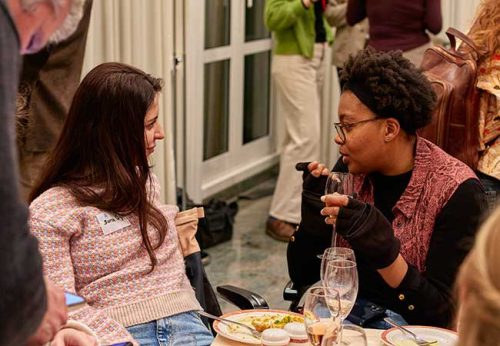
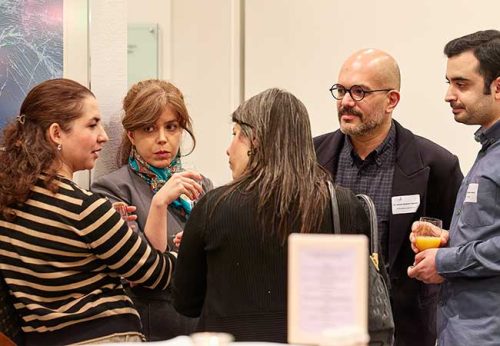
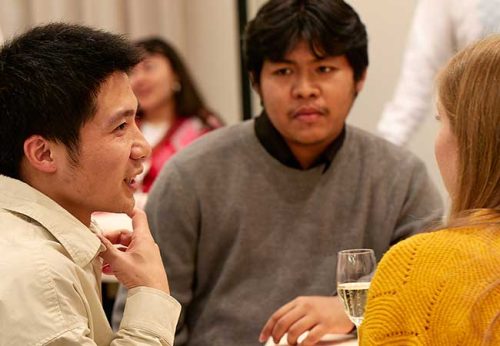
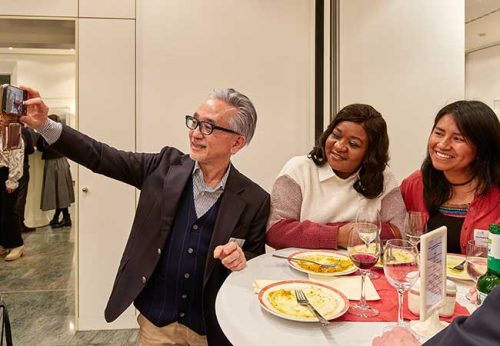
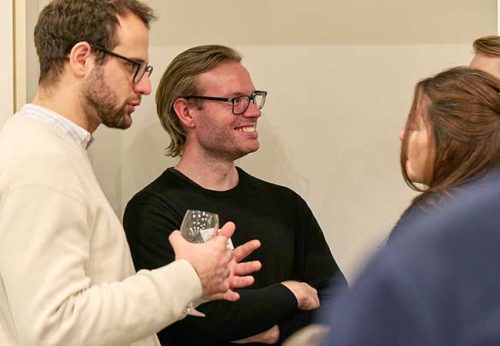
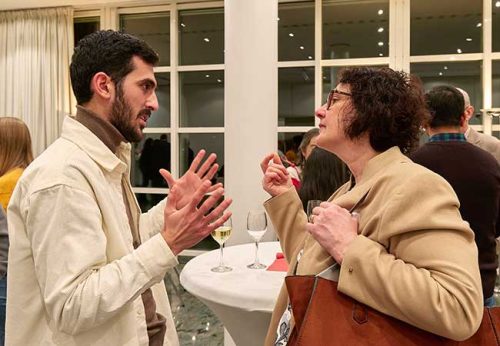
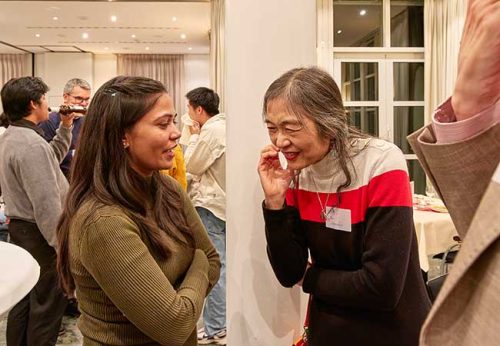
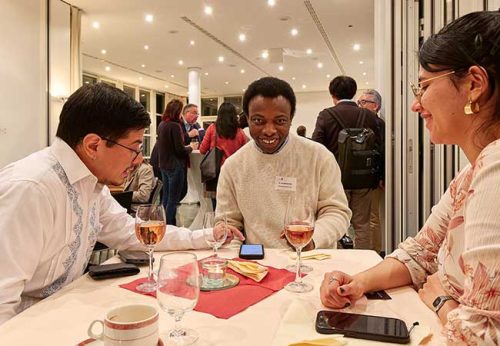
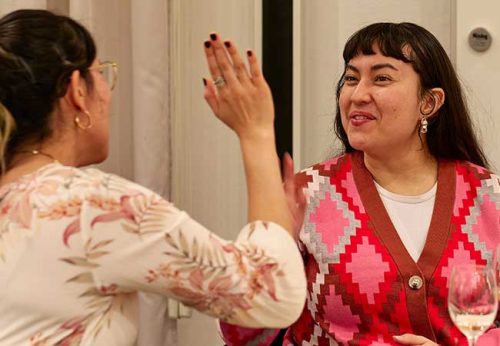
It is sometimes in the strangest of settings that we are reminded that physics is everywhere. Whether in faraway galaxies or here at home, its laws govern co-presence, motion, attendance and chance. Its elemental logic can even deliver insights into social encounters, including the 2026 New Year’s reception for Goethe University’s international researchers. During this encounter in late January, many different bodies – in our case quite literally those of the more than 90 participants from 26 different countries – came together in a set space for a specific length of time. The conversations these bodies engaged in can be compared to particles in motion – as individual voices bounced around the room, lingering engaged with another set (or two, or three) for a while, and then – drawn by other forces (a familiar voice? The buffet?) – moving on.
Adopting a physics-inspired observational perspective of the reception’s initial state, we find several different bodies converging on a specific location for a set span of time. While the bodies were mostly left to themselves, the evening’s protocol also included several targeted interruptions consisting of speeches, musical performances and food. Thanks to the cold temperatures, fewer guests ventured outside, providing for an optimal control environment set within the confines of the historic Villa Cahn, one of Goethe University’s guest houses.
It should be said here that physics did not play any role in the initial preparations for this article, planning for which deliberately accounted for the principle of random encounter – to enable a flexible selection of conversation partners, based on criteria like “not currently deeply engaged in another conversation” or “eating”. It is by pure cosmic coincidence that three of the six longer conversations that evening happened to take place with nuclear or astrophysicists, none of whom, incidentally, is named Sheldon.
“Physicists across the world unite!” – at Goethe University Frankfurt
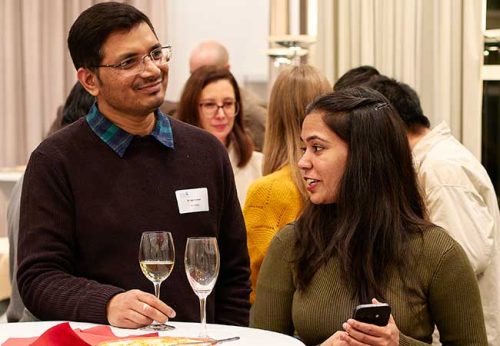
It would require closer analysis and knowledge to determine the probability of this transpiring, or to put forth an equation that explains the chance of three brilliant young physicists from India, China and Mexico choosing Goethe University Frankfurt as the place to conduct their studies.
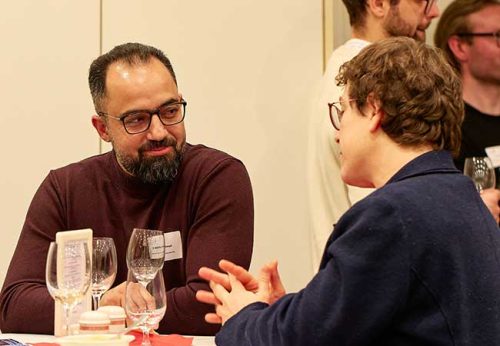
Had it not been for physics, Dr. Ajit Kumar might never have met Daineng Liu. The two men, whose home countries share common borders, are united by a deep fascination for nuclear physics, the Big Bang and collisions. Both appreciate Goethe University’s proximity to Darmstadt-based GSI-FAIR – in terms of geographic distance as well as research ties.
Dr. Ajit Kumar from Uttar Pradesh is currently pursuing his third postdoc. He completed his first in India – “the relatively short program helped me find future employment in Europe”, he says modestly. As fate would have it, that decision ended up making life a lot easier for him and his wife, who married at around the same time. Her postdoctoral work in demographics took her to Paris, France, and before joining Goethe University last year, Dr. Ajit Kumar held a postdoctoral position in Strasbourg. “My work in Strasbourg focused on detector R&D for modern and future experiments, like the ones planned for Future Circular Collider at CERN. My earlier experience working and experimenting with Compressed Baryonic Matter (CBM) at GSI proved invaluable to this task.”
The nuclear physicist is now a senior member of the research group led by Prof. Joachim Stroth, of Goethe University’s Institute for Nuclear Physics and GSI. Being able to operate independently is very important to Dr. Ajit Kumar, both professionally and privately. With a nod to his wife, he says “I don’t understand anything about demographics, and she doesn’t understand my work on nuclear physics. What unites us is a similar mindset, an appreciation for intellect and dedication, and shared experiences of how difficult research is to navigate and how you constantly have to adapt over time.” He finds a similar understanding among his peers.
The couple’s deep appreciation for knowledge and learning becomes evident as the discussion turns towards the future. Although Dr. Ajit Kumar is still unsure what will follow his third postdoc, physics will definitely play a part. “To me, there is nothing more fascinating than finding the answer to what particle caused all of our universe to come into being and to replicate not only that moment, but what comes afterwards.” To that end he is currently exploring the CBM micro-vertex detector system. “I work on very small silicon sensors and the readout system that detects particle hits, which resembles an ultra-fast scientific camera. In addition, I develop the software that checks detector health, cleans the raw signals, and turns them into usable results for the experiment.”
As for what will come once his contract expires in 2027, the 35-year-old would like to stay in Germany, ideally in the GSI environment. It helps that his wife is also fond of Frankfurt, and Germany in general. Both see their future in Europe, which has the advanced technological infrastructure required for Dr. Ajit Kumar’s work, where distances between important laboratories or research centers are manageable, and academic freedom is protected. Although the feasibility study is still underway, his eyes light up when he talks about the Future Circular Collider (FCC) and what questions its higher energy levels will help answer.
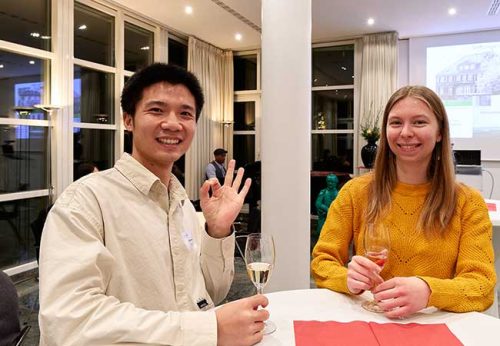
Although he only arrived in November 2025, Daineng Liu is also already a big fan of Germany and of Frankfurt in particular. The doctoral candidate from Fudan University in Shanghai can find a lot of similarities between the two cities’ metropolitan culture. “Of course, Frankfurt is much smaller than Shanghai, but the minds of the people that live here are just as big, and the culture is just as welcoming. I find it an extremely convenient place to live.” Since arriving in Frankfurt, the young physicist has already made friends from all over the world, from Germany, China, Thailand, and many more countries. “I find it especially magical when I look at my new Chinese friends, who come from so many different fields and cities, and who I became friends exactly because we met here in Frankfurt.”
Like Dr. Ajit Kumar, Daineng Liu is also very familiar with the work and experiments conducted at GSI-FAIR and the insights into new materials offered by the collision experiments. Having already worked at a similar facility in Shanghai and after receiving a government-funded scholarship, Daineng Liu is thrilled to be able to pursue his passion here and learn German at the same time. His research is related to relativistic heavy-ion collisions. “I want to better understand the dense state of matter known as quark-gluon plasma, which is much smaller than atoms and even nuclei, and which exists in the first seconds after the Big Bang,” he explains, adding that, “Astrophysics is a hot topic in China, and many people are eager to know more. I love that it doesn’t matter what country you are in, what language you speak or who your immediate peers are – physics is the same everywhere.” Workstyles may differ, he says, but the knowledge gained and produced applies universally.
Daineng Liu is very fond of his supervisor, Prof. Markus Bleicher, head of Goethe University’s Institute for Theoretical Physics. “He is a great man”, he says, adding that he already knew this to be true when he applied to him specifically for supervision, to learn from his thought process. Beyond academic guidance, Prof. Bleicher also helped the nuclear physicist secure accommodation in Goethe University’s newest guest house on Riedberg Campus. “I consider myself extremely lucky to live in the International House. It is an excellent, beautiful and comfortable place to be, and it just completes my experience.”
Once his two-year, state-funded scholarship ends, Daineng Liu will return to Fudan University to finish his studies. Unsure of how often he will return home until then or whether his family will come and visit, he says what he misses most right now, in addition to friends and loved ones, is the food. Maybe the big bang teaches us that there is just no way of replicating exactly that one particular dish so dearly missed. But culinary physics aside, the 26-year-old already knows he will be all the richer in knowledge, method and network, enabling his own universe to expand that much more.
Fire at GSI
In the early hours of February 5, 2026, a fire broke out at the GSI complex in Darmstadt. The full extent of the damage and the cause of the blaze remain unclear at the time of this article’s publication. It is also uncertain whether and to what extent the damage will impact the research of Dr. Ajit Kumar and Daineng Liu. During the preparation of this article, both expressed their shock and sympathy, as well as their relief that no one was harmed.
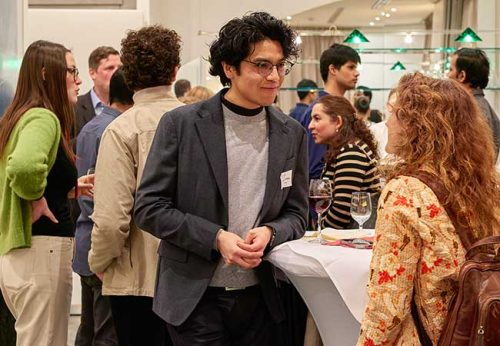
As temporal spatial overlap would have it, among the young men whose lives were changed by physics is also Iván Hernández Garibay from Mexico City. The PhD candidate arrived last August, gravitating towards the center of a rather significant force in the field of astrophysics – and embodied in the research group of Prof. Luciano Rezzolla, Chair of Theoretical (Relativistic) Astrophysics at Goethe University’s Institute for Theoretical Physics (ITP). “Luciano is quite popular in Mexico, and my supervisor encouraged me to apply to join his research group – one of the world’s leading institutions specialized on simulations.” Although there are other astrophysics working groups in Europe, the U.S. and Japan, none fits the interests of the graduate of the National Autonomous University of Mexico better. “The computational resources we can use here are extremely nice, and I really appreciate the fact that the working group is so international, allowing me to interact with people from all over the world.” This benefits his research on secular matter and electromagnetic emissions from compact remnants systems that arise from the mergers of binary neutron stars and black-hole neutron star systems. “The central question of my PhD is: How do physical parameters, including the equation of state of neutron star matter, magnetic fields, viscosity properties, neutrino transport mechanisms, and more, affect the physical and geometric properties of the remnant system?”
The passion for his subject is evident with every word. “I think astrophysics and astronomy is visually very attractive, making it a great entrance point for people to develop an interest in science. As a kid, nothing fascinated me more than black holes or how stars fade into compact objects. That’s why I studied physics.” Today, he says, astrophysics is quite big in Mexico, which also has some excellent observatories thanks to its high-altitude mountain ranges, the dry, stable air (especially in northern regions), low light pollution in remote areas as well as latitude advantages.
The equipment and network he now has access to make up for some of the things the 29-year-old misses, including family and friends; “but,” he adds quite rationally, “I wanted to come here and knew what I was getting myself into.” Helping him make the most of his time is his newly found social circle, many of whom are fellow internationals based in Frankfurt. While he likes the Main metropolis – “it provides the main services and attractions that a big city has to offer” – and appreciates that there is a lot to do, he doesn’t feel the city is doing its best to cater to its high student population, mentioning the high cost of living as one downside.
In the future, Iván Hernández Garibay says, he would like to obtain a professorship in his home country. The first step lies in completing his three-year DAAD scholarship. After that, he is open to other stations along the way. The key lies in “getting as much experience in other places as possible.”
A space where expertise in skull-based tumors meets radicalization research and religious ethnomusicology
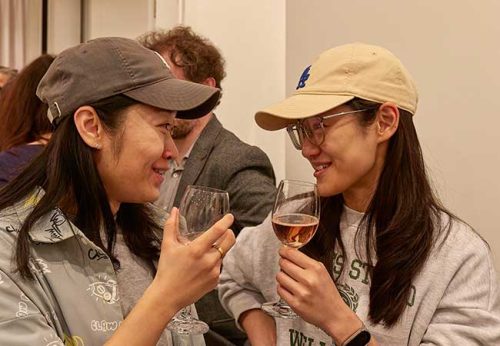
While it was not physics that drew Lumeng Song from Sichuan Province to Frankfurt, in keeping with the analogy of this piece, as far as co-presence in a specific time and place is concerned, the neurosurgeon and her fellow countrymen and women made the most of the reception to meet and touch base with other visiting researchers from China.
Having already focused on skull-based tumors in her master’s degree, the 26-year-old is now pursuing her doctoral studies under PD Dr. Thomas Broggini, of Frankfurt University Hospital’s Department of Neurosurgery, and Principal Investigator at the Interdisciplinary Center for Neuroscience Frankfurt (ICNF). “He is a great man and great supervisor,” she says, adding that apart from helping her get settled, he also “manages to give both a lot of advice and a lot of freedom for us to explore our own ideas.”
Outside the laboratory, there are admittedly some cultural peculiarities that are difficult to get used to. “In China we hardly use cash anymore; everything is done via phone,” she explains. Although she misses the convenience this offers, she adds with a smile that she personally feels it helps her keep better track of her own spending. As for the language barrier, her very good English (“I watched a lot of American movies as a child”) and her social circle help her navigate Frankfurt. Time permitting, she might start learning German next year.
One thing Lumeng Song has already learnt to appreciate since her arrival in September 2025 is the campus. “It is amazing, like a big branched out hospital in which each different department has its own building.” The design, she explains, is totally different in China, where different departments share a building, and are usually separated by levels. “For patients requiring complex treatments, this organizational structure is highly convenient, as it allows them to see the relevant specialists simply by taking the elevator up or down a few floors.” However, the campus-style organization, with each department having its own building, also has its own advantages, she says, including the ability to specialize. “There is an up- and a downside to both approaches,” she concludes.
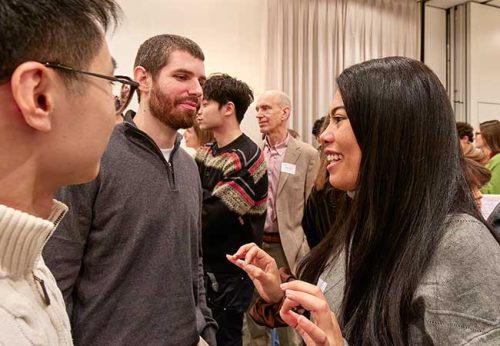
Margarita Navarro, 30 years old, is a student at Goethe University’s PRIF – an abbreviation that despite beginning with a “P” does not stand for anything physics-related. Rather, the Peace Research Institute Frankfurt analyzes the causes of international and intrastate conflicts and looks for ways to resolve them. “I think I am the only woman from the Caribbean part of my home country Colombia currently studying Political Science at Goethe University,” she says. Although she has met fellow Colombians from Bogota, none are from this northern part of the country.
It was the work on her master’s at ICESI University in Cali that initially brought Margarita Navarro in touch with PRIF. “I was associated with the Institute at first, but I had already worked with my supervisor, in a project with the Instituto Colombo-Alemán para la Paz (CAPAZ) and the Friedrich Ebert Foundation while doing my master’s degree.” Work on her doctorate began in earnest in 2024, when she received the necessary funding thanks to a DAAD scholarship. But the social scientist had already completed a lot of her work prior to that, in part because of the freedom offered by an initial three-month starter scholarship she was awarded from Goethe University in 2023.
Her exceptional planning and execution skills appear to be one reason for the repeated funding her research has already received. She values the fact that she shares these traits with her supervisor, Prof. Jonas Wolff, Professor of Political Science with a focus on Transformation Studies and Latin America at the Faculty of Social Sciences. After first approaching him with her idea for a PhD in 2021, both Prof. Wolff and the staff supporting doctoral candidates explained the peculiarities of the German science system as well as the demands placed on doctoral candidates to her. Margarita Navarro then drew up a structured plan – just the kind she and her supervisor now devise together for this year and next. “I managed to set checkmarks on every point of the three-year plan I conceived in 2021 and even went a bit beyond. This means I can now take a small step back from my research and divert some focus to my teaching.”
Aside from her efficiency, it is the unique nature of her research topic and her method of documenting it that make Margarita Navarro’s project so worthy of support: She is investigating the demonstrations that rocked Colombia between 2019-2021, among the largest in the country’s recent history. Hundreds of thousands of people, including students and young activists, took to the streets, demanding broader justice, improved living conditions and accountability from the political establishment. As part of her focus on radicalization within social and student movements, she will conduct a prolonged field work phase back home, interviewing and working with people on site. “My plan for my thesis is to make a documentary series, accompanied by a book.”
Before that, however, the well-prepared and executed plans of the conflict researcher working in PRIF’s China research network and the relations between the people’s Republic and the Latin-American and Caribbean countries will complete another “first”. This year, she will be giving her own course on “Researching in Contexts of Violence: Methods, Ethics, and Challenges.” “I have already finished the design and would like to spend at least one year teaching at Goethe University before returning home for my fieldwork.” There is little doubt she will succeed in this, too – and not just thanks to her realistic and meticulous planning, but also her near immaculate German. “The DAAD was generous enough to fund some of my German studies, too. After starting on my own, this allowed me to complete an intensive B2 course, and later my C1 at the Internationales Studienzentrum (ISZ) under Kerstin Sharaka, to whom I am very grateful.”
If all goes well, the multitalented researcher will complete her PhD in 2028. And then? “I want to continue researching and teaching, ideally in Germany or Europe. I will also be a research guest at the COSMOS Center on Social Movement Studiesin Italy this summer, and will do an internship there, work on a paper/thesis chapter and apply what I have learnt in my teaching here. Of course, another documentary film project in Colombia is always a fascinating option.“
In the more immediate future, it is a call from the realtor that she is waiting for. Margarita Navarro is hoping to sign the lease on an apartment that will serve as the new home for her and her term boyfriend. After meeting in Colombia in 2019, as a result of the pandemic and the planning for her studies, the two have since had differing amounts of time with each other and are looking forward to spending this year making their new home together in Frankfurt. – Just before this article went to press, the good news arrived: “We found the perfect apartment and will be moving in March.” Then they will explore the city that she says offers a little bit of everything to everyone together.
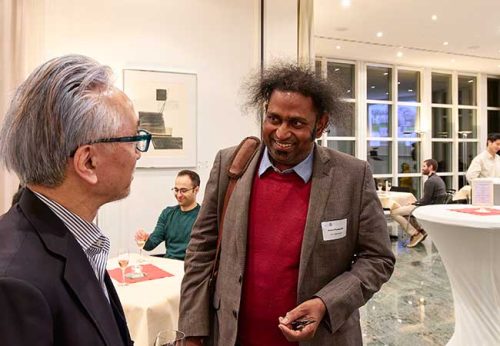
Samuel Ramapuram’s trajectory at Goethe University has been noteworthy, too. As one of the first recipients of the Franz Adickes Foundation’s starting scholarship (€3,000) for international doctoral candidates, the COVID-19 pandemic necessitated a postponement of the start of his PhD studies under Prof. Anja Middelbeck-Varwick at the Faculty of Catholic Theology. Since attending his first Summer Festival for Goethe University’s international researchers – the end-of-semester equivalent of the New Year’s Reception – his research and professional network have continued to advance.
Originally from Bangalore, Samuel Ramapuram is an ordained priest in the Anglican Church and received formal musical training at a music school in Chennai, India. He is particularly interested in the interplay between music and religion, focusing on historical ethnomusicology, conversion narratives, and the role of devotional and ritual sound practices in shaping social and religious identities. “I divide my time between reading, writing, and several short research stays,” he notes. His work has been presented in diverse academic contexts, including discussions with colleagues and research groups at Bar-Ilan University in Israel, Oxford University, the University of Warsaw in Poland, the University of Szeged in Hungary, the University of Edinburgh and the University of Aberdeen in Scotland, as well as the University of Coimbra in Portugal. Over the course of 2024 to 2025, he contributed to 20 international conferences and workshops across these institutions. “These exchanges have been extremely helpful in refining the comparative and theoretical dimensions of my research, particularly regarding music, religion, and postcolonial history,” he observes.
Illustrating the breadth of his research, he presented a paper at Bar-Ilan University on comparative musical dialogues between Judaism and Hinduism, exploring how sounds and scales influence the human brain, memory, trauma, and emotion. In addition to his strong personal connections to Sweden, Samuel Ramapuram possesses considerable musical talent. Beyond the piano and accordion, he is learning the nyckelharpa, a bowed Swedish string instrument whose name translates literally as “keyed fiddle”, and which is played similarly to a violin.
An inter-religiously engaged scholar, Samuel Ramapuram both affirms and critically examines the universality and distinctiveness of his other central passion, music within religious practice. He regularly visits a wide range of religious institutions in Frankfurt, including churches, synagogues, Hindu temples, Sikh Gurdwaras, Mosques, Buddhist temples, and the Baháʼí Center. He also maintains dialogue with atheists as part of his broader intellectual engagement with questions of meaning, learning, and the shared mysteries of human existence, to be more human than an intellectual. Given the central role of music in his life and scholarly work, he translated aspects of his theoretical research into a self-composed musical work, performed by the Inter-religious Choir in Frankfurt on November 12, 2024. On this occasion, Samuel Ramapuram himself participated as a percussionist.
In the immediate future, however, Samuel Ramapuram will have less time for his compositional activities as he concentrates on two closely related research projects: a doctoral dissertation developing an analytical framework for the study of music and religion in Indigenous contexts in India, and a substantial book-length manuscript extending his earlier work through newly identified archival sources, recent field interviews, and a novel theoretical contribution concerning sound. The nyckelharpa and other musical instruments remain integral to his reflective practice, providing both intellectual organization and opportunities for contemplative withdrawal.
And although physics is not an explicit focus of his research, its principles are nevertheless operative within his work. Classical acoustic laws govern the propagation of sound waves, wave equations predict the pitch of a string, and Fourier analysis facilitates the determination of timbre, or a sound’s fundamental frequency. Physical principles also inform the production of sound in musical instruments – whether bowed, struck, or plucked – by explaining how the resonant bodies of these instruments amplify and shape the frequencies, thereby accounting for the distinct tonal characteristics of each instrument. Beyond classical physics, quantum principles offer further insight into the behavior of sound at the microscopic level, elucidating phenomena such as quantized vibrational energy in strings and the probabilistic interactions of particles that influence resonance and harmonic overtones. In this way, both classical and quantum physics contribute to a deeper understanding of the mechanics and aesthetics of musical sound.
A resonating afterglow
At the end of the evening, after all guests had left and the music subsided, the historical Villa Cahn stood empty once again. The bodies previously assembled here, which had touched upon and bounced off each other throughout the course of the reception each gravitated to a new center – much like matter disperses following the eclipse of a star.
What is left is a warm afterglow, one that resonates the evening’s countless conversations and encounters, leaves traces in the form of questions answered or newly posed, and most importantly lays the groundwork for new knowledge and constellations to emerge.
Nominations now open for the first “Goethe Science Diplomacy Award”
Do you know someone who has made a significant contribution to Goethe University’s intercultural exchange and societal dialogue with international academic guests? Is there a project that you believe best exemplifies innovative forms of international collaboration in research, teaching, and publishing – including in the virtual realm? Or maybe you attended an exceptional international academic conference or workshop held in Frankfurt or know of international research cooperations between Goethe University Frankfurt and partner institutions in challenging or crisis-affected regions, as well as efforts to protect the freedom of research and supporting researchers at risk?
Bestowed by the Foundation for the Promotion of International Scientific Relations at Goethe University, the Goethe Science Diplomacy Award recognizes researchers working at Goethe University Frankfurt, who meet any of the criteria listed above. Nominations may be submitted by all members of the university, as well as by partner institutions involved in larger research collaborations. Self-nominations are not accepted.
For more information and to download the nomination form, see here