The superconducting accelerator in Darmstadt
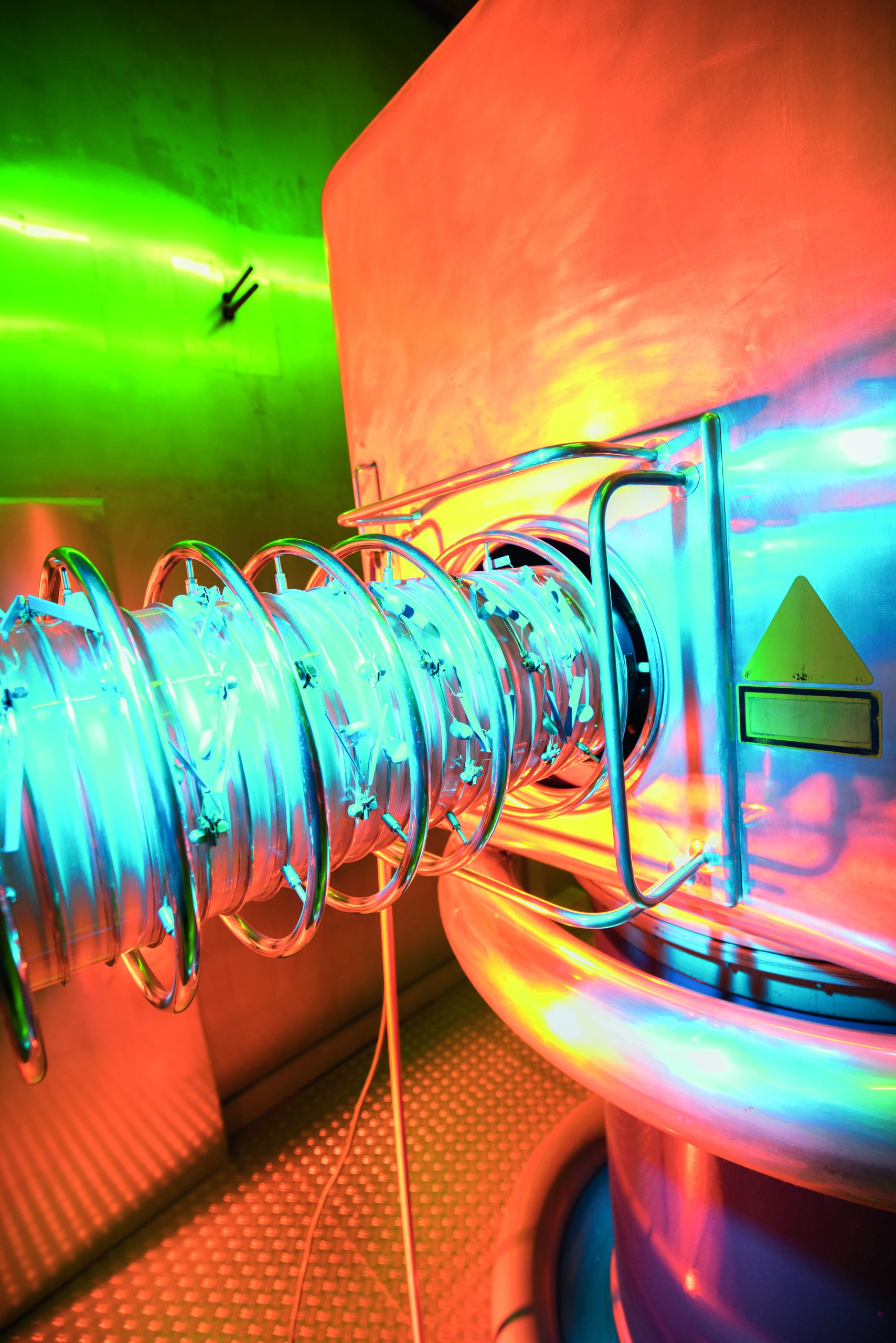
The electrons are released from a hot metal plate under high voltage in a thermionic electron source. Foto: Jan-Christoph Hartung
At the electron accelerator in Darmstadt, physicists are studying in the laboratory aspects of the extreme conditions in our Universe. In the process, they have successfully developed an efficient technology that reuses energy for particle acceleration. The particle accelerator plays a key role in the ELEMENTS cluster project led jointly by Goethe University Frankfurt and the Technical University of Darmstadt.
If you walk across the Stadtmitte campus of the Technical University of Darmstadt, the Institute for Nuclear Physics is not particularly impressive at first glance. A grey building from the 1950s, bare concrete, a lot of windows. Inside, linoleum flooring and rows of identical doors. Behind one of these doors, however, is an imposing room with lots of monitors and control panels, their countless lights and switches reminiscent of a science fiction film from the last century. It is both the control room and the entrance to a huge facility located in the institute’s basement. You must go down a fleet of stairs then venture through a concrete door weighing 15 tons – and are rewarded with an awe-inspiring sight: a vast hall full of technical apparatus, stainless steel tubes and cables. It houses the “Superconducting Darmstadt Linear Accelerator”, in short S-DALINAC, which was once Europe’s first recirculating superconducting linear accelerator.
It went into operation in 1991, and since then above all young researchers have been working continuously on its further development. Only recently, for example, they achieved a phenomenal breakthrough in accelerator physics: the reuse of energy by utilizing the main accelerator several times. Norbert Pietralla, the institute’s director, explains: “With this multi-stage energy recovery mode, we are able to save vast amounts of energy required for powering the particle acceleration. Normally, well under 1 percent of the accelerated electrons participate in scientifically interesting reactions, and in effect we throw the rest away, together with the energy in them. By contrast, the new technology allows us to reuse this energy by decelerating the particles again, much like in a car with a hybrid engine.” Pietralla, who hails from the Rhineland, would never have dreamt this possible when he took up his post at the Technical University of Darmstadt in 2006.
IN A NUTSHELL
- In the superconducting S-DALINAC accelerator, electrons are accelerated almost to the speed of light.
- The electrons can split atomic nuclei. From the fragments, it is possible to draw conclusions about how heavy elements form in the Universe.
- Only a small number of electrons are used for experiments. The rest can be fed back into the accelerator in such a way that their energy can be used again.
A stroke of luck
It was during his doctoral degree that Pietralla began tinkering with the Darmstadt accelerator. Back then, he was studying in Cologne and devoting himself to the scattering of photons off atomic nuclei, that is, the deflection of the path of one of these light particles by a nucleus. This is possible because light behaves not only like a wave but also like a stream of particles. “This was a really niche topic – hardly anyone was busying themselves with it at the time,” Pietralla recalls. That niche was to become the key to his success.
When he learnt at a conference in the US a few years later that Duke University had a laser worth millions of dollars that could not fulfil its original purpose in military research due to a lack of funding, he seized the opportunity with both hands. “I was just a little postdoc, and suddenly there’s this really big thing and they don’t know what to do with it. Just imagine!” Thanks to his expertise concerning photons, Pietralla was allowed to put his experimental idea into practice and managed to first apply nuclear resonance fluorescence reactions with a gamma ray of a specific wavelength (monochromatic gamma ray) and polarization to advances in basic nuclear research. In nuclear resonance fluorescence, an atomic nucleus absorbs a (gamma-ray) photon and then emits another photon. Since then, this method has been used many times to determine the properties of atomic nuclei and provided answers to long unsolved questions. The community was abuzz, and nothing more stood in the way of Pietralla’s scientific ascent. “That was one of the most wonderful moments in my career,” he says.
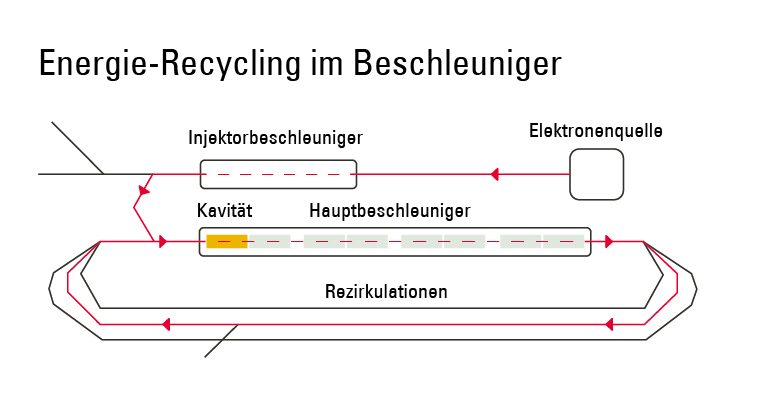
Energy Recycling in the Accelerator
The successful implementation of the energy recovery linac concept took place for the first time in Germany at S-DALINAC in 2017. In this process, the electron beam is directed back into the main accelerator, where – having waited for the exact moment after the end of its scientific use – it is decelerated again and its kinetic energy recovered. Since 2021, it has been possible to repeat this process up to three times by means of the electrons releasing their energy back into the accelerator’s electromagnetic field at a defined position and time. This increases the energy efficiency of the whole system.
Tracking down heavy elements
Today, Pietralla’s work in the ELEMENTS cluster project, a research collaboration between Goethe University Frankfurt, the Technical University of Darmstadt, GSI Helmholtz Center and Giessen University, focuses on the formation of heavy elements such as gold and platinum. In the Universe, these only form under extreme conditions, such as the collision of neutron stars [see page 19]. When such a collision occurs, large numbers of neutrons can move around freely. Under these conditions, very heavy atomic nuclei form by capturing neutrons (known as the r-process). Large amounts of neutron-rich matter are released. This matter is unstable and subjected to rapid nuclear fission and beta decay processes, in which the short-lived radioactive atomic nuclei then rapidly decay to stable atomic nuclei such as gold or lead, or to long-lived ones such as uranium. The discovery in 2017 of gravitational waves and light signals from two colliding neutron stars supports this finding. Hypotheses by ELEMENTS scientists center on more precise analyses of astronomical observations and suggest that the poorly understood fission processes of superheavy nuclei play a highly significant role in the formation of heavy elements by terminating the r-process. Corroborating these expectations with experiments is now the task of the team at S-DALINAC.
As the “axe” for splitting nuclei the researchers use electrons because as elementary particles these are “stable” and cannot be split further. The electrons are fired at fissile atomic nuclei, such as uranium or plutonium, at almost the speed of light (just under 300,000 kilometers per second). The resulting fragments deliver illuminating insights into mass distribution in the r-process. “Through these high-precision measurements, we are coming a little closer to understanding how heavy elements form,” says Pietralla. “With the models produced by the theorists in the ELEMENTS project, we can identify how the exotic nuclei inside neutron stars look.”
The electrons’ journey
The accelerated electrons have to cover quite a distance before they reach the heavy nuclei. Their journey begins in a small chamber where a source emitter generates the tiny particles under high voltage: a filament releases electrons continuously, which are pre-accelerated here to about 74 percent of the speed of light. To be able to use them effectively, the beam is separated into individual sections and then compressed. These electron bunches enter the superconducting injector. The cavity microwave resonators (or simply “cavities”) installed there operate in a bath of liquid helium at only 2 K. At -271 °C, this roughly equates to the freezing cold of interstellar space. Here, the beam reaches 99 percent of the speed of light, and it is already possible to guide the electron beam to a first experiment in a kind of “switch”. Alternatively, the electrons are directed into the main accelerator, which is 15 meters long, where they pass through a further eight cavities. Electromagnetic microwave fields there cause them to pick up even more speed.
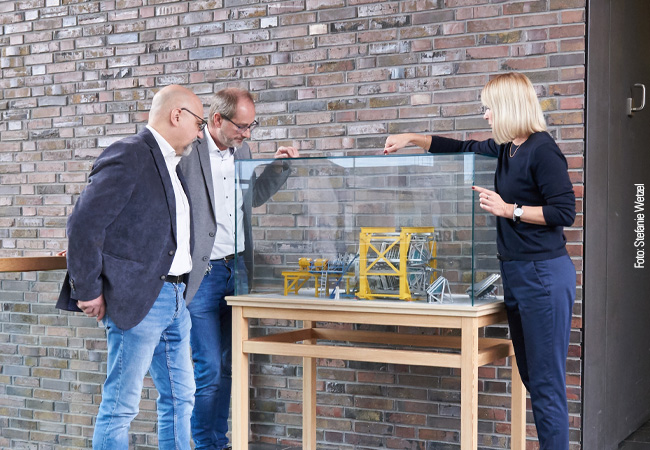
There is then a second switch: the electrons are either guided directly into the neighboring experiment hall via a magnet or they become part of the energy recovery mode, which is unique worldwide (see box). Finally, they continue at 99.999 percent of the speed of light to the experiments, passing through further sections that optimize the beam’s quality and are located in a labyrinth of metal and concrete. Layers of lead serve as a shield, and some superstructures are several meters high. This is also where the spectrometers are found, which are used to measure the fragments from the nuclear fission experiments. In the near future, the aim is to add highly sensitive detectors that will enable the researchers in the ELEMENTS project to decipher the structure of heavy atomic nuclei even more precisely.
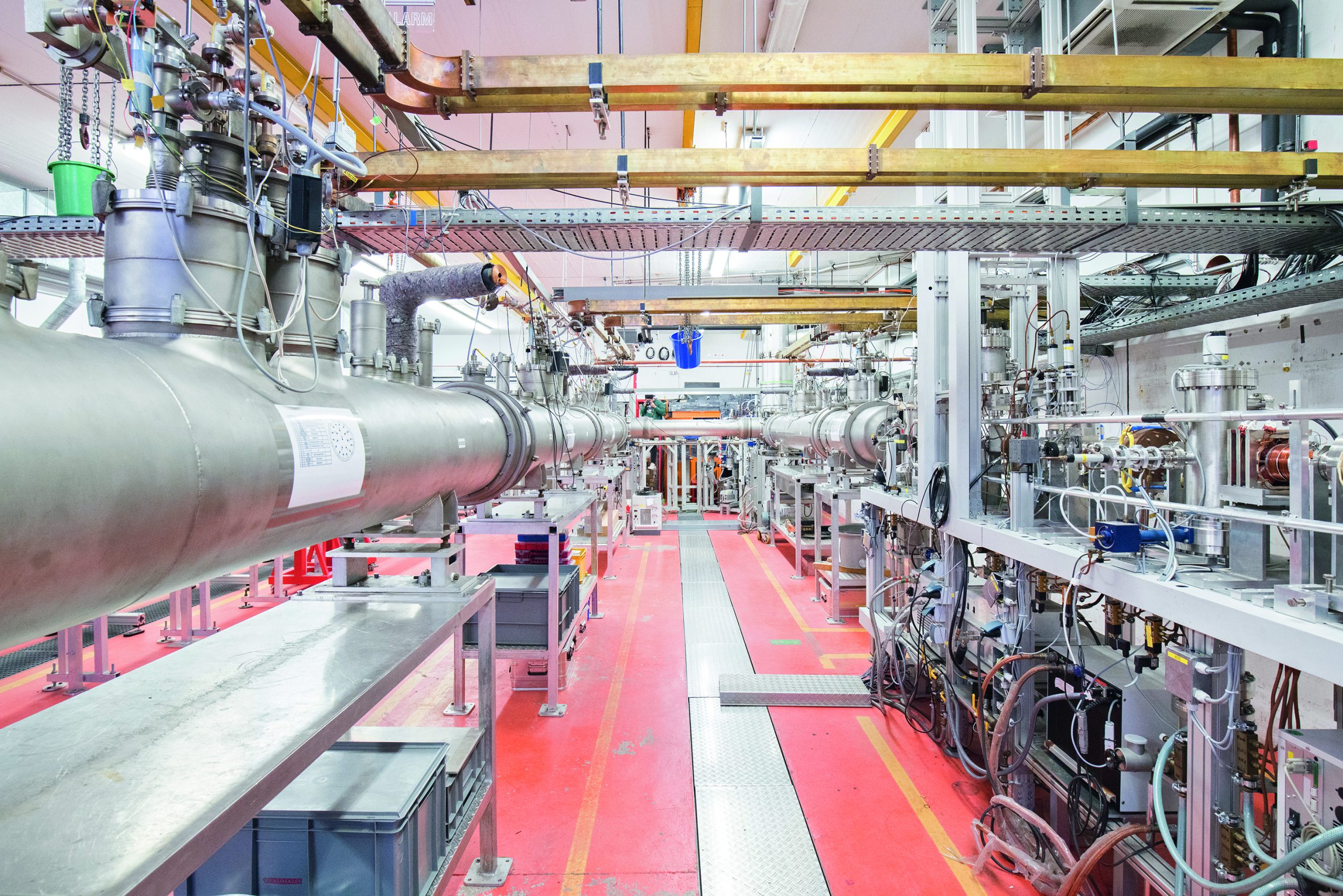
View of the accelerator hall. In the preparation section (front right), the electron bunches are made ready and pre-accelerated in the injector (back right), then brought to almost the speed of light in the main accelerator (left). Photos: Jan-Christoph Hartung;
Trailblazing technology
The successful implementation of the energy recovery mode was announced in the journal Nature Physics at the beginning of 2023. Research at the S-DALINAC is thus paving the way for trailblazing projects. With this technology, for example, the long-discussed “Large Hadron-Electron Collider” at CERN could finally become reality. At the present time, this would necessitate an electricity consumption in the double-digit gigawatt range, equivalent to the output of several nuclear power plants. Thanks to the technology developed in Darmstadt, only a fraction of that is required, which makes the project realistic. The ELEMENTS experiments at GSI [see page 25] will also benefit from these advances: the construction of DICE (“Darmstadt Individually Circulating Compact ERL”) is intended to sound in the next generation of the relatively small-scale linear accelerator. When that time comes, the S-DALINAC, which is over 30 years old, will go into retirement. But until then, “Small but mighty!” will remain the order of the day!
About
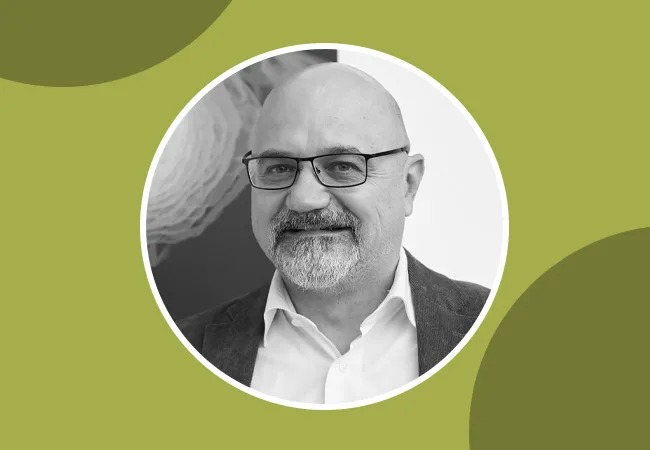
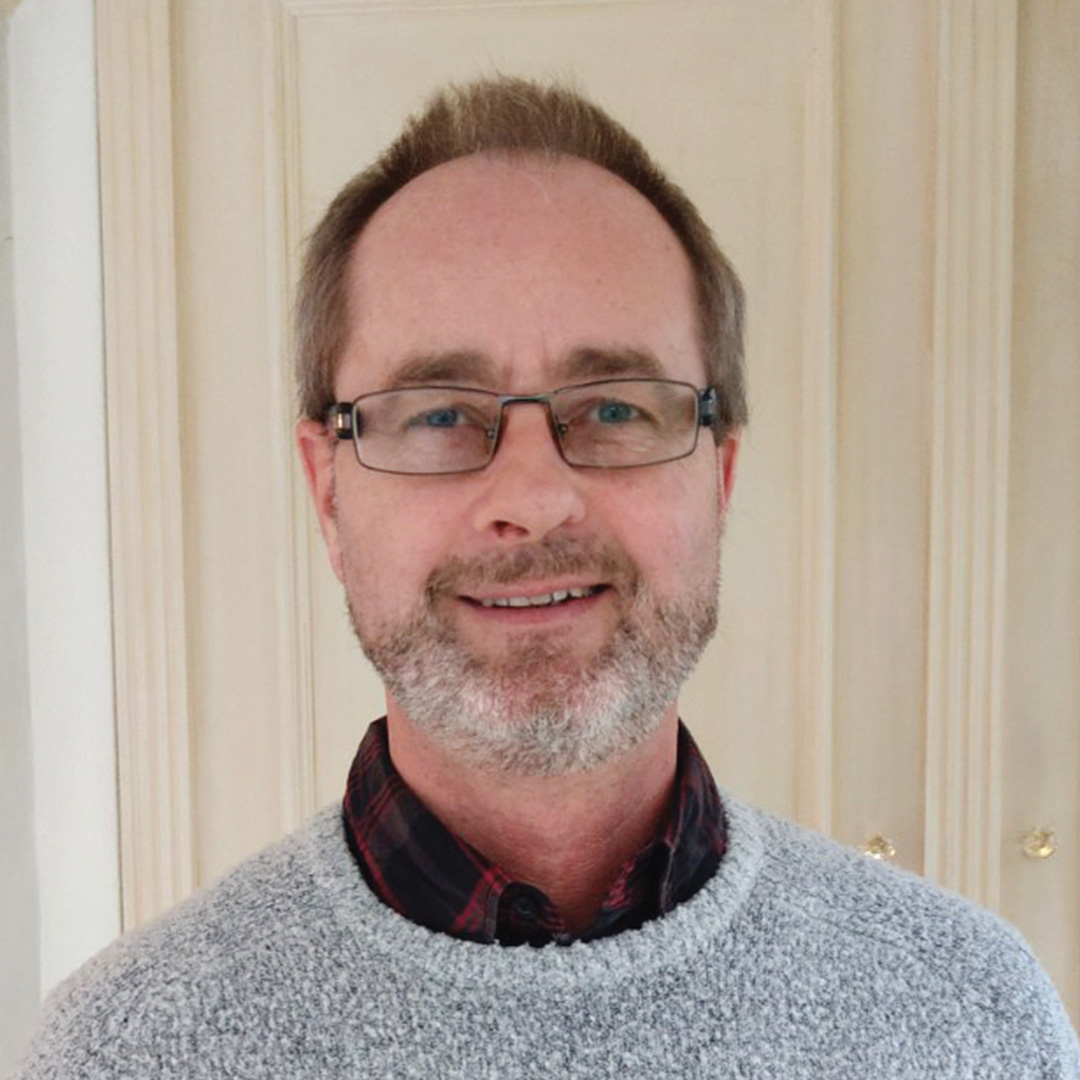
Norbert Pietralla, born in 1967, is an expert in nuclear spectroscopy and particle acceleration. He studied physics at the University of Cologne, was a postdoctoral researcher at Yale University and professor for nuclear physics at the State University of New York and the University of Cologne. He has been full professor at the Technical University of Darmstadt since 2006 and director of its Institute for Nuclear Physics since 2008. He has received honorary doctorates from University Politehnica of Bucharest and Sofia University St. Kliment Ohridski for his work on nuclear resonance fluorescence. Since 2021, he has been co-spokesperson of the ELEMENTS cluster project, a research collaboration between Goethe University Frankfurt, TU Darmstadt, Giessen University and GSI Helmholtz Center for Heavy Ion Research.
The author:
Phyllis Mania, born in 1988, studied psychology and cognitive neurosciences in Hamburg and Maastricht. After her doctoral degree, she worked as a freelance author, among other things. She is Science Communication Officer for the ELEMENTS cluster project at Goethe University Frankfurt.