Analysis of Goethe University’s Results in the “Benchmarking Internationale Hochschule” BintHo Survey 2023/24
In January and February 2024, Goethe University Frankfurt took part in the “Benchmark Internationale Hochschule (BintHo)” survey, organized by the German Academic Exchange Service DAAD for the second time; the first poll was held in 2021. The aim of the survey is to gather insights into the internationalization of German universities from the students’ perspective. A total of 132 universities participated, allowing for reliable benchmarking to support the interpretation of the results. After the field phase, the data were cleaned and analyzed by the conducting institute UZBonn and reports were made available to participating universities. The results were also discussed in three nationwide workshops with the DAAD. At 8.8% (3,499 participants), Goethe University’s response rate was slightly above the national average. Among the survey participants were 472 international students. Below are the key BintHo findings on international mobility and visiting students for Goethe University Frankfurt.
Previous or Planned Stays Abroad as well as Popular Types and Regions
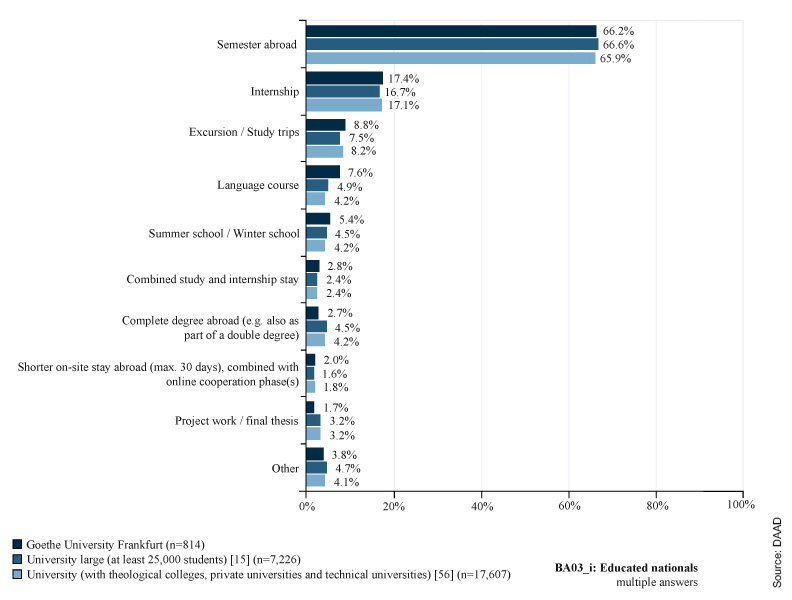
As of the 2023/24 winter semester, 23.5% of Goethe University students had already participated in a study-related stay abroad (42.7% Master’s students vs. 17.9% Bachelor’s students), while 4.3% of respondents were abroad at the time the survey was held. The responses show that the most preferred format by far was a semester abroad (66.2%), followed by internships (17.4%), excursions/study trips (8.9%), language courses (7.6%), as well as summer/winter schools (5.4%) – see chart. The semester abroad was especially popular among Bachelor’s students (76%), compared to 66.9% of Master’s students, who showed slightly more interest in internships.
Prime among the preferred locations was western, northern, and southern Europe (63.1%), followed by Asia and Pacific (16.1%), central and southeastern Europe (11.7%), North America (9.7%), Latin America (5.7%), North Africa and the Middle East (3.6%), Sub-Saharan Africa (2.5%), as well as eastern Europe and central Asia (0.6%). This distribution closely mirrors the national average.
Sources of Funding
At 62.7%, most students received financial support from parents/relatives, almost the same percentage as those who relied on their own savings (62.3%). Other sources of funding included Erasmus scholarships (41.8%), side jobs (32.8%), other scholarships (12.5%), BAföG for studying abroad (12.1%), other DAAD scholarships (5.6%), support from institution/employer (5.8%), PROMOS scholarships (4.9%), and loans (3.1%). Master’s students were more likely than Bachelor’s students to have a job (35.5% vs. 27.4%), obtain a DAAD scholarship (7.0% vs. 1.7%), and receive support from an employer/institution (7.6% vs. 2.1%). Master’s students’ three main sources of funding were parental support (30.2%), Erasmus funds boosted by increased funding and social top-ups (18.2%), as well as own savings (12.8%). Side jobs are more common for Master’s students, and constitute the main source of funding for 8.3% (compared to 4.7% for Bachelor students).
Heritage and Mobility
38.6% of Goethe University students surveyed came from non-academic households. That percentage increased to 54.1% among students with a migration background. While mobility patterns were largely similar regardless of background, students with a migration background were less likely to choose a stay abroad in Europe (54.8% compared to 66.4%) and more inclined towards Asia-Pacific (19.6% compared to 14.6%). Starker differences emerged with regard to financing stays abroad: Students with non-German heritage who were already on a stay abroad faced more funding difficulties (23.3%) than those without (16.7%). Only 47.6% received support from relatives, compared to 68.9% of students without migration background. This was also reflected in higher use of Auslands-BAföG (23.3% vs. 8.1%) and its more frequent role as the main funding source (14.8% vs. 3.7%). At 20.1%, the share of students with a migration background who received financial support from their parents was about 14% lower than that of their peers (34.1%).
Plans, Concerns, and Obstacles Regarding Stays Abroad
Of the students polled, 34.4% planned to go abroad, an additional 8.5% were already in the concrete planning stages and another 5% had already confirmed a stay – meaning a total of 50% of respondents expressed the intent to study abroad. 17.8% of those surveyed were undecided, 19.8% had abandoned previous plans for a stay abroad, and 14.4% had no interest in this option. The results show an interesting difference between Master’s and Bachelor students, with 20% of Master’s students more reluctant to go abroad (vs. 11.4% Bachelor), while another third dropped plans to do so (vs. 14.4% Bachelor). The most frequent types of format were semesters abroad (74%), internships (22.1%), language courses (8.1%), and study trips (7.4%).
Key motivators for stays abroad were unique courses or teaching staff, while key deterrents included difficulties in finding housing abroad, delays in studies, financial constraints, curriculum incompatibility or credit transfer issues.
Hybrid and Virtual Mobility & Continued Online Access to the Alma Mater
Willingness to go abroad would increase if Goethe University students were able to take their exams online, participate in online courses, and continue accessing the university’s services remotely.
However, a purely virtual semester abroad is not considered an option among 78% of respondents with previous experience abroad, compared to 36% of those who have not yet taken advantage of a mobility scheme. The same was true for virtual internships. The benefits of virtual formats include lower cost, less organization, no time lost, climate protection, no social disruption and higher accessibility. Disadvantages include fewer intercultural/practical experiences, less language improvement and limited personal development. The picture is different with hybrid formats (e.g. Erasmus BIPs, COIL), which were particularly appealing to non-mobile students (34%) who abandoned previous mobility plans.
Visiting Students at Goethe University
For 70% of visiting students, Goethe University was their first-choice destination. The main reasons (in order) were a partnership with home university, English-language courses, good reputation/rankings, attractive location. While 26.5% of visiting students said their stay at Goethe University met their expectations, 35.1% said it slightly and 17.2% said it significantly exceeded their expectations. 83% would recommend Goethe University to their peers. Two-third of visiting students reported that their language skills were sufficient for studies, and 73% attended German language courses offered by Goethe University. Their main funding sources were parents/relatives (73.1%), Erasmus (69.2%), own savings (42.3%), and side jobs (15.4%). The main source of funding was parents/relatives (46.2%) and Erasmus (26.9%).
Olaf Purkert, Global Affairs Study and Teaching (SLI)
The next UniReport issue will feature Part 2 of the BintHo survey results focusing on international students at Goethe University.